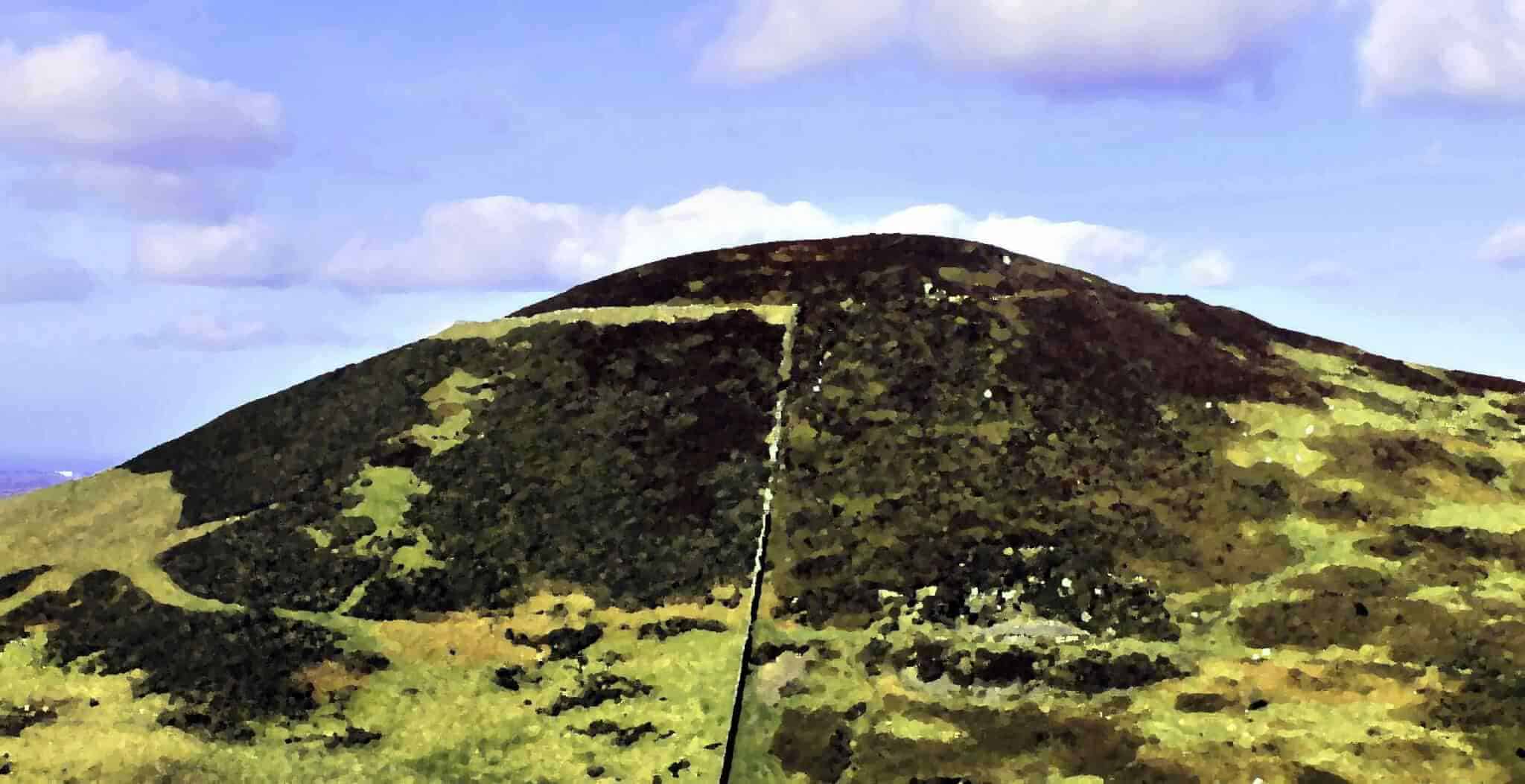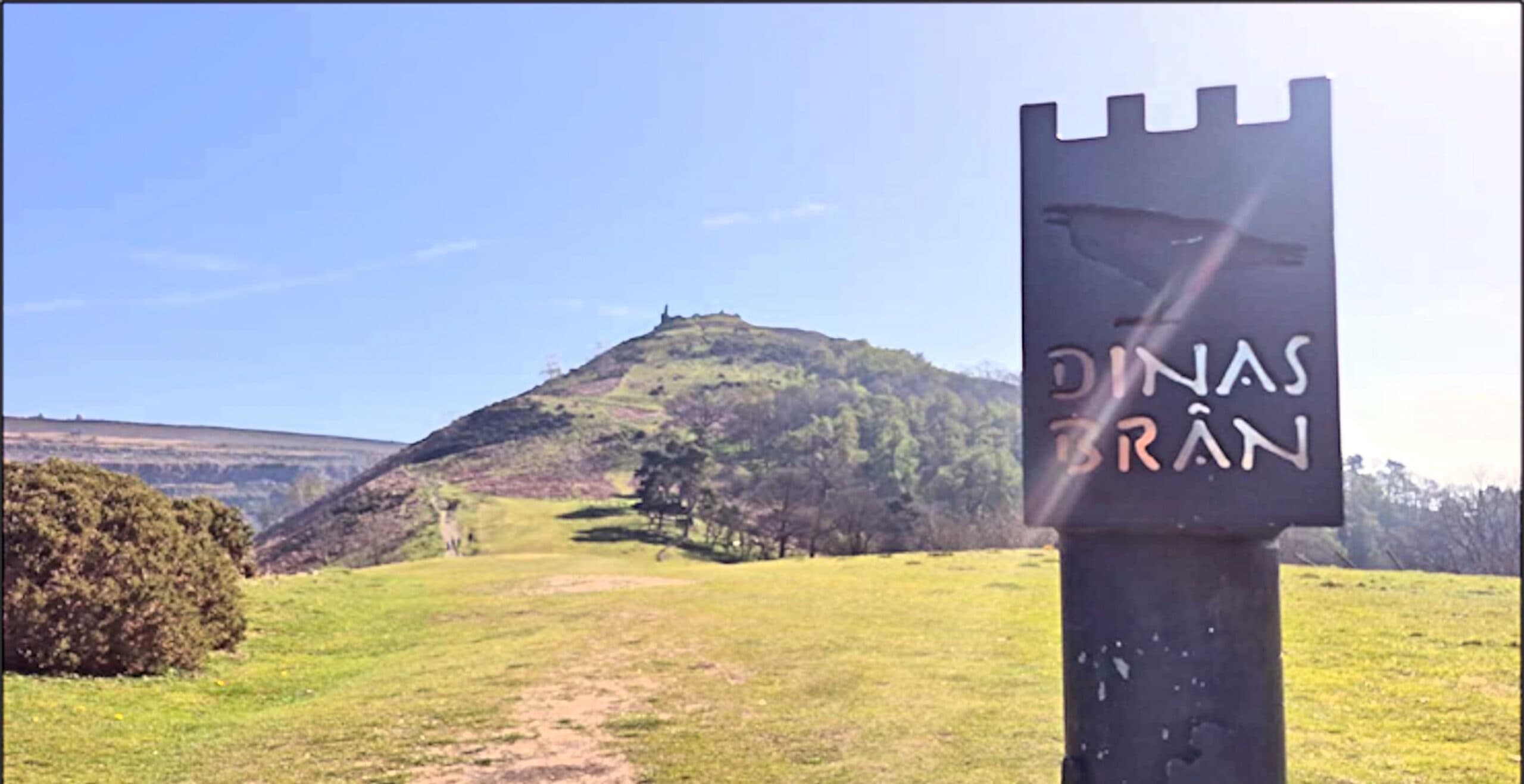


Soaring high above the idyllic Welsh riverside town of Llangollen is a ruined hilltop castle. Its crumbled walls and towers are still large enough to be visible for miles around, and the hike up to stand beside them is assuredly rewarding. Beneath the ruins lies a fascinating historical story; for this silent sentinel is one of the last remaining artefacts of a long vanished medieval kingdom…
The hill of Dinas Brân has been part of a borderland for millennia. When the Romans arrived, around 50 AD, it was likely the site of an Iron Age hillfort controlled by the Ordovices, denizens of today’s North Wales. Just a few miles down the River Dee lurked their neighbours, the Cornovii, rulers of what is now Shropshire and Cheshire, who seem to have controlled Old Oswestry Hillfort. Less than 12 miles from each other, it’s easy to imagine the two tribes launching tit-for-tat raids from their respective hilltop command posts.
Fast forward to the Post-Roman period, circa 500 AD, and Dinas Brân is said to have been inherited by the Kingdom of Powys, a large and powerful Welsh state that emerged in Rome’s wake and that may initially have been centred on Viroconium (Wroxeter).
Soon enough Powys found itself pushed back into today’s Mid-and-North Wales by the Anglo-Saxon kingdom of Mercia, making a strong defensive location like Dinas Brân very valuable indeed. Not only is the hill a natural redoubt; it also guards access up the Dee Valley to the West, controlling a significant route into North Wales. Hence there may well be truth in the story that Elisedd ap Gwylog, an 8th century King of Powys, re-fortified Dinas Brân for the first time in centuries. The remains of a memorial to him, the ‘Pillar of Eliseg’, stand a few miles away in the village that still bears his name.
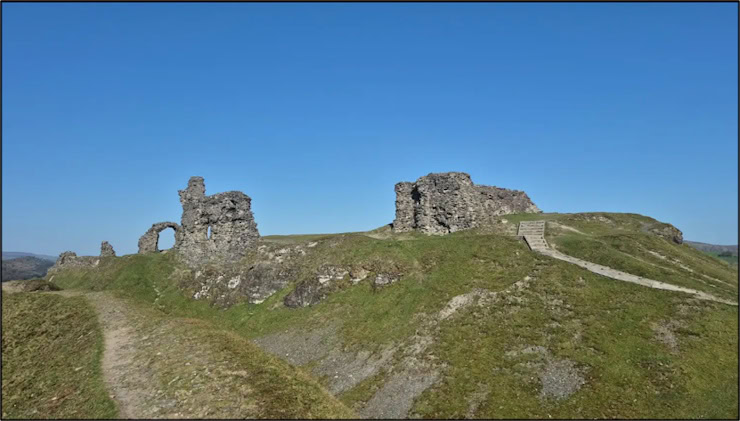
Dinas Brân likely remained a strategically important location for the next few centuries but seems not to have had any significant stone building during that time. The defences would have remained wooden (as most early castles were before the 12th century), and indeed one of these wooden keeps seems to have burnt down in the 1100s. It would take a looming crisis to provoke the creation of the stone structure familiar to us today.

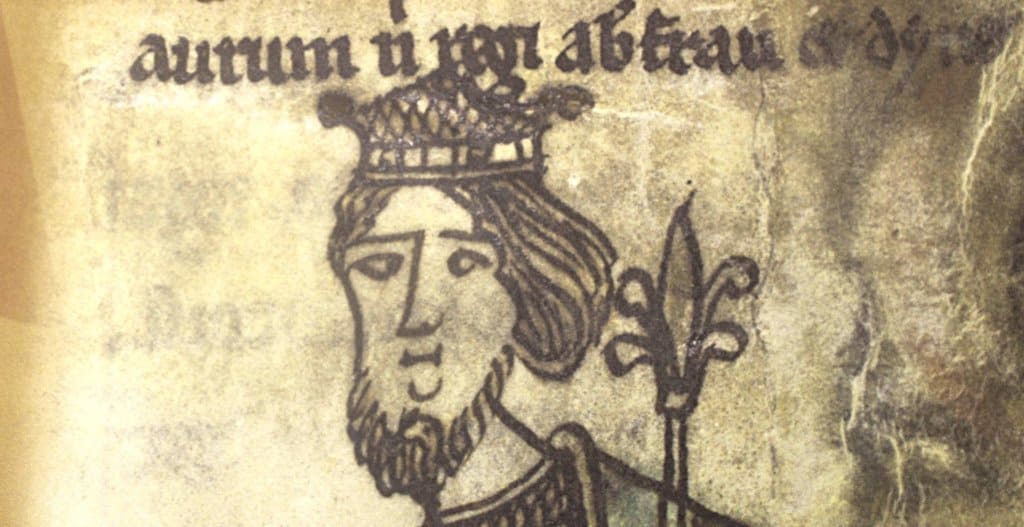
By the 1260s, the Kingdom of Powys had been split in two – with the northern portion, Powys Fadog, centred on Dinas Brân. It’s Prince, Gruffydd ap Madog, was an ally of Llywelyn ap Gruffudd, ruler of Gwynedd and most powerful of the Welsh Princes, amidst brewing tensions with the ancient enemy: England.
Llewellyn had got himself embroiled (on purpose) in England’s civil wars during the 1250s and 1260s and had ended up achieving a big prize: recognition from King Henry III that he, Llewellyn, was Prince of Wales in his own right. No Welshman had achieved anything comparable since Gruffud ap Llewellyn united the Welsh (briefly) 200 years earlier. But it must have been evident to Llewellyn that Henry, and his son tenacious son Edward, would want to revisit this issue before too long.
Border defences, then, were paramount. Powys Fadog was a vital buffer between Cheshire (where some of England’s fiercest soldiers, seasoned Welsh fighters, were drawn from) and the heartlands of Gwynedd. During the 1260s Gruffydd fortified Dinas Brân in stone, probably on the orders of his liege lord Llewellyn. It was likely complete by the time of Gruffydd’s death around 1270; an imposing fortress of stone now dominated the Dee valley, visible for miles around as a warning – or a challenge – to King Edward I, who inherited the English throne in 1272.
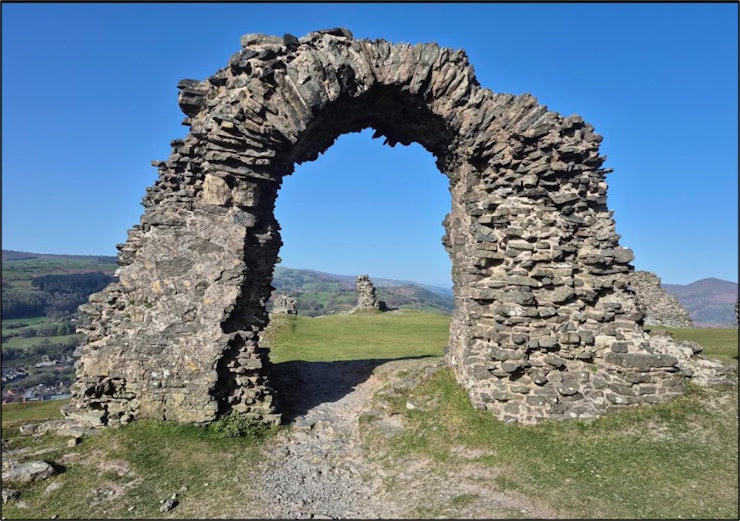
We could be forgiven, then, for expecting an epic showdown between a besieging English army and a resolute Welsh garrison. History, however, sometimes disappoints you. When Edward made his move on Wales in 1277, marching out from Chester bent on humbling Llewellyn, Gruffydd’s sons Llywelyn and Madoc, who had inherited Dinas Brân, struck a deal with the English agreeing to surrender the castle. The reason was almost certainly the factionalism inherent in medieval Welsh politics. They may have been allied to Llewellyn’s Gwynedd, but in the face of the oncoming English juggernaut, they perhaps thought twice about dying for it. That, and the fact that their two younger brothers, Owain and Gruffudd, seem to have been the ones actually in control of the castle at the time; Llywelyn and Madoc were perhaps scheming to get them out of the way (and out of the line of succession).
Either way, when Henry de Lacy, Earl of Lincoln, arrived from Oswestry to capture the castle, he found it abandoned and ablaze, Owain and Gruffudd having apparently decided that discretion was the better part of valour. The fire seems to have done little damage, and Dinas Brân was occupied by English forces until the Treaty of Aberconwy, completed in November 1277, brought a (crippling) peace to North Wales.
But this was not enough for Edward, who wanted Wales tamed once and for all. When hostilities resumed in 1282, resistance was stiffer across the board, the Welsh seemingly realising that this was their final stand. What this meant for Dinas Brân is unclear, and it’s possible that there may have been an actual siege at the castle this time, though there are no reports to confirm this.
Certainly, with Madoc now dead, the three remaining brothers all fought for Llewellyn, in a fierce campaign that caught fire across Wales. Edward’s army found itself caught in something of a mangle (for example, an attempted amphibious landing on Anglesey, the Battle of Moel-y-don, was a catastrophe for the English in which their commander perished along with 400 of his men). Only Llewlyn’s unlucky death, in a skirmish near Builth Wells in December, ended the war and, with it, Welsh independence.
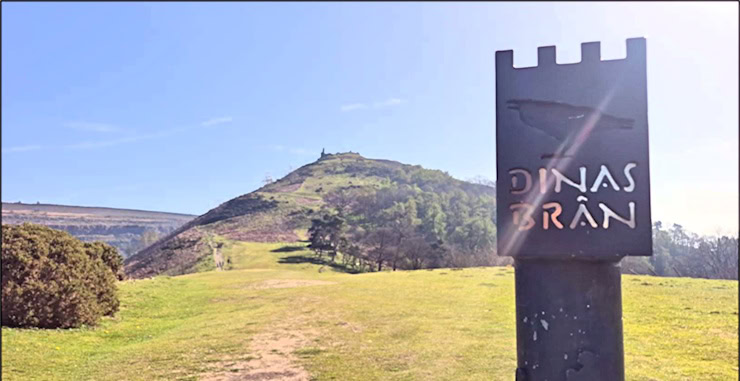
With much of Wales now an English colony, Dinas Brân was granted to John de Warenne, Earl of Surrey. He neglected it and chose to build his own castle several miles down river at Holt. This may have been because the flatlands of the Cheshire border were much more amenable to the Englishman; it may also indicate that the castle had seen action and it was in a state of severe damage. In any case, from that point on Dinas Brân was left to decay, a silent memorial to the age of Welsh Kingdoms.
For centuries that it is how it remained, but from the 18th century it was rediscovered as a subject for art, painted by Turner, and as a leisure spot for hikes and family picnics. Today, it is arguably the jewel in Llangollen’s crown, offering those intrepid enough to tackle the 30 – 60 minute some hike majestic views of the verdant valley amidst the crumbled towers (and the chance to really earn those tea cakes and ice creams down by the riverside afterwards). Today, you can hike up Dinas Brân and enjoy this hidden gem, one of Britain’s most breathtaking castle ruins.
Mike Edwardson is a history writer with an MA from The University of Sheffield. Passionate about uncovering the lesser-known stories of British history, Mike combines his enthusiasm for exploring with a love for storytelling to bring the past to life.
Published: 7th September 2026.