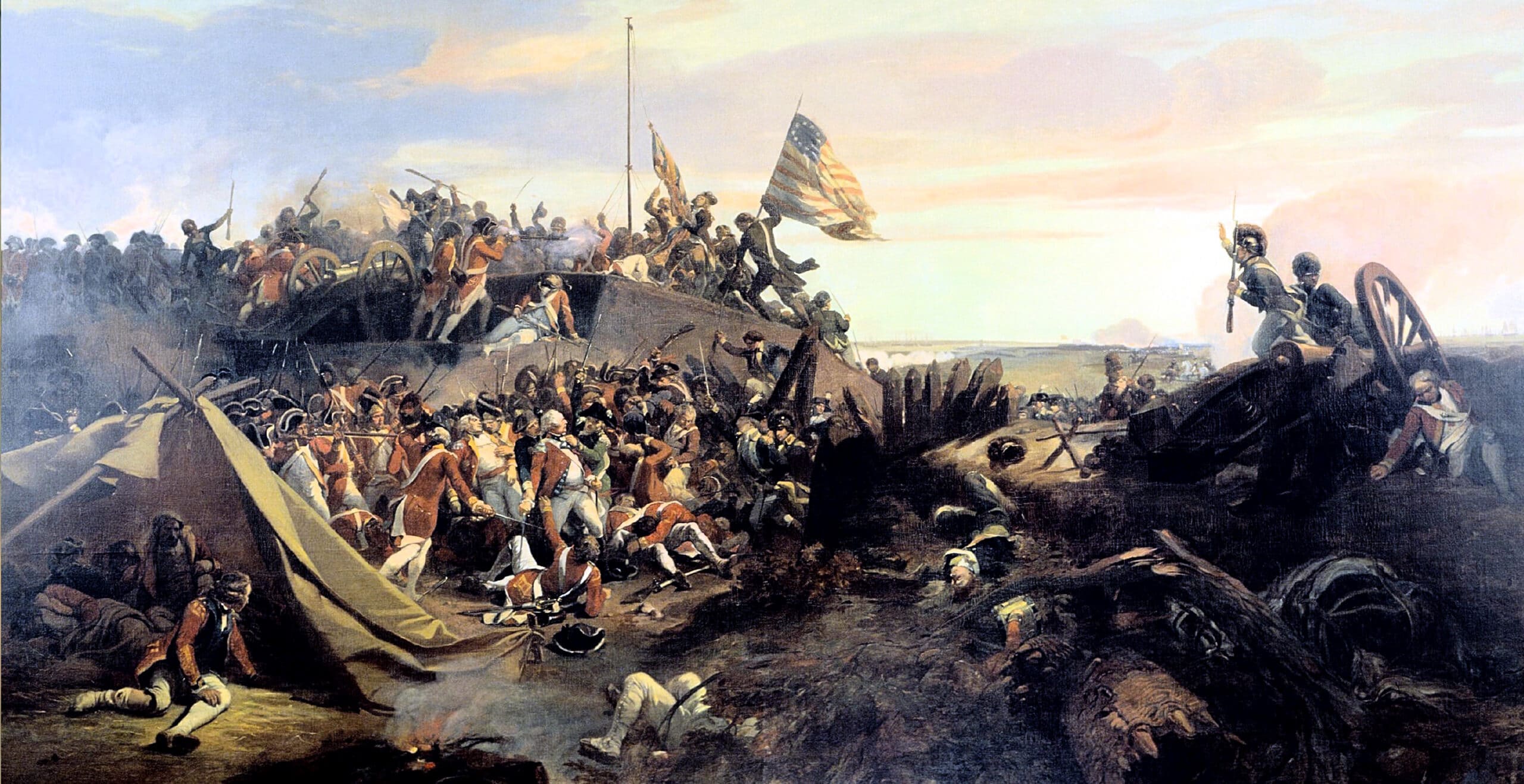


On the 19th October 1781, the British surrender at Yorktown, Virginia marked the beginning of the end for British colonial rule in America. This was to be the final decisive battle, bringing years of conflict to an end and concluding in an American victory and most importantly, American independence.
The preparations for the siege of Yorktown were made in the summer of 1780, when almost 6000 French troops under Comte de Rochambeau arrived in Newport, Rhode Island in order to assist their American counterparts.
After forming a strategic alliance in February 1778, the French provided the Americans with critical military assistance in the form of aid and troops. This would prove to be a significant turning point in the battle against British troops, with both sides set for a final showdown in Virginia.
At the time of the French arrival in Rhode Island, the British were already engaged in fighting on two fronts, with command split between General Henry Clinton who was in New York and Cornwallis who could already boast of the capture of Charleston and Savannah.

In May 1781 Cornwallis, who had been commander in the southern colonies, moved his army from North Carolina eastwards to Virginia. In order to keep his line of communication with Clinton in New York, Cornwallis and his troops arrived in Yorktown and proceeded to fortify in July in preparation for an attack.
The Continental Army could choose two possible targets, either wrestling control of New York away from the British under Clinton, or executing a military operation against the British under Cornwallis in Virginia.
Reinforcements in the form of a French West Indies fleet under Comte de Grasse decided matters, as de Grasse informed Rochambeau of his intent to sail to Chesapeake Bay, where Cornwallis and his men were in command.
Upon the instructions of Clinton, Cornwallis began to build a deep-water port in Yorktown, whilst his army’s movements were watched by the Continental Army.
With their sights now set on Virginia instead of New York, an intention to deceive the British into thinking that New York was in fact the main target was now executed by both the French and Americans, who moved southwards towards Virginia.
By the end of August, de Grasse and his West Indies fleet had arrived at Chesapeake Bay, alongside more troops, thus initiating a naval blockade on Yorktown.
The French fleet benefited from the support of the Spanish navy after promises were made by Francisco Saavedra de Sangronis (agent to King Charles III of Spain) to assist the French merchant fleet, thus freeing up de Grasse and all of his warships.
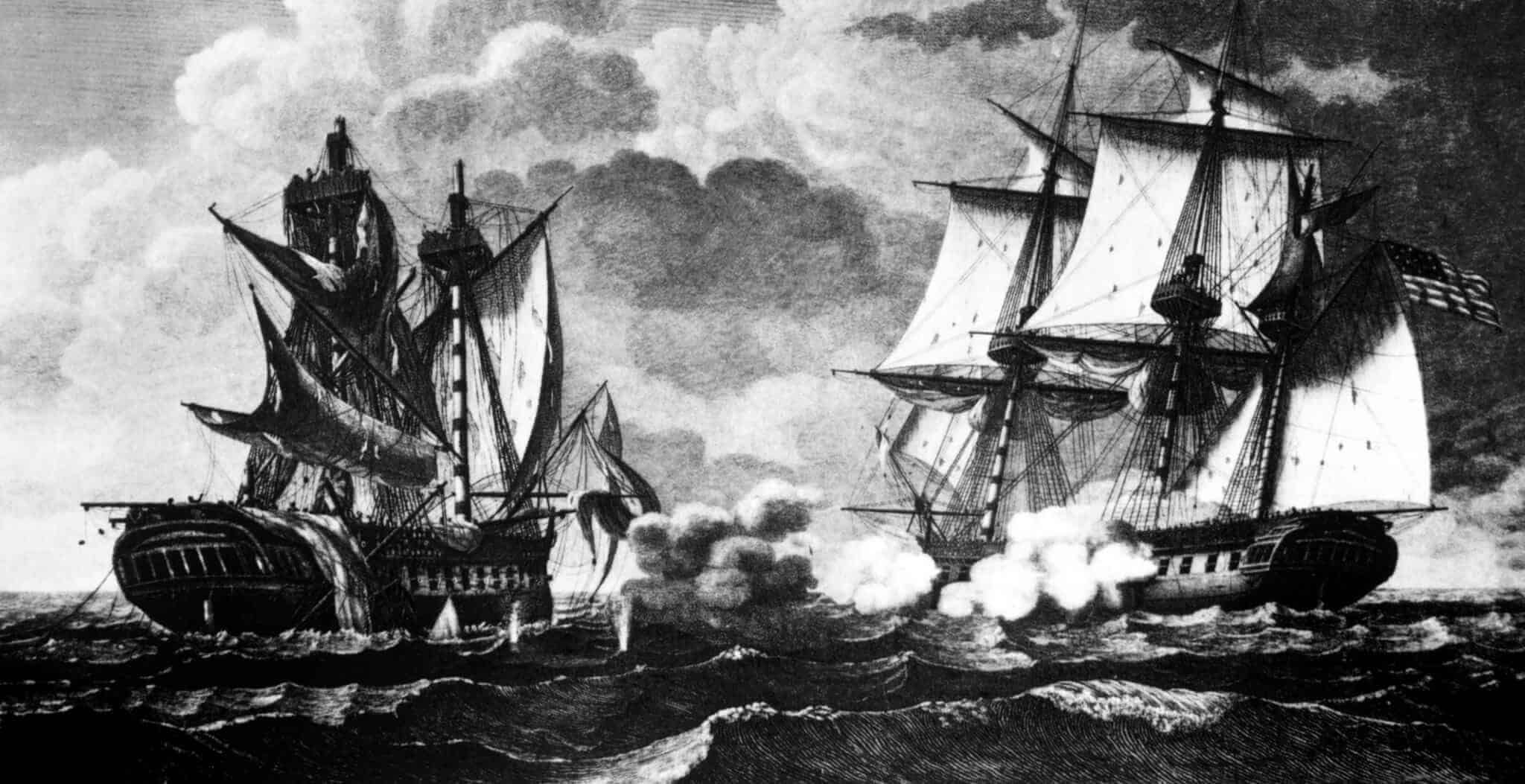
His English counterpart was Sir Thomas Graves, who arrived at Chesapeake Bay to relieve Cornwallis and his men. This led to the engagement of the French and English naval forces at the Battle of the Chesapeake on the 5th September 1781, which concluded with a French victory, thus crucially trapping Cornwallis and preventing any vital reinforcements from relieving him and his men.
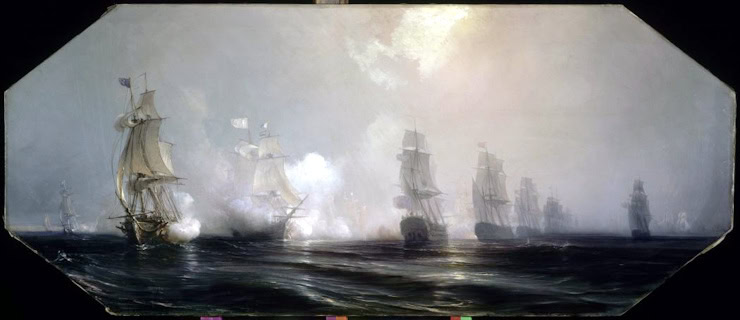
The French meanwhile had control of the sea lanes and provided the Continental Army with both siege artillery and French reinforcements, consequently laying the groundwork for the successful siege of Yorktown.
A few weeks later Washington had arrived in Williamsburg alongside Rochambeau. The Continental Army with its French allies were reinforced by the naval forces which had encircled Cornwallis at Yorktown.
On 28th September, Washington led his men out of Williamsburg to surround Yorktown, with American troops stationed on the right and French positioned on the left. That night, his men would sleep out in the open whilst bridges were built over the marshes.
The following morning, Washington moved his troops closer to the town, whilst the British responded by opening fire on the infantry. The gunfire exchange between both armies would continue for the rest of the day.
In the meantime, both sides made preparations to improve their defences, with the American and French troops occupying the abandoned outer defences.
The next day, the French launched an attack on the British Fusiliers in their temporary fortification. The contact between them would last for a couple of hours before the British were finally able to push back the French, who in the process of the attack had incurred numerous casualties.
With tension heightened, the seriousness of the situation grew more tangible, particularly when the British side began to slaughter hundreds of their horses in order to preserve their food stores. Meanwhile, the Americans were busy felling thousands of trees to use for their fortification plans.
By the 2nd October, the British had maintained a steady level of gun fire, whilst the allies continued to make their preparations and Washington continued to visit the front in order to keep abreast of the situation.
A few days later, with sappers and miners putting the finishing touches to the trench construction, Washington and his men were ready.
The trench was almost 2,000m long and was to be stationed half with French troops and the other half consisting of Americans. With the trench running from the head of Yorktown down to the York River, another support trench was constructed in order to enable the French to bombard British ships.
The British, now with a view of this allied trench and with the final pieces of artillery being put in place, saw the reality of their enemies firing capabilities.
On 9th October, with all their guns in place, the French troops opened fire at 3pm and drove HMS Guadeloupe across the York River. As planned, American fire followed two hours later, with Washington symbolically firing the first shot.
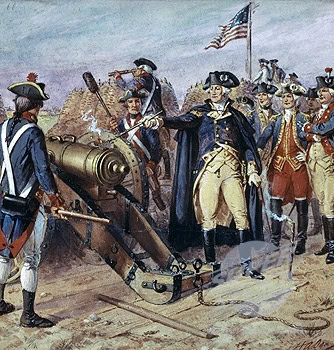
In very little time, the combined gun power of the French and Americans began to sever British defensive lines.
Washington gave orders to fire continuously in order to prevent the British from making any attempts to repair and regroup. Under this relentless gunfire, British soldiers began to succumb to the constant barrage, with British guns all but silenced whilst many troops began to desert in huge numbers.
British ships too were targeted as cannonballs reached the harbour. The French began to fire and hit HMS Charon which caught fire and in turn led to three other British ships catching fire.
Meanwhile, Cornwallis heard from Clinton in New York who informed him that the British fleet was to depart on 12th October. Cornwallis’s response was simple; he was not sure if they would be able to hold out for that long.
The following night, Washington gave orders to move closer to British lines and dig a second trench. The unsuspecting British continued to fire at the old position and by the following morning, American and French allied troops were now in a new stronger position.
By 14th October, the British line of defence was much weakened and under these conditions, Washington gave the orders to send in two columns to attack the last remaining outer defences. The French troops of the Royal Deux-Ponts Regiment took on Redoubt no.9 whilst the Americans consisting of 400 light infantry troops under Lieutenant Colonel Alexander Hamilton took on Redoubt no.10.
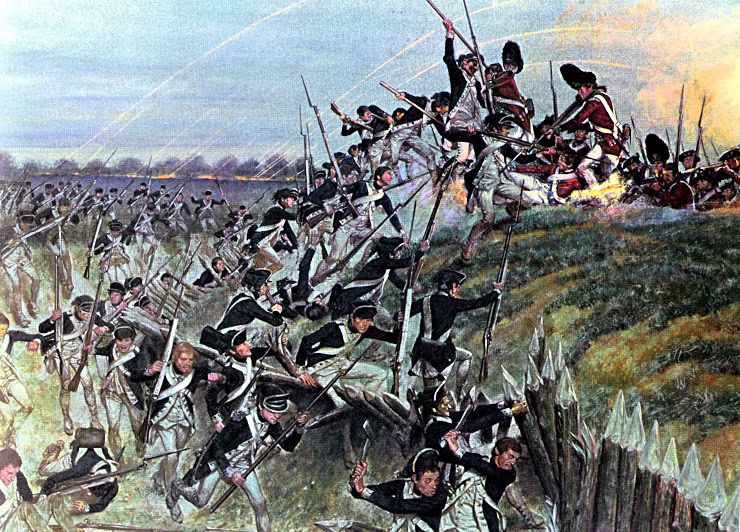
The British sustained heavy fire against the Americans who had forced their way in, however eventually they were overwhelmed by the bayonet fight which ended any British hopes of maintaining control.
Meanwhile at Redoubt no.9, a combination of British and German Hessian troops attempted to fight off the French charge, however they too were forced to surrender.
After succumbing to this two-prong attack, British defences were fracturing and the allied artillery were closing in on their positions.
Washington was now in an increasingly strong position and was able to move his allies into the redoubts.
In the last few days of battle, the British made one final effort to push back the advances of allied troops by launching a storming party of around 350 men under Colonel Abercomby, who successfully attacked allied lines and spiked the American and French cannon (a quick way to prevent an artillery piece from firing by hammering a pre-prepared barbed spike in the touchhole).
This manoeuvre was a swansong for the British troops, as the French were able to push them back to Yorktown and repair the damage by the morning.
In one last ditch effort, Cornwallis attempted to launch a sea evacuation by night, however his efforts were hampered by a storm.
Under constant bombardment and with their position seemingly untenable, Cornwallis was left with little choice but to capitulate.
After two days of negotiations, on 19th October 1781 the formal surrender ceremony took place, with the British sending a red-coated drummer boy followed by an officer waving a white handkerchief to the parapet. 7,000 British soldiers were captured and thus negotiations between the United States and Great Britain resumed.

Cornwallis’s surrender unofficially marked the end of the war. With an American success at Yorktown, the Continental Army was well on its way to declaring an outright victory and with it, the independence of their nation.
Six months later, back in Britain, Parliament passed a resolution calling for an end to war with the Prime Minister Frederick North forced to concede defeat.
The following year, the terms and conditions would be decided by the Treaty of Paris which was signed on 3rd September 1783, officially ending the Revolutionary War, signifying American independence from Britain and with it, a new chapter for the New World.
Jessica Brain is a freelance writer specialising in history. Based in Kent and a lover of all things historical.
Published: 29th June 2026.