


Although an integral part of the United Kingdom, Wales is not represented on the national flag, or Union Flag, more popularly known as the Union Jack.
The proud and ancient battle standard of the Welsh is The Red Dragon (Y Ddraig Goch) and consists of a red dragon, passant (standing with one foot raised), on a green and white background. As with any ancient symbol, the appearance of the dragon has been adapted and changed over the years, and hence several different variations exist.
The current flag was officially adopted in 1959, and is based on an old royal badge used by British kings and queens since Tudor times. The red dragon itself has been associated with Wales for centuries, and as such, the flag is claimed to be the oldest national flag still in use. But why a dragon? The answer to that particular question is lost in history and myth.

One legend recalls Romano-British soldiers carrying the red dragon (Draco) to Rome on their banners in the fourth-century, but it could be even older than that.
It is considered that the Welsh kings of Aberffraw first adopted the dragon in the early fifth century in order to symbolise their power and authority after the Romans withdrew from Britain. Later, around the seventh century, it became known as the Red Dragon of Cadwaladr, king of Gwynedd from 655 to 682.
Geoffrey of Monmouth in his Historia Regum Britanniae, written between 1120 and 1129, links the dragon with the Arthurian legends, including Uther Pendragon the father of Arthur whose name translates as Dragon Head. Geoffrey’s account also tells of the prophecy of Myrddin (or Merlin) of a long fight between a red dragon and a white dragon, symbolising the historical struggle between the Welsh (red dragon) and the English (white dragon).
The oldest recorded use of the dragon to symbolise Wales however, is from the Historia Brittonum, written by the historian Nennius around 820.
The red dragon was even said to have been used as the British standard at the Battle of Crecy in 1346, when the Welsh archers, dressed in their beloved green and white, played such a crucial role in defeating the French.
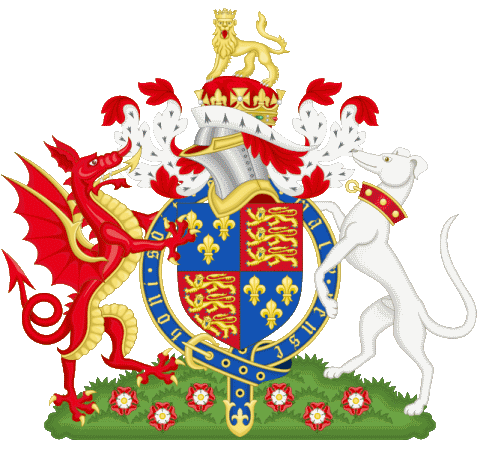
And although Owain Glyndwr raised the dragon standard in 1400 as a symbol of revolt against the English Crown, the dragon was brought to England by the House of Tudor, the Welsh dynasty that held the English throne from 1485 to 1603. It signified their direct descent from one of the noble families of Wales. The green and white stripes of the flag were additions of Henry VII, the first Tudor king, representing the colours of his standard.
During Henry VIII’s reign the red dragon on a green and white background became a favourite emblem on Royal Navy ships.
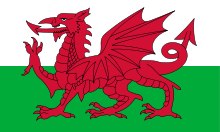 As the national flag of Wales, the red dragon appears to have regained popularity in the early part of the twentieth century, when it was used for the 1911 Caernarfon Investiture of Edward, Prince of Wales. It wasn’t until 1959 however, that it became officially recognised as the national flag of the country.
The Red Dragon now flies proudly over public and private buildings throughout Wales, and thousands still cross the border into England every other year, when the two nations meet for their ‘historic struggle’ on the rugby battlefield known as Twickenham. Welshmen, women and children carrying the dragon as a symbol of pride in their history and culture.