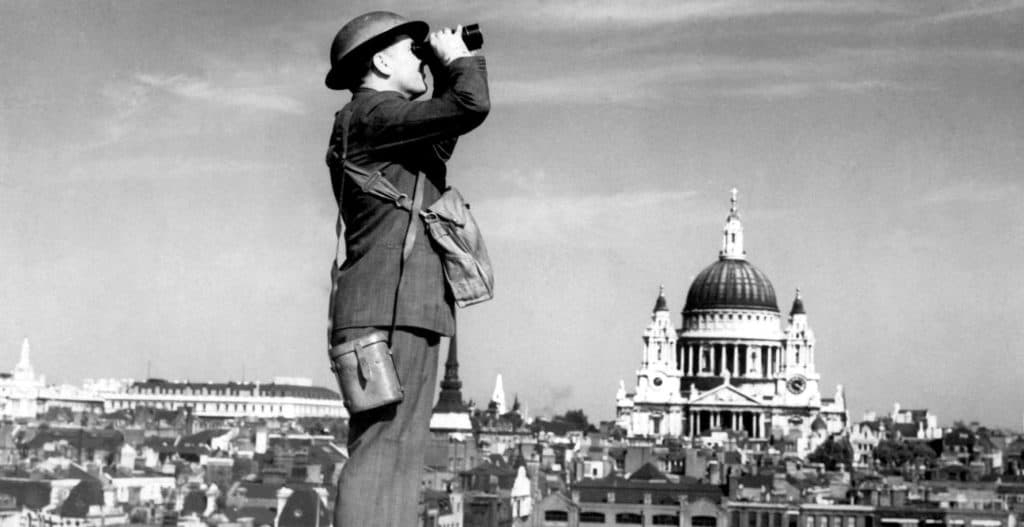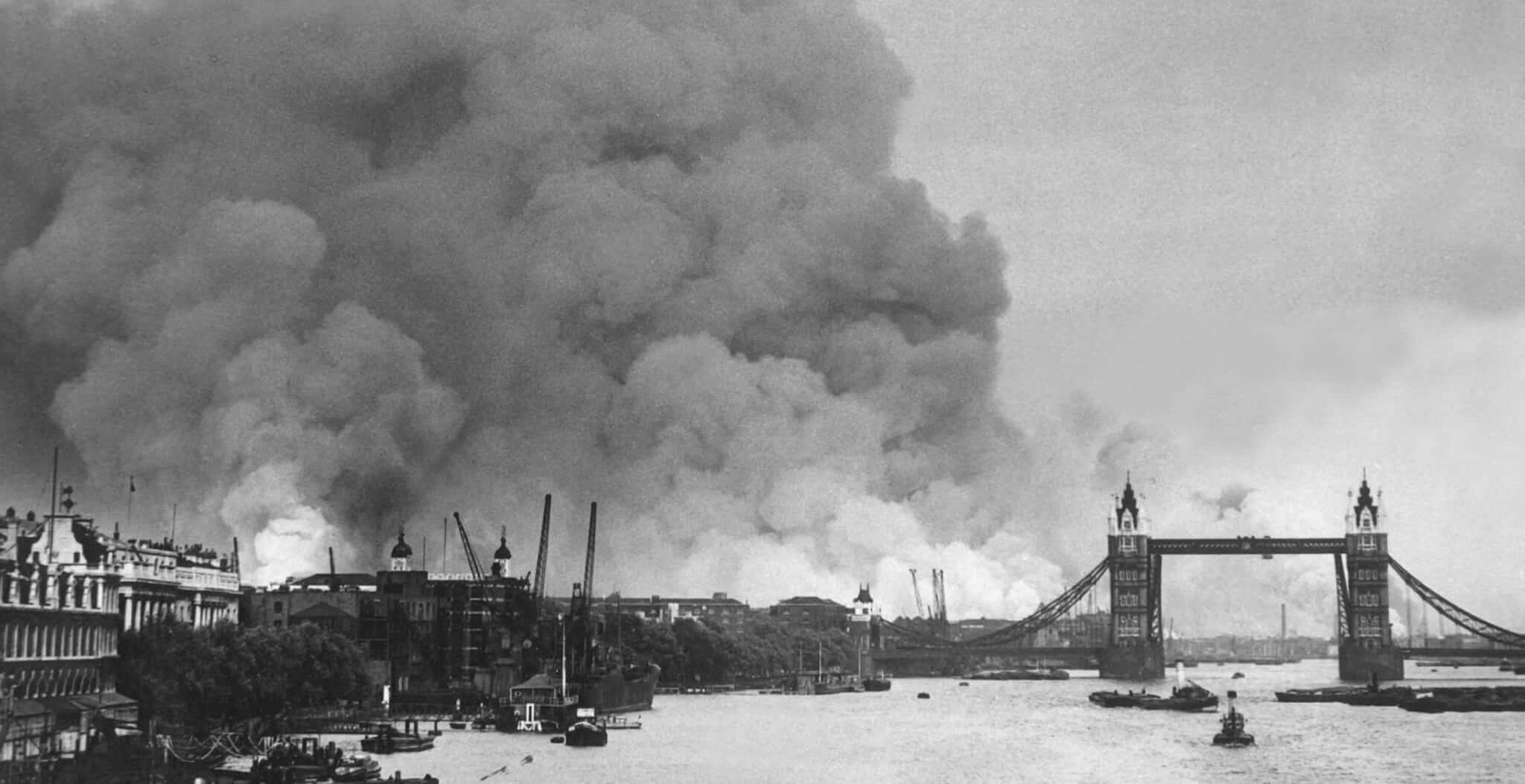


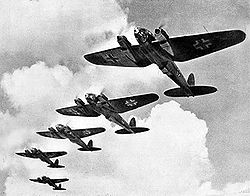
Important events of 1940, including the beginning of the London Blitz (pictured above) and the Battle of Britain.
| 5 Jan | Leslie Hore-Belisha, Britain’s Minister of War, is dismissed. Unpopular with many of his fellow MP’s, Prime Minister Chamberlain agreed to replace him under pressure from several established military commanders. |
| 8 Jan | To deal with extreme shortages, food rationing of butter, bacon and sugar begins in Britain. Each person is issued with ration books in order to buy these essentials. |
| 1 Feb | With overwhelming troop numbers and equipment, Soviet forces launch a major offensive against Finland during the Winter War. Finnish resistance would be fierce and determined. |
| 14 Feb | Britain announces that merchant ships in the North Sea would be armed. |
| 15 Feb | Germany announces that all British merchant ships would be classed as warships. |
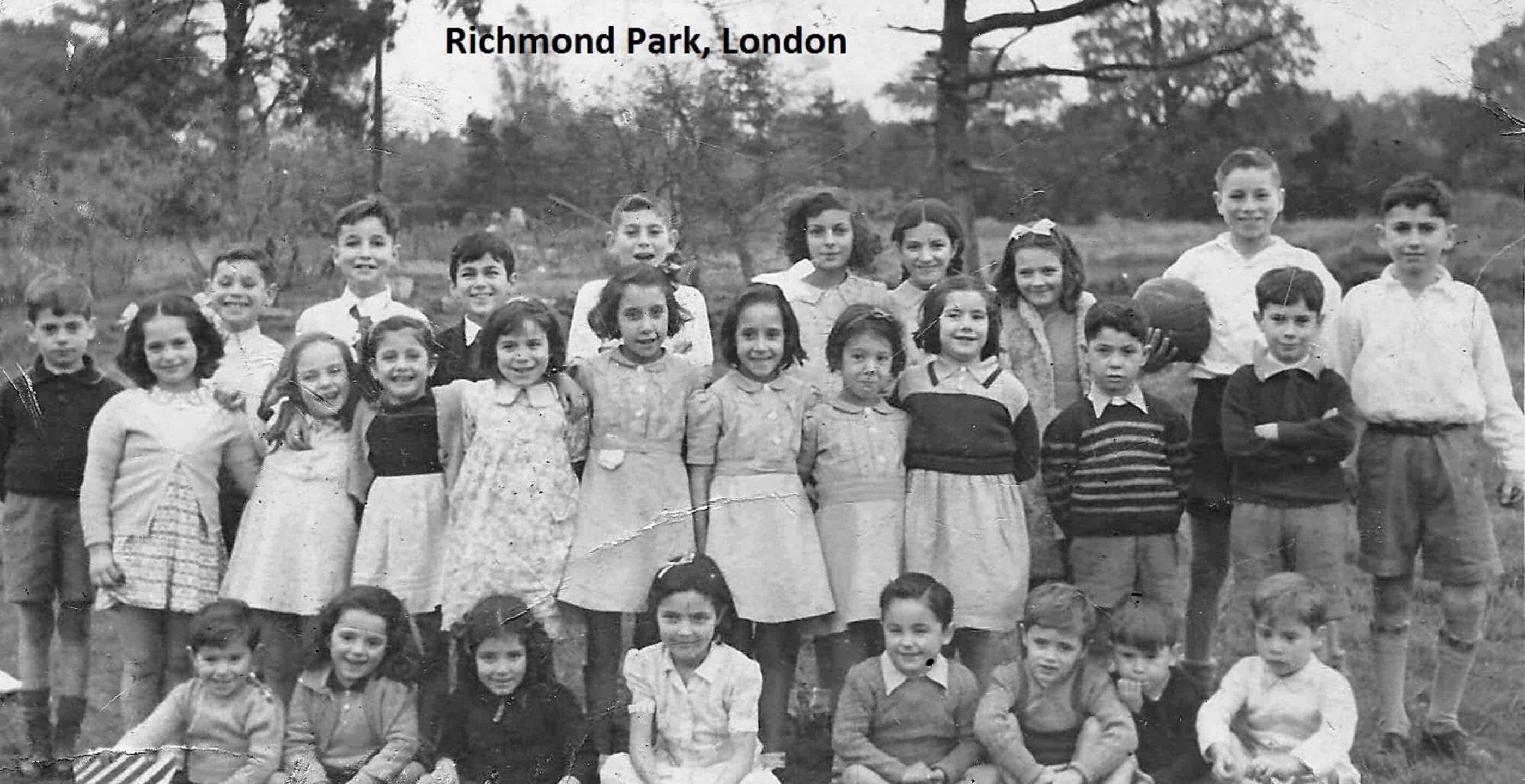
| 17 Feb | Britain makes plans to evacuate 400,000 children from cities to rural areas. |
| 13 March | After almost 5 months of fighting, the Treaty of Moscow ends the Winter War between the Soviet Union and Finland. Despite being outnumbered 3:1 in terms of forces, 30:1 in aircraft and 100:1 in tanks, the Finns had retained their sovereignty and pride. |
| 20 March | Daladier’s government in France is overthrown in Paris; Reynaud becomes the new premier. |
| 8 April | Royal Navy starts laying mines in Norwegian waters. |
| 9 April | Germany invades Denmark and Norway. The war in the west starts and the so called Phoney War ends. |
| 10 May | Germany invades Holland, Belgium and Luxemburg. King George VI appoints Winston Churchill as British Prime Minister, replacing Neville Chamberlain who had consistantly sought to follow a policy of appeasement with Germany. |
| 11 May | Churchill gives Bomber Command permission to bomb Berlin. Being the only heavy bomber in the RAF arsenal, the Armstrong Whitworth Whitley, together with the Wellington and Hamden medium bombers, are the only aircraft available to take the war to Germany. |
| 12 May | The ill prepared French defences at Sedan are overrun by German forces. The captured bridges that span the Meuse river allow German troops and armour to pour across giving them direct access to the rear of the undefended Allied frontline and on to the Channel ports. The Battle of Sedan would be instrumental to the fall of France |
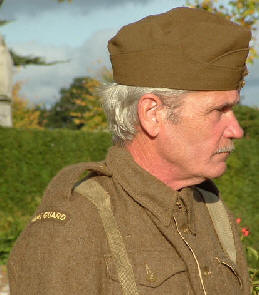
| 14 May | The British government launches the Local Defence Volunteers, later known as the Home Guard (Dads Army). The Luftwaffe attack Rotterdam, causing 30,000 civilian casualties. |
 |
|
| 15 May | Rommel’s tanks clash with French tanks at Philippeville in the first major tank battle of the war. Reinhardt’s German tanks advance 37 miles to the west of the Meuse. Holland surrenders. |
| 18 May | General Kleist’s German armour captures St Quentin, half-way between the English Channel and Sedan. Antwerp surrenders. |
| 19 May | French General Weygand is appointed Supreme Commander of all Allied forces in France. |
| 20 May | German tanks reached Abbeville, cutting off Allied forces to the north. |
| 21 May | Allied forces launch counter-attack on Arras. |
| 24 May | Hitler orders a halt to the advance of German armour to allow infantry divisions to catch up in order that a conventional assault could be mounted against the trapped Allied forces. |
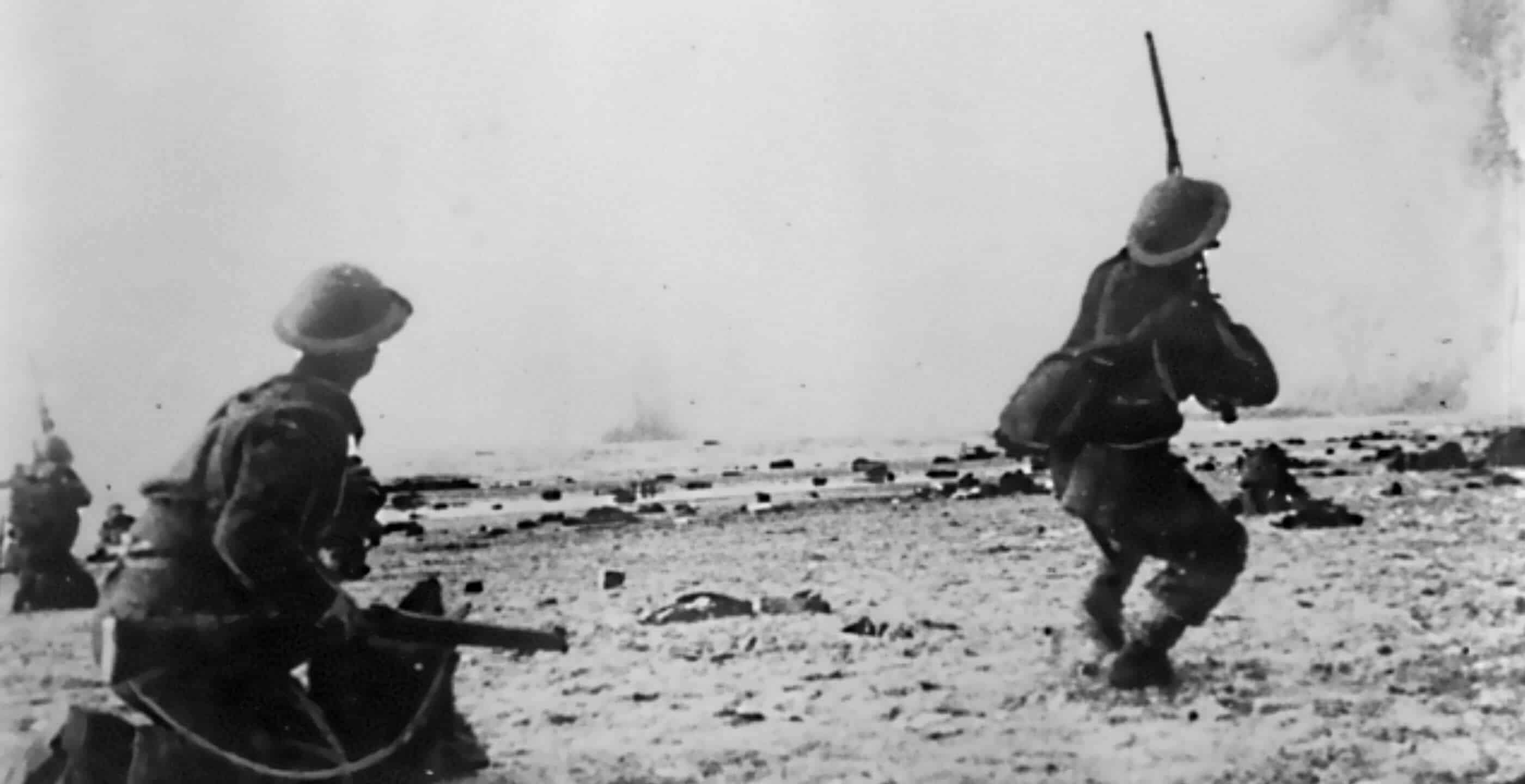
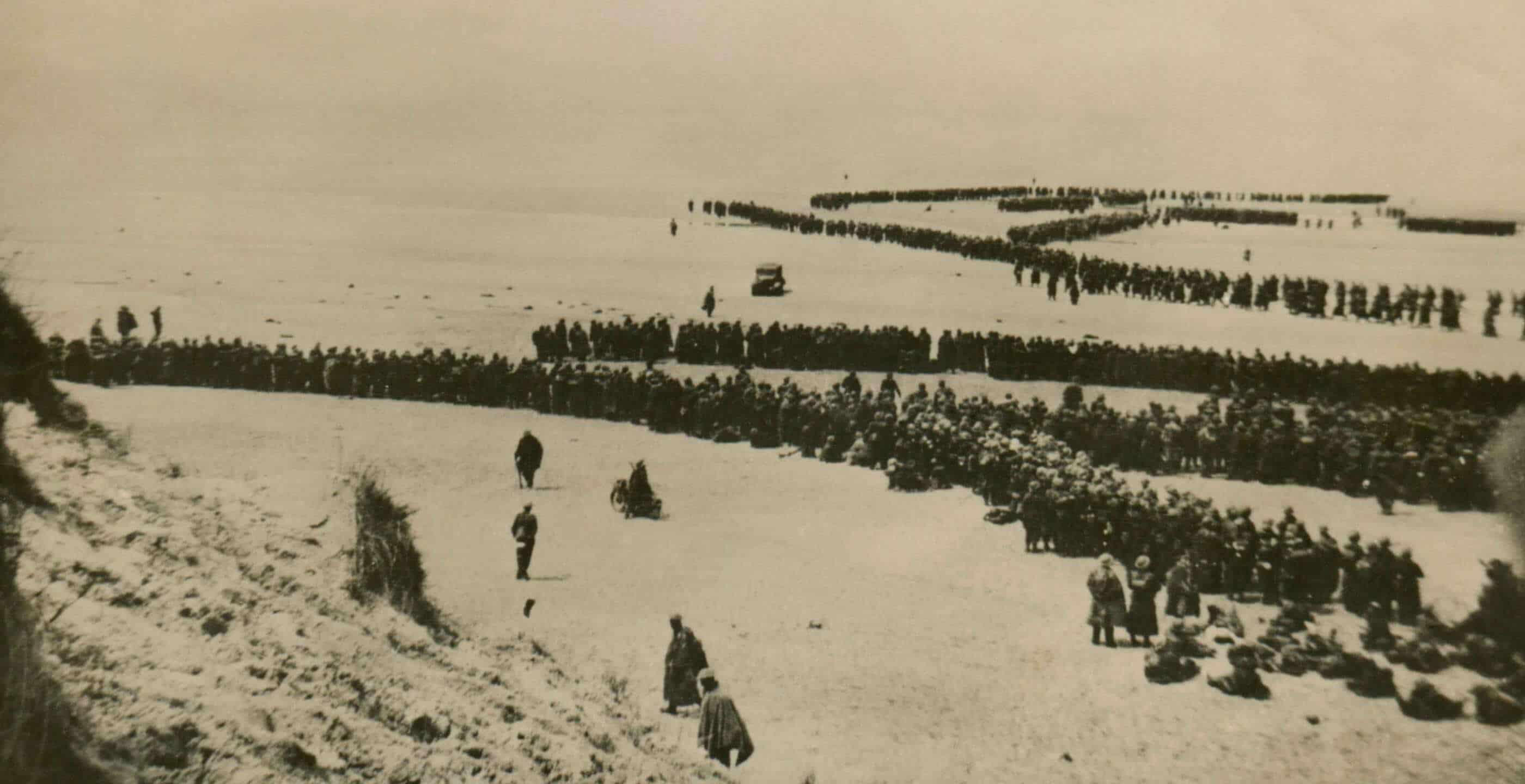
| 26 May | British and French troops trapped at Dunkirk, a full-scale evacuation begins – Operation Dynamo. The plan had been drawn up by Gen John Gort of the British Expeditionary Force. |
| 28 May | Belgium surrenders to the Germans. |
| 4 June | The evacuation from Dunkirk ends.
As well as destroyers and large ships, the famous ‘little ships of Dunkirk’ – around 700 small boats, fishing boats, paddle steamers, pleasure craft and lifeboats, crewed by civilians – were employed to help evacuate more than 330,000 Allied troops. |
| 5 June | Germany launches major offensive against the French Army at the Somme. |
| 7 June | Rommel’s VII Panzer Division advances to Forges-les-Eaux – 37 miles in two days. |
| 8 June | The last French lines of defence fall on the Somme and the Aisne. |
| 10 June | Mussolini declares war on France and Britain with the immediate intention of expanding Italian colonies in North Africa into British and French territories. |
| 11 June | Paris threatened by the speed of the German advance, the city is declared an “open city”. Churchill, de Gaule, Eden and Pétain meet at Briare to discuss the situation. |
| 13 June | French troops abandon Paris. |
| 14 June | German troops enter Paris in the early hours of the morning. Later that day Panzer tanks would roll past the Arc de Triomphe down the Champs Elysees to Place de la Concorde. |
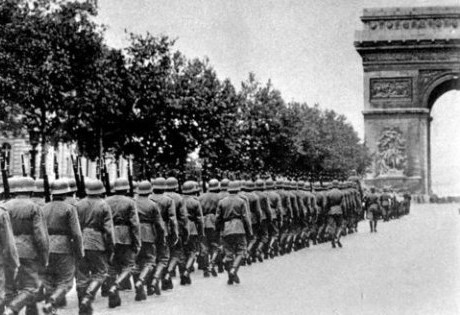 German troops marching on Paris |
|
| 16 June | Paul Raynaud’s cabinet in Bordeaux is ousted by Marshal Henri Pétain, one of France’s greatest hero’s from World War I . |
| 17 June | Pétain broadcasts to the French people urging them to stop fighting, he also asks the Germans for the terms of an armistice. |
| 18 June | The RAF attack Hamburg and Bremen.
Famous appeal by Charles de Gaulle (photo right), leader of the Free French Forces, in support of the French Resistance to the German Occupation. |
| 20 June | Italy launches an offensive on the Alpine front, with the intention of defeating what remains of the French forces in the south and to take control of the Alps and the Mediterranean port of Nice |
| 21 June | A French delegation meets Hitler at Rethonde. |
| 22 June | France surrenders and is split into two. The north is governed by the Germans and the south becomes known as Vichy France under the control of Marshal Pétain. |
| 16 July | Plans for the invasion of Britain – Operation Sealion, were issued by Hitler – known as ‘Directive 16, Preparations for the Landing Operation against England’, the objective is to land 160,000 German troops in south-east England. To have any chance of success, the operation requires both naval and air supremacy over the English Channel. |
| 1 Aug | Hitler instigates the Battle of Britain, ordering that victory should be “as soon as possible”. His orders include the complete obliteration of all RAF flying squadrons and their ground support units, as well as the destruction of the entire British aircraft industry. |
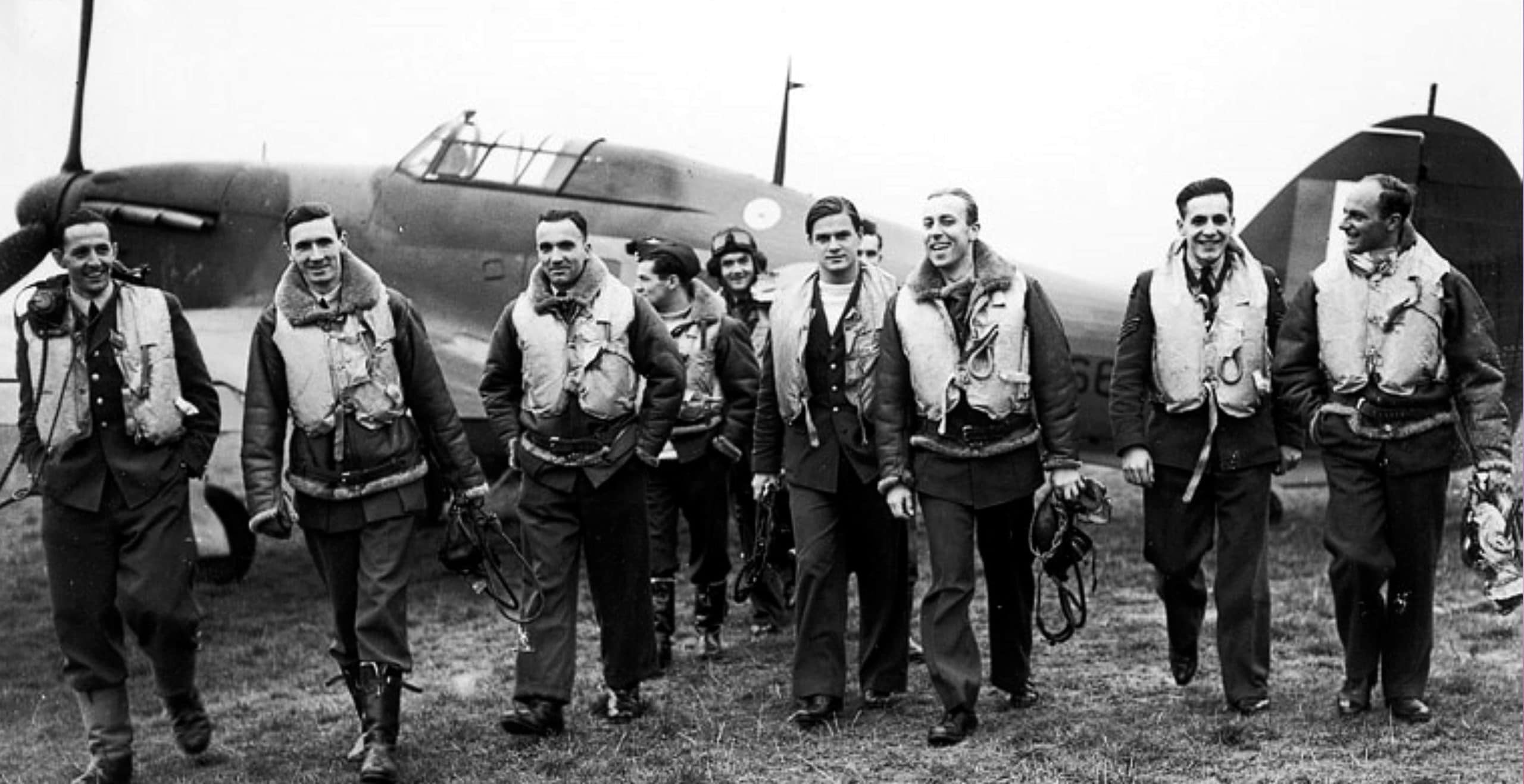
| 5 Aug | The Battle of Britain begins. With nearly 3,000 aircraft stationed in France, Belgium, Holland and Norway, the German Luftwaffe outnumber the RAF by four to one. The Few, did of course, have some help from an early warning radar system. |
 |
|
| 13 Aug | Eagle Day – the German Luftwaffe launches 1,485 sorties against RAF airfields. The Luftwaffe looses 45 planes and the RAF 13. |
| 15 Aug | Germany launches its most intense attack on RAF airfields with more than 1,000 aircraft and 1,790 sorties. The Luftwaffe looses 75 planes and the RAF 34, however its airfields suffer major damage.
The Greek cruiser “Helle” is torpedoed and sunk – the Italians are blamed. |
| 20 Aug | Italy announces the total blockade of Britain’s Mediterranean and African territories. |
| 24 Aug | Central London is attacked for the first time by the Luftwaffe. A lost formation of German bombers mistakenly drop their bombs on the capital, damaging St. Giles and Cripplegate. |
| 25 Aug | In retaliation for the accidental attack on London the night before, RAF Bomber Command launches its first night-attack on industrial targets around Berlin. |
| 3 Sept | The Anglo-American Lend-Lease Agreement is signed by President Franklin D Roosevelt. In return for 50 World War I destroyers, Britain allows the US a 99-year-lease to several British air and naval bases |
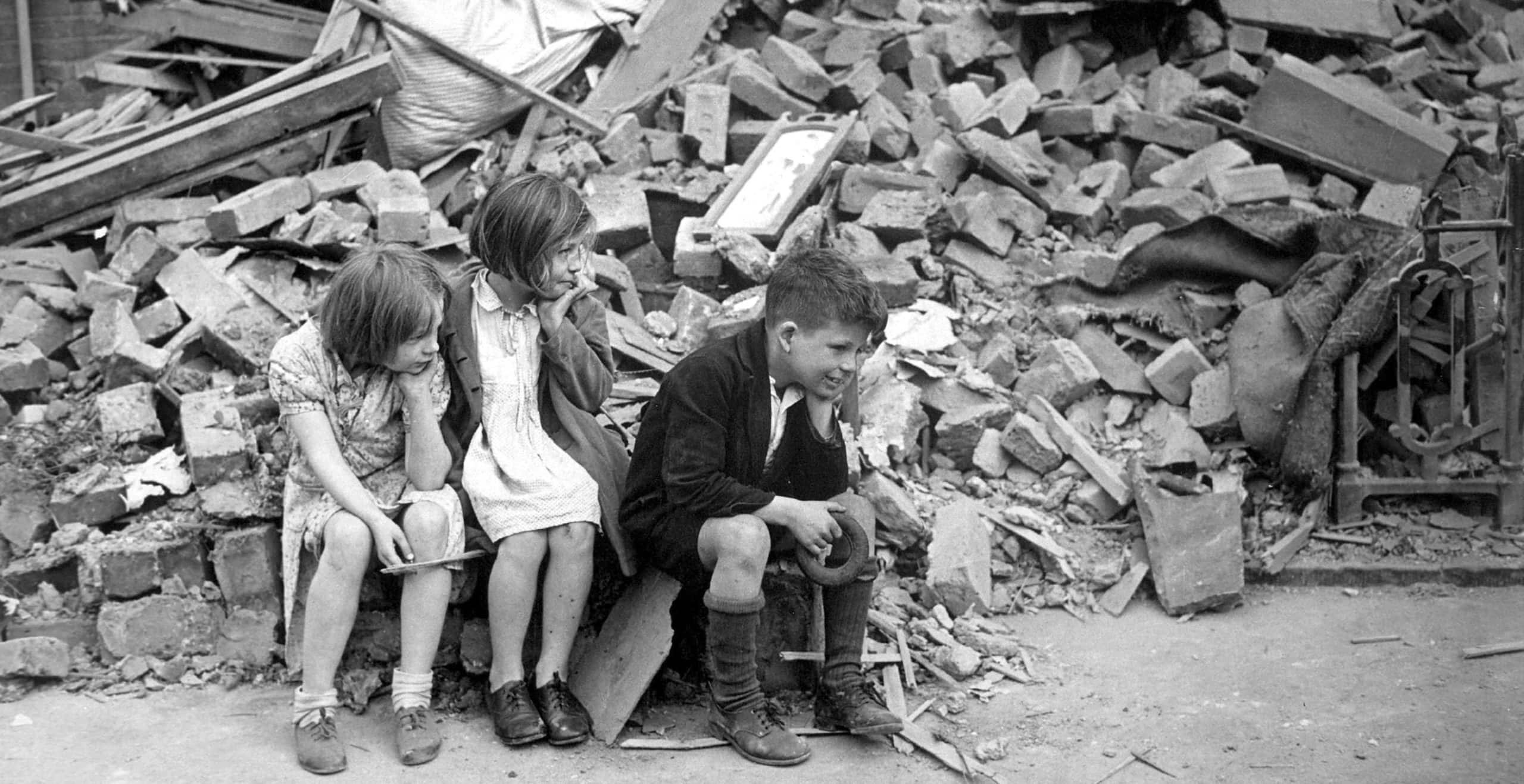
| 7 Sept | The Blitz of London begins with 300 German bombers escorted by 600 fighter aircraft. These night-time raids were designed to be so frightening that they would lower Britain’s morale and resolve. In switching tactics however, from bombing airfields to civilian targets, the RAF which had been close to defeat was allowed time to regroup and reform. |
| 13 Sept | Italy invades Egypt. |
| 15 Sept | The RAF claim to have shot down 183 German aircraft during the last major engagement of Battle of Britain. A figure of 60 Luftwaffe losses compared with 28 RAF aircraft lost is perhaps a more realistic estimate. |
| 17 Sept | After failing to take control of the skies over Briatin, Hitler announces that Operation Sealion will be postponed “until further notice”. He orders the dispersal of the invasion fleet, which included some 2,000 barges held in Belgian, French and German Harbours. |
| 28 Sept | The Battle of Britain ends, during which the RAF had lost almost 800 aircraft, compared with Luftwaffe losses of 1,400. The Few who had maintained control of the skies of Britain, totalled 3,000 air crew members, supported by several thousand ground staff. |
| 12 Oct | Operation Sealion is formally cancelled as Hitler directs his attention towards Russia. |
| 28 Oct | Seeking to prove his worth to his Axis partners, Mussoloni orders the invasion of Greece, thus marking the start of the the Balkans Campaign. |
| 11 Nov | The Royal Navy’s Fleet Air Arm attack the Italian Navy at Taranto. In the first ever all-aircraft Naval battle, several obsolete British biplanes armed with torpedoes and bombs destroy three battleships. |
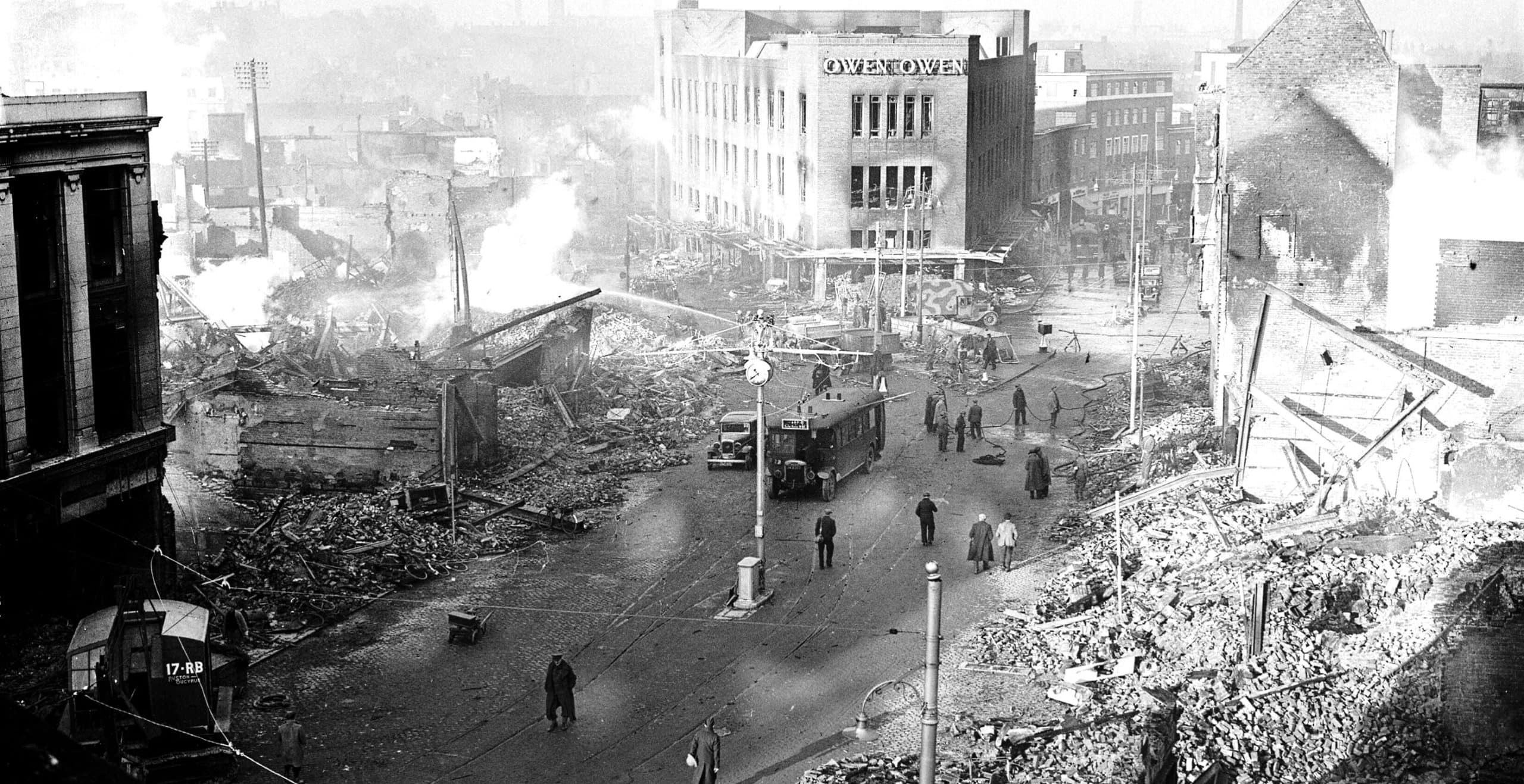
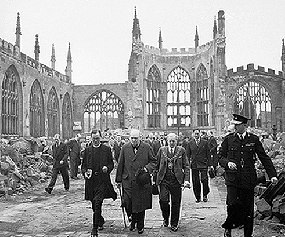
| 14 Nov | In a massive air raid lasting more than 10 hours and involving 500 enemy aircraft, the midlands city of Coventry is left all but destroyed. Heat from the incendiary bombs used causes the lead from the roof of the 14th century cathedral to run down street like a river. |
 |
|
| 22 Nov | The Italian IX Army is defeated by the Greeks at Koritsa. |
| 9 Dec | Operation Compass – starts the first Allied offensive in the Western Desert Campaign. In an attempt to disrupt the Italian forces who had invaded Egypt in September, Lt Gen. Richard O’Conner launches his own version of a British Blitzkrieg. |
| 11 Dec | British and Commonwealth forces capture Sidi Barrani. Crowded Italian troops retreating down the coastal road provide easy targets for Royal Navy gunboats. |