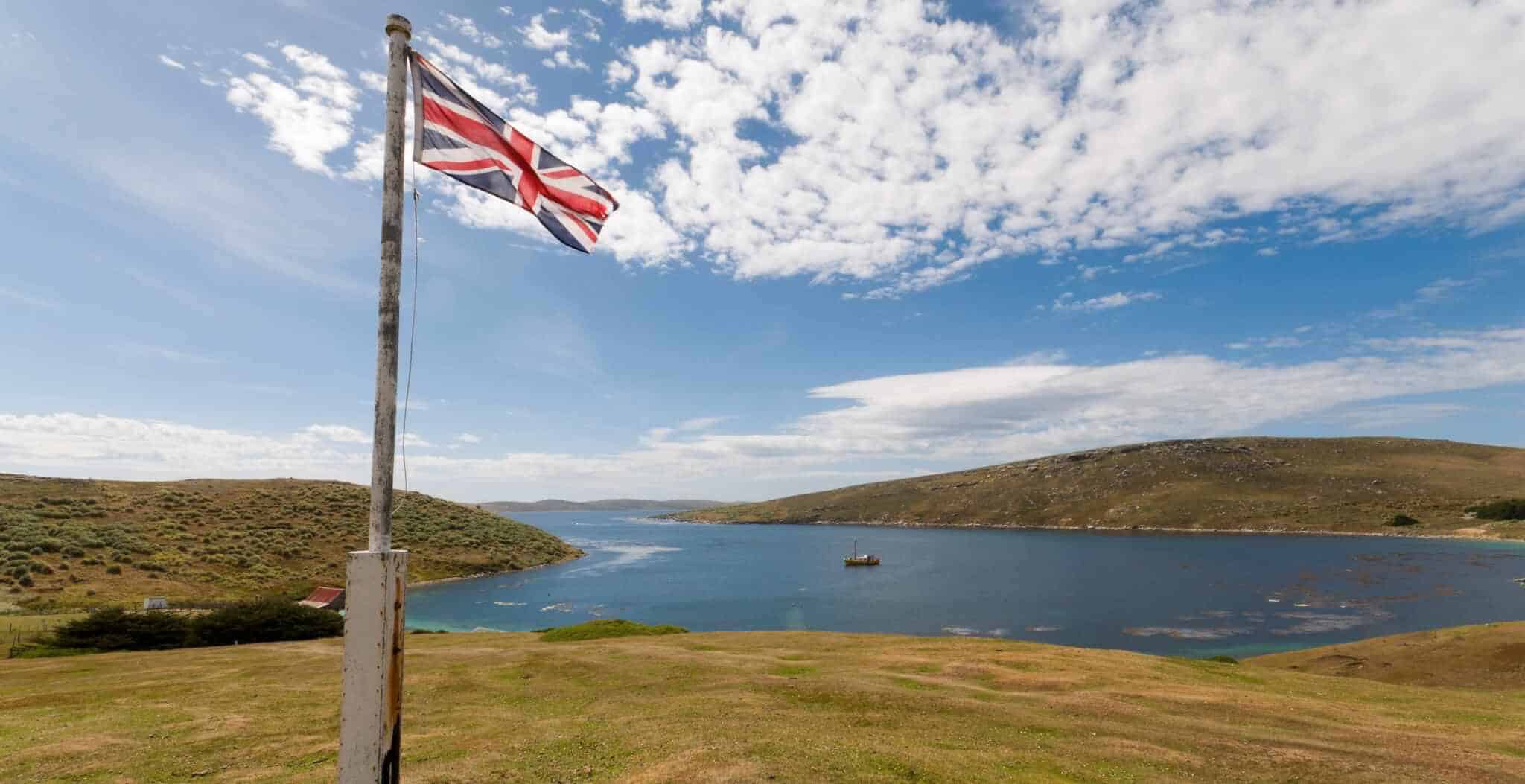


The Falkland Islands are an archipelago of around 700 islands in the South Atlantic, the largest being East Falkland and West Falkland. They are situated about 770 km (480 miles) north-east of Cape Horn and 480 km (300 miles) from the nearest point on the South American mainland. The Falklands are a dynamic overseas territory of the UK and are becoming an increasingly popular tourist destination.
 The Islands were first sighted in 1592 by English seafarer, Captain John Davis, in the sailing ship “Desire”. (The vessel’s name has been incorporated in the Falkland Islands motto on the crest “Desire the Right”). The first recorded landing on the Falkland Islands was by Captain John Strong in 1690.
The islands have a total land area of 4,700 sq. miles – more than half the size of Wales – and a permanent population of 2931 ( 2001 Census). Stanley, the capital (population 1981 in 2001) is the only town. Elsewhere in Camp ( the local name for the countryside) there are a number of smaller settlements. English is the national language and 99% of the population speak English as their mother tongue. The population is almost exclusively of British birth or descent, and many families can trace their origins in the Islands back to the early post-1833 settlers.
Traditional Buildings
Standing out in the landscape, the timber framed house clad in iron sheets or wooden weather boarding, with its white walls, coloured roof and painted woodwork shining in the sun, characterises the Falkland Islands.
The distinctive charm of old island buildings comes from traditions forged by pioneering settlers. They had to overcome the hardships not only of isolation, but also of a treeless landscape which did not easily yield other materials for shelter. An 18th century Benedictine priest was the first to discover that the prevalent local stone was unlikely to be adaptable for buildings. When he arrived in the islands in 1764, travelling with Bougainville’s party, the Frenchman Dom Pernety wrote, “I attempted in vain to carve a name upon one of these stones….. it was so hard that neither my knife nor a punch could make any impression upon it.”
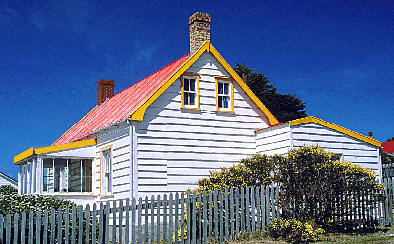
Later generations of settlers struggled with the unyielding quartzite and lack of natural lime also hampered building in stone. In the end it was only normally used for foundations, although the sheer perseverance of some of the pioneers has left us with a handful of beautiful, solid stone buildings, such as the Upland Goose Hotel which dates from 1854.
With the stone so hard to use and an absence of trees, there was no alternative but to import building materials. The cheapest and lightest available, wood and tin, were chosen, for the settlers were not wealthy and everything had to be transported hundreds of miles across stormy oceans. All the main settlements on the islands were built on natural harbours for the sea was the only highway. Anything moved overland had to be dragged painfully across the rough, trackless countryside by horses pulling wooden sleighs. Timber and iron had an advantage over stone in that buildings could be constructed quickly and without special skills. The early settlers had to live on board schooners or in the roughest shelters whist they constructed their houses.
In the early 1840s the capital was moved for naval reasons from Port Louis to Port William. In the infant settlement of Stanley, named after the Colonial Secretary of the day, even the Colonial Surgeon lived in a tent in the garden while he built his house, Stanley Cottage, which today serves as the offices of the Education Department. The Governor, Richard Clement Moody, laid out his new town on a simple grid pattern and gave the streets names connected with the settlement of the islands: Ross Road, after Sir James Clark Ross, the naval commander instrumental in deciding the site for the new capital and Fitzroy Road after Captain Robert Fitzroy, commander of the survey ship HMS Beagle, which brought Charles Darwin to the Falklands in 1833.
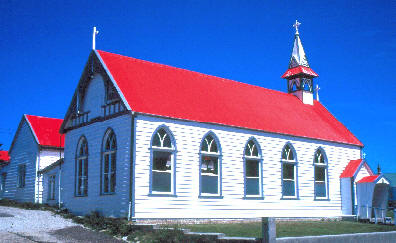
Buildings were sometimes sent from Britain in kit form, to make construction easier. Examples in Stanley include the Tabernacle and St Mary’s Church, both dating from the late 1800s. But in order to save time and money islanders became adept at using whatever materials came to hand.
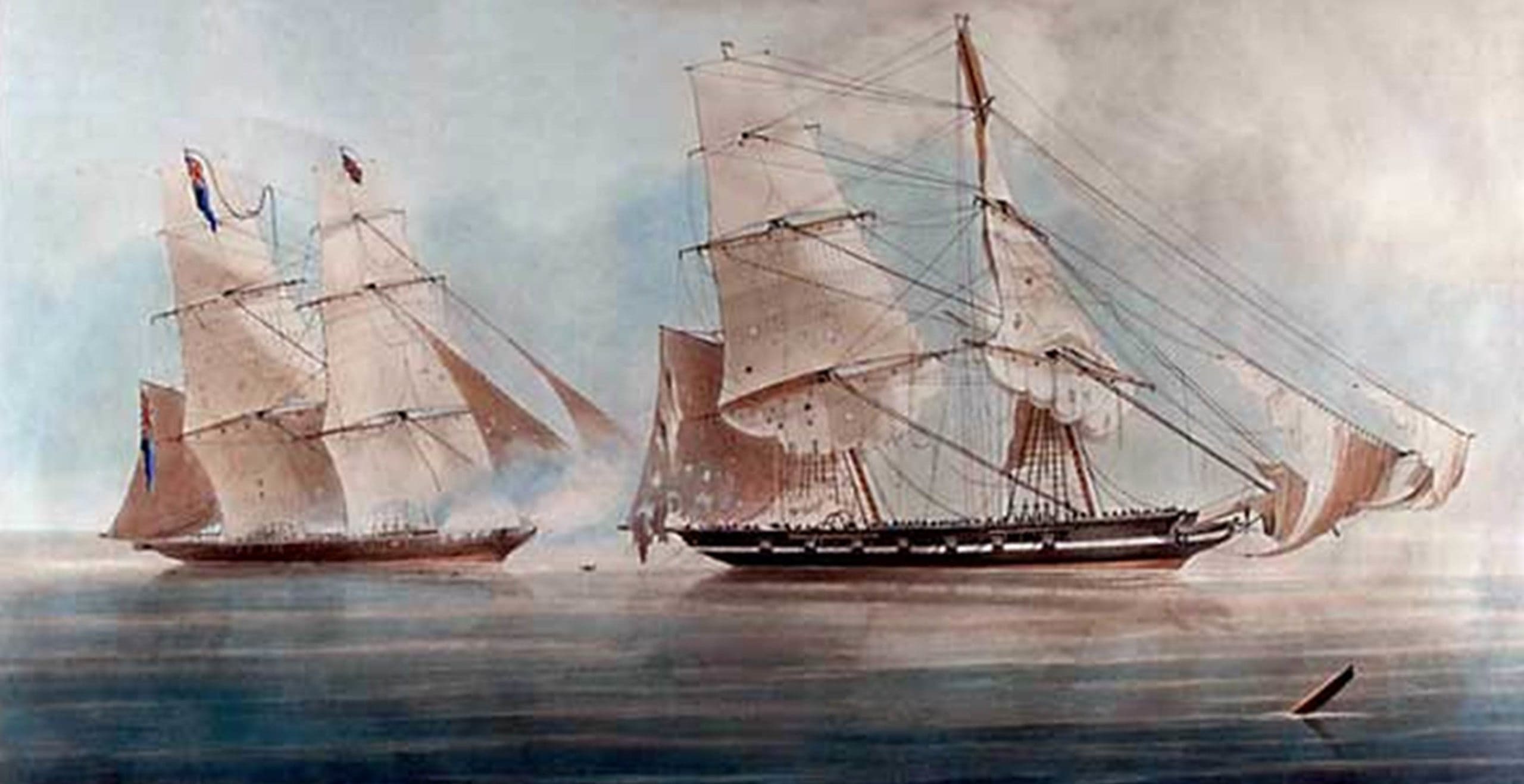
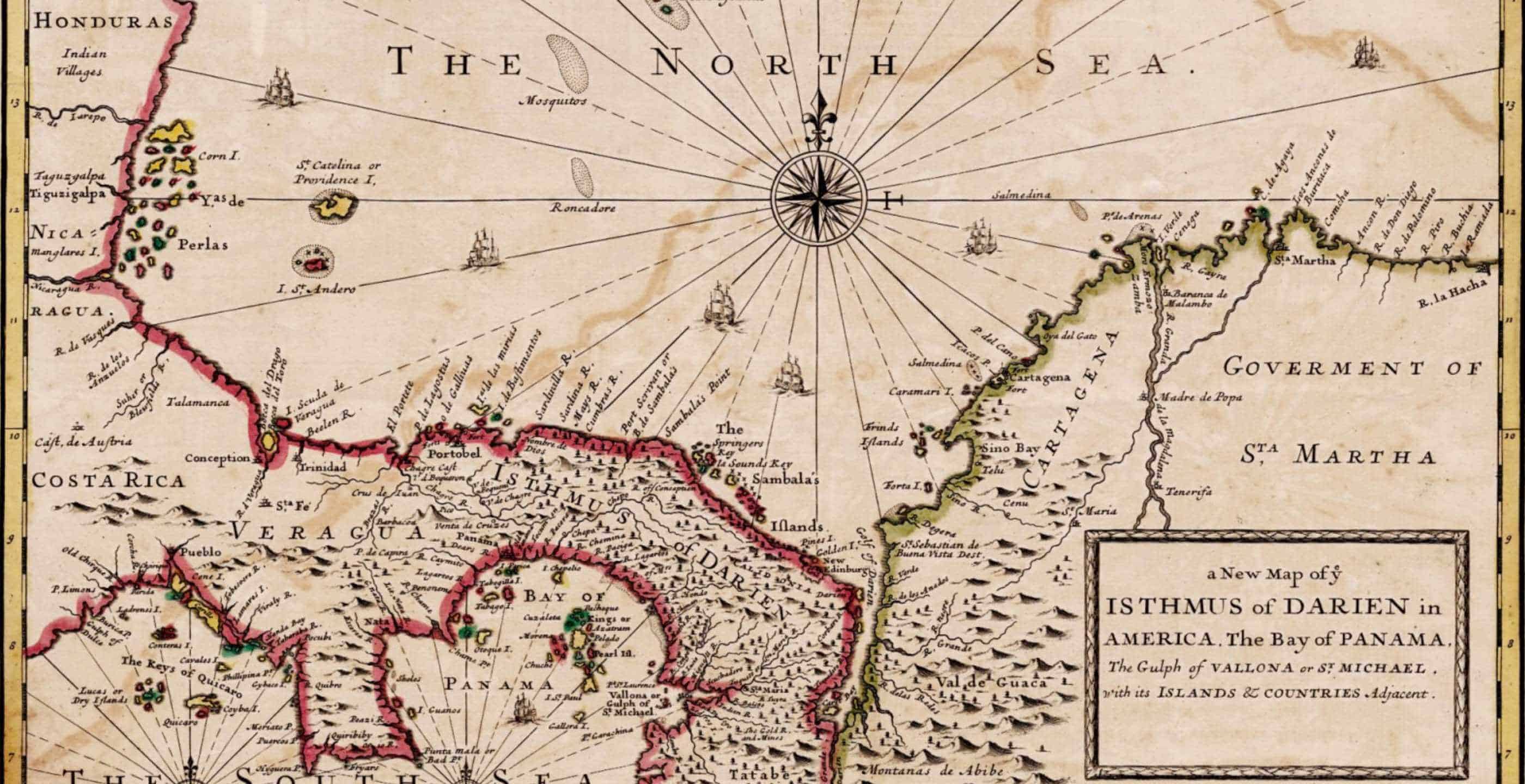
The sea proved a rich treasure chest. Before the opening of the Panama Canal in 1914, Cape Horn was one of the great trading routes of the world. But many sailing ships came to grief in the stormy waters and ended their days in the Falklands. Their legacy lives on in older buildings, where sections of masts and yards can be found serving as foundation piles and floor joists. Heavy canvas sails, patched and torn after battles with the southern ocean, lined bare boards. Deckhouses sheltered chickens, skylights were used as cold frames in gardens. Nothing went to waste.
So simple timber-framed buildings with corrugated iron roofs, improvised insulation, and walls covered in sheets of flat tin or wooden weather boards came to be typical of the Falkland Islands. Paint was originally used to protect the wood and iron from the effects of the salt Atlantic air. It became a much-loved form of decoration. The Falkland Islands have seen many changes in recent years, but the tradition of colour in buildings continues to breathe life and character into the landscape.
by Jane Cameron.
Basic Information
FULL COUNTRY NAME: The Falkland Islands
AREA: 2,173 sq km
CAPITAL CITY: Stanley
RELIGION(S): Christian, with Catholic, Anglican and United Reformed Churches in Stanley. Other Christian churches are also represented.
STATUS: UK Overseas Territory
POPULATION: 2,913 ( 2001 Census )
LANGUAGES: English
CURRENCY: Falkland Island Pound (at par with sterling)
GOVERNOR: His Excellency Howard Pearce CVO