

As with Christian festivals such as Easter, many Celtic celebrations do not have definite dates and are moveable or flexible. Readers should always check with local Tourist Information Centres (TIC’s) that events or festivals are actually taking place before setting out to attend.
| DATE | EVENT | LOCATION | DESCRIPTION |
| Various dates throughout the Easter period, checkout at The Morris Ring | Morris Dancing | Various locations, checkout The Morris Ring website | Regarded as an ancient tradition even in the reign of Elizabeth I, these ‘madde men’ with their ‘Devils dance’ were banned by the Puritans following the Civil War. |
| Maundy Thursday, the day before Good Friday. | Royal Maundy Distribution | Westminster Abbey on even-year dates and other churches on odd-year dates. | Already an established custom at the time of Elizabeth I. The custom derives from the Last Supper at which Christ washed the feet of his disciples. It is recorded that Edward II washed the feet of the poor as an act of humility. In the modern ceremony the sovereign distributes specially minted silver coins to the recipients, the number of which corresponds with her age. |
| Good Friday | Bun Ceremony | The Widow’s Son Tavern, Bromley-by-Bow, London | For over two hundred years a bun has been added every Good Friday to a collection preserved at the Tavern. The name and the custom derive from an 18th century widow who hoped that her missing sailor son would eventually come home safely if she continued to save a bun every Easter. |
| Good Friday | Butterworth or Widow’s Charity | Church of St Bartholomew the Great, Smithfield, London | The original custom involved placing twenty-one sixpences on a tombstone which were then gratefully retrieved by twenty-one poor widows. In the current ceremony hot cross buns are distributed to local children before the morning service. |
| Ash Wednesday to Good Friday | British Marble Championships | The Greyhound Hotel, Tinsley Green, Sussex | A popular pastime in ancient Rome, the current British and World Championship is fought out by teams in a game known as Ring Taw. |
| Good Friday | Pace-Egg Play | Upper Calder Valley, Yorkshire | A traditional masked mime or mumming play, based upon the legend of St George and featuring such colourful characters as Toss Pot. The pace-egg being the Pasch or Easter Egg. |
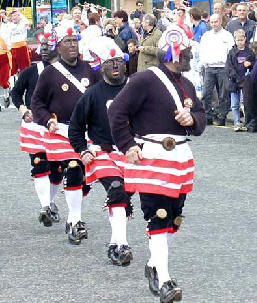
Photograph courtesy of the Britannia Coco-Nut Dancers of Bacup
| Easter Saturday | The Nutters’ Dance | Bacup, Lancashire | Not a traditional Morris Dance as such, this most unusual dance is performed by an eight-man team with blackened faces and wearing black and white costumes with wooden cups attached. |
| Easter Monday | Biddenden Dole | Biddenden, Kent | Biddenden cakes are distributed as part of an ancient charity known as the Biddenden Dole. Each cake bears a picture of two females who are joined on one side. These are said to be two sisters who bequeathed money for the Dole of beer, bread, cheese and cakes. Legend records their names to be Eliza and Mary Chulkhurst, Siamese twins who were born in 1100 joined together at the shoulder and hip. When one of the sisters died at the age of 34 the other refused to be separated from her and died six hours later. They left 20 acres of ground called the Bread and Cheese Lands to provide money for the Dole. |
| Easter Monday | Bottle-kicking and Hare Pie Scramble | Hallaton, Leicestershire | The proceedings start with the parading of a giant hare pie. Hallaton’s vicar emerges from church and blesses the pie. Great greasy handfuls of it are thrown into the hungry scrambling crowd. After that, things get even sillier … The Bottle Kicking contest between Hallaton and nearby Medbourne can commence. Confusingly, this involves neither bottles nor kicking. Instead the two village teams face each other at Hare Pie Bank and fight over three small beer barrels, which have been decked in ribbons. The casks are released in turn, and the opposing teams attempt to roll or carry them to their village boundary. The scrum is rules-free and notoriously bloodthirsty. The whole event can last for hours, with the both teams sharing the beer contained within the final cask.
Bottle Kicking is recorded as early as 1770, but its origin is thought to be much older. It is believed to be linked to the sacrifice of the hare in the Dark Age worship of the goddess Eastre. |
| Easter Monday | Egg-Rolling | Avenham Park, Preston, Lancashire | |
| Easter Monday | Morris Dancing Festival | Thaxted, Essex | Visit the Morris Ring website for further details. |
| Easter Monday | Running Auction | Bourne, Lincolnshire | In 1742 Mathew Clay bequeathed a piece of land, the rental income from which was to be used to buy white bread for the poor folk of the Eastgate Ward.
The land is let from year to year and Clay stipulated that the winner of the following years tenure should be decided by a running auction. The auctioneer starts two boys running and as soon as they have set off, the bidding for the grazing rights begins but can only go on until the boys return and then the highest bid made just before the race ends becomes the tenant for the following year. The rental money now goes to a local charity but in 1968, one of the last times that bread was actually distributed, around 350 loaves were handed out from the proceeds of the charity which then amounted to £13. |
| Easter Monday | The World Coal Carrying Championship | Ossett, Nr. Wakefield, Yorkshire | A tradition that dates back to the dark ages of 1963, when one local man challenged another local man in the middle of their local, the Beehive Inn, is now an annual contest of stamina and muscle.
The main event, the men’s contest, starts at The Royal Oak, from where competitors, each carrying 1cwt. of coal, have to run nearly a mile as quickly as possible, before being allowed to drop the “secks ‘o’ coil ” (Yorkshire dialect for sacks of coal) at the foot of the Maypole, which stands on the village green. The current and world record is 4mins. 6secs |
| Second Tuesday after Easter | Hocktide Festival – Tutti Day | Hungerford, Berkshire | Though once widespread throughout Britain, Hungerford is now the only place in the country still to maintain the annual Hocktide festival. The festival dates from the 14th century when Prince John of Gaunt gave the rights of free grazing and fishing to local ‘commoners’.
The town-crier blows his horn and calls together the Hocktide Court in the town hall. Here, all commoners living in the High Street must pay a fine to ensure their rights of fishing and grazing. While the court continues, “Tutti-Men” or Tithe Men (originally rent collectors), with florally decorated poles are led through the streets by the “Orange-Man” to collect a coin from the men and kisses from all the ladies resident in the High Street. They receive an orange in return. Various traditional suppers, lunches and balls follow. |
| Ascension Eve | Planting the Penny Hedge | Whitby, Yorkshire | In this ancient festival wooden stakes are cut and carried through the town at sunrise to the shore, where they are woven into a strong hedge before the tide turns. The name Penny Hedge is thought to derive from Penance Hedge. The ceremony is said to date back to 1159 when the Abbott of Whitby imposed a penance on three hunters and their descendants for murdering a hermit with wooden staves. The hermit was protecting a boar they were chasing. To save themselves from execution they had to agree to construct a stake hedge strong enough to withstand three high tides every year until their descendants had died out. Sir Walter Scott recorded the legend in his novel Marmion. |
| Ascension Day, 40 days after Easter | Well Dressing | Tissington and Ashbourne, Derbyshire | |
| Ascension Day | Beating the Bounds | Lichfield Cathedral, City of London and Tower of London | This custom has existed in Britain for over 2000 years its precise origins however are unclear. In simple terms it involves local people walking their farm, manorial, church or civil boundaries pausing as they pass certain trees, walls and hedges that mark the extent of the boundary and ritually ‘beat’ these with sticks.
These sticks would originally have been of birch or willow, both being of significance to pre-Christian tribes. The English folk-song “Stripping The Willow” is a relatively modern record of these practices. Such processions would occur every seven or ten years. In a time when literacy and map-reading were not widespread skills these inspections served to ensure boundaries remained intact, were known by local people and had not been grabbed by neighbouring landowners. Before the Roman invasion rituals connected with spring were performed each year as part of the pagan festival of Beltane. Birch twigs or Besoms were struck against the boundary marks as part of the ritual. |
Related Links:The Folklore Year – January |