

Gaius Suetonius Paulinus was a Roman general and more significantly, Governor of Britain during the final stages of rebellion by Boudica and the Iceni tribe, before their efforts were completely subdued by Roman forces.
Whilst little is known of the man himself, Suetonius’s time in Britain and his governorship proved to be vital in suppressing rebellion by the Celtic tribes.
He was thought to derive from Pisaurum (Pesaro) on the Adriatic coast and was first registered as having served as praetor in AD 40. He would make a mark for himself in North Africa when he was appointed governor of Mauretania and played a pivotal role in suppressing a local rebellion led by Aedemon in the province. He was also notably the first Roman commander to lead troops across the Atlas Mountains (as noted by Pliny the Elder’s use of his descriptions of the local area and topography).
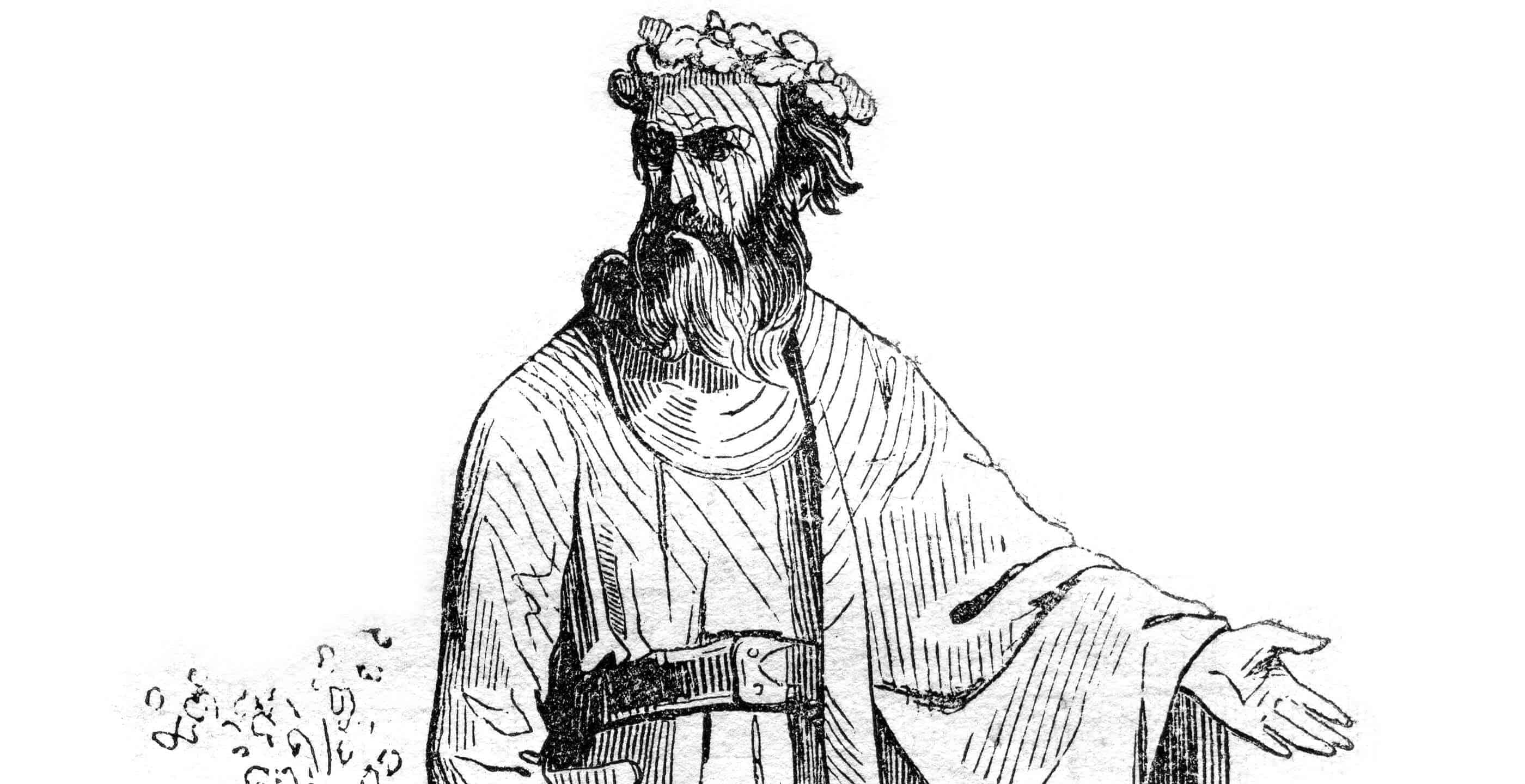
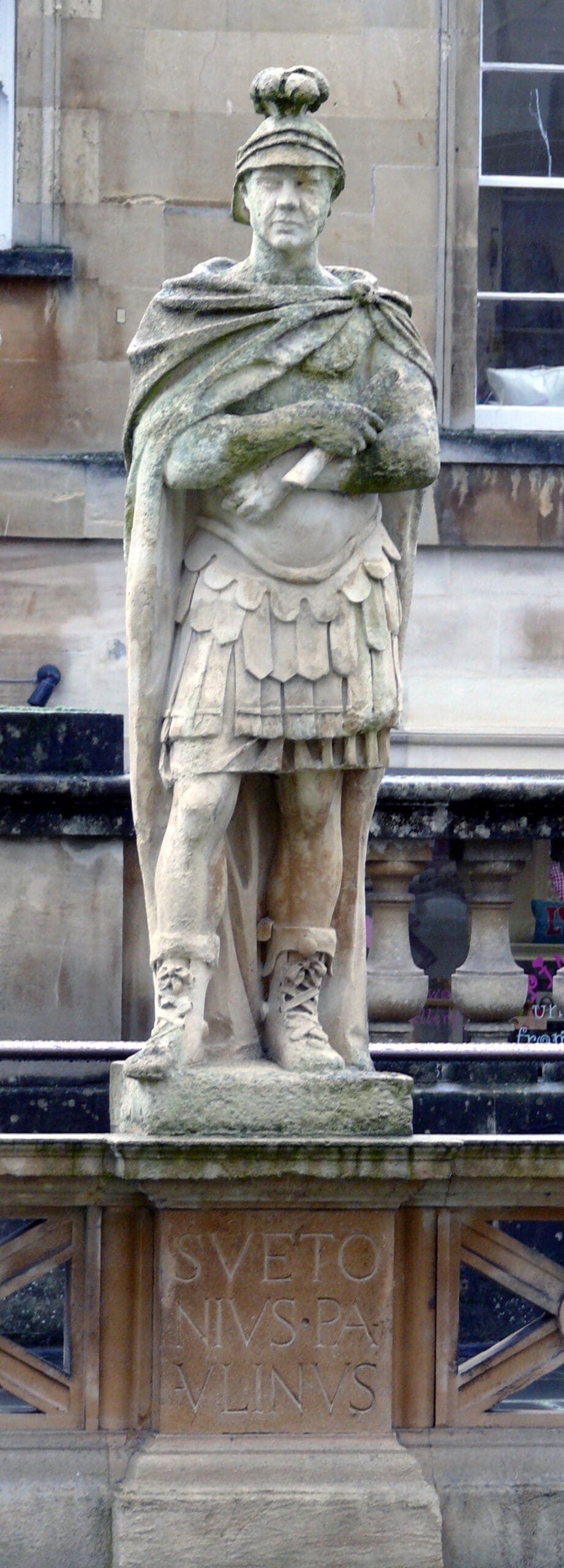 Statue of Gaius Suetonius Paulinus on the terrace of the Roman Baths (Bath). The Terrace is lined with statues of Roman Governors of Britain, Roman Emperors and military leaders. The statues date to 1894. © Ad Meskens / Wikimedia Commons
After serving in North Africa and proving his capabilities during the reign of Emperor Claudius, in AD 58 he was appointed to a position much further north, to serve as governor of Britain.
Replacing Quintus Veranius who had died during his time in office, Suetonius saw fit to maintain the previous governor’s policy of subduing local resistance to Roman domination.
He took over during a time when the Romans had made some headway, particularly in the south eastern regions between the Wash and Severn estuary, however there was much instability and pockets of native resistance which hampered Roman efforts.
As a result, Suetonius first act as governor was to wage war against the Ordovices in Wales.
The Ordovices were a tribe whose lands were located in northern Wales and the surrounding area. Unlike some of their compatriot tribes, the Ordovices invested heavily in a strong resistance against the Romans, initially rallying under the leadership of the famous Celtic warrior Caratacus.
The tribe continued to oppose throughout the subsequent decade, undeterred by Roman strength, and remained dedicated to a policy of armed resistance. Suetonius demonstrated continuity with Veranius’s policy of using extreme force to quell the rebellious tribes of modern-day Wales.
During this time, he gained a solid reputation as a general and his inspired leadership paved the way for two future governors who served under him during this period.
He would subsequently turn his attentions to the druids in Anglesey at the start of his campaign in AD 61.
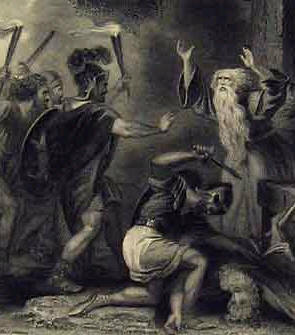
Located in northern Wales, the island was a stronghold for the group and was a natural obstacle for the Romans in their ambitions to control the Celts. As spiritual leaders, the druids held great status and Suetonius knew if he wanted to quell Celtic rebellions and achieve a prosperous governorship, he needed to launch a campaign against them.
The island at this time was a bastion for the druids and also provided sanctuary for British fugitives. Known in Welsh as Ynys Môn, the s referred to it by its Latin name, Mona.
With an extended history shared between the island and the druids, Suetonius was determined to sever the power of the group.
Druids were a high-ranking priestly class whose role was not only as spiritual leaders but was in fact multi-faceted, providing guidance on matters pertaining to legal, medical and political issues, as noted by the ancient Greek geographer Strabo. He described the druids observed in Gaul as falling into three different categories, that of poets and singers, diviners and specialists in the natural world and finally, experts in moral philosophy.
As the Romans continued to engage with the druids and have more encounters particularly in the region of Gaul and Britannia, observations of their practises was duly noted and recorded by the Romans, with descriptions appearing in works by Cicero, Pliny the Elder and Tacitus.
Their strong leadership, Celtic identity and practises made them a prime target for the Romans, who subsequently suppressed the druid orders during their invasion of Gaul under the emperors Tiberius and Claudius.
Following in this tradition, Suetonius decided to target the druids on Anglesey using his elite squad of Batavians (expert soldiers from a Germanic tribe) in a surprise assault. During this attack the shrine and sacred groves (known as nemeta) were destroyed.
The encounter was subsequently documented by the Roman writer Tacitus, who described how surprised the legionaries were to discover the band of druids who held their hands up to the sky and began reciting curses upon the invaders. Such a spectacle was an unprecedented sight which ‘terrified our soldiers who had never seen such a thing before’. Nevertheless, despite the consternation at their practises and the fear they had elicited, the Romans successfully repressed the druids and in a symbolic act of destruction, cut down their sacred groves. Tacitus’s account remains the only primary source regarding the druids and Suetonius’s successful conquest.
Shortly after claiming victory however, Suetonius received the news of Boudica’s revolt, forcing him to withdraw his army before they could consolidate matters in the region.
The island of Anglesey was only spared for a short while as the future Roman governor, Gnaeus Julius Agricola, who had learned under Suetonius, would later bring the island under Roman occupation in AD 78.
Meanwhile, Suetonius was able to gather around 10,000 men and assemble forces, however rebel forces were significantly higher in number and were led by the indigenous Iceni tribe who had since Roman occupation, maintained a degree of autonomy.
Under their king, Prasutagus, the Iceni lived in an uneasy harmony with the Romans, securing a level of independence in the face of the growing might of the Romans.
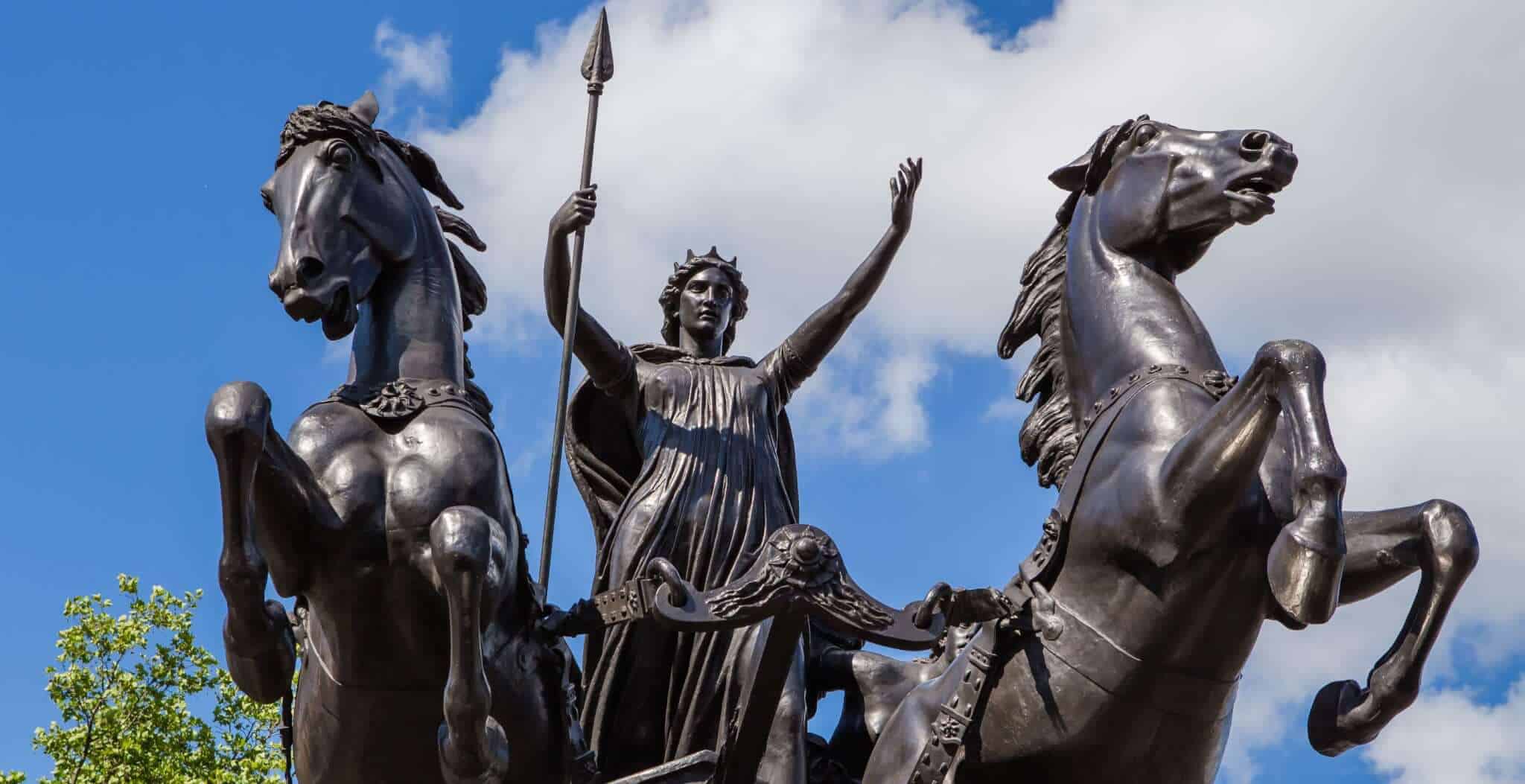
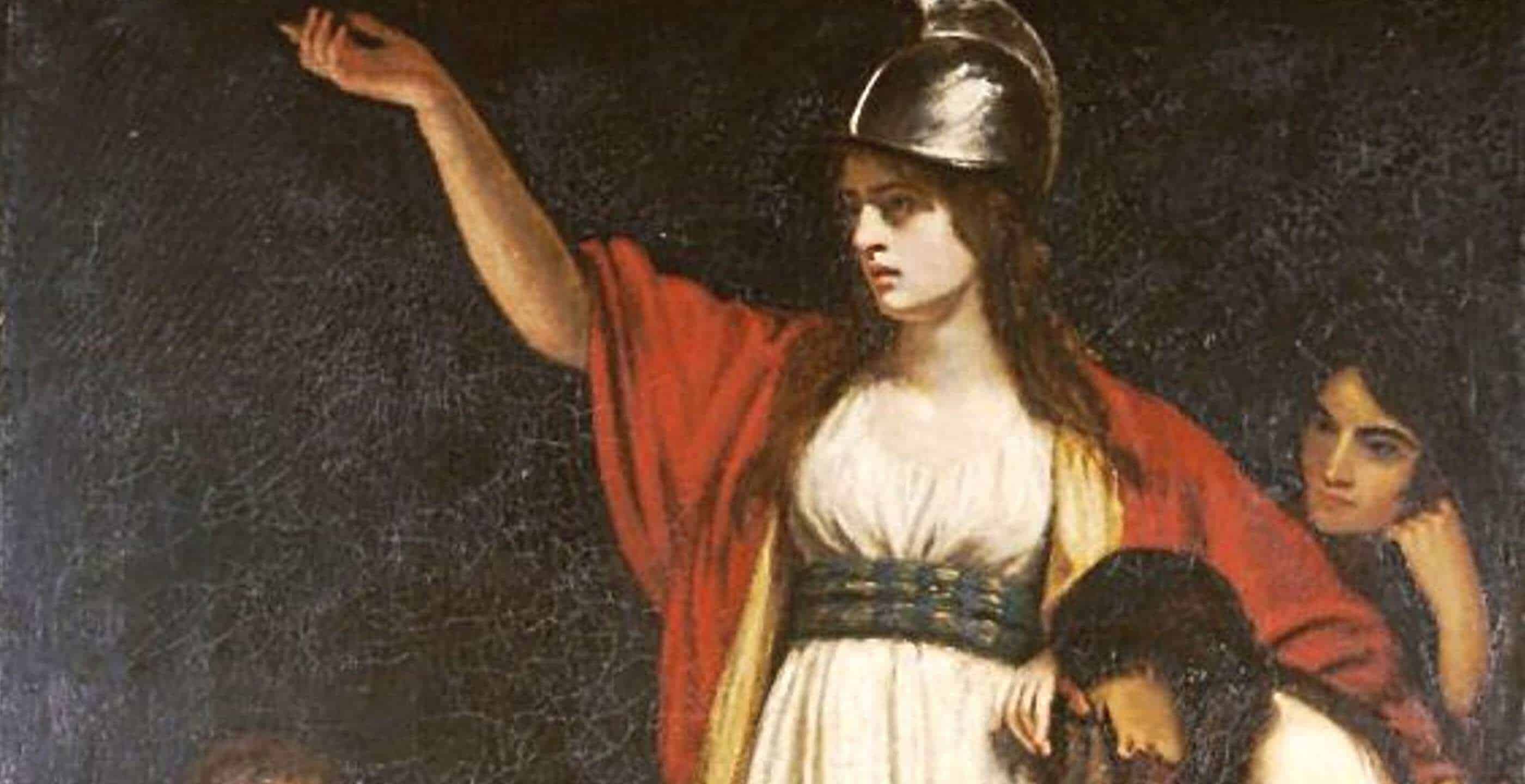
According to Tacitus, Prasutagus lived a long and prosperous life however upon his death, the Romans took the opportunity to plunder the kingdom, ignoring his will and legacy he had left behind and instead seizing their lands and women. After plundering the kingdom, the king’s widow Boudica was flogged and her daughters raped.
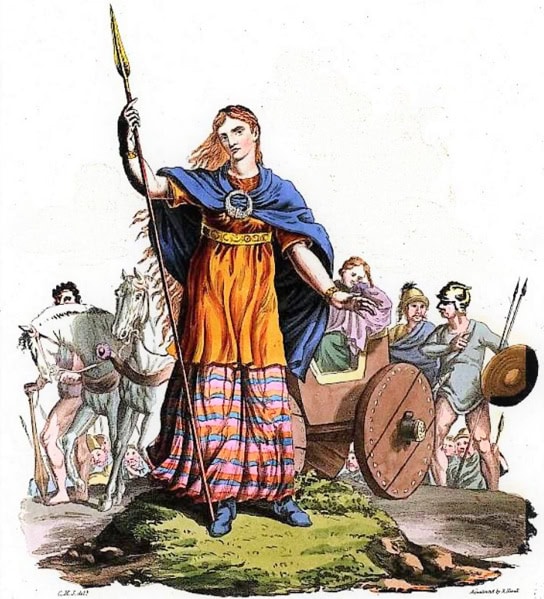
In the face of such brutality, Boudica instigated an uprising of the Iceni, who rose up against the Romans and sacked Camulodunum (modern-day Colchester). Once Suetonius heard of this chaos he quickly journeyed away from his preoccupation with the druids in Anglesey and travelled to the south east in order to put an end to the uprising which threatened not only the rich and stable south eastern province but also more personally, threatened his career.
Before he had a chance to arrive in the region, the Iceni had destroyed Camulodunum, its inhabitants suffering from torture, rape and slaughter. Meanwhile, Roman opposition proved futile and Petillius Cerialis’s legion was routed.
Suetonius meanwhile was marching along the Roman road Watling Street, heading in the direction of Londinium (London) which was next on the hit list for the rebel forces.
He was forced under these extreme circumstances to judge that the city was not able to defend itself and called for an evacuation. As predicted, the Iceni rebels sacked the city, destroying it.
A similar picture subsequently unfolded in Verulamium (St Albans) where the rebel forces headed next.
Eventually, the two forces met and in an infamous battle which took place in the Midlands. The Roman and Iceni rebels met in a showdown known as the Battle of Watling Street.

With huge numbers on the side of the rebels, Suetonius’s men could easily have been overwhelmed, however his skilled leadership ensured victory for the Romans.
Whilst the Celts were fierce warriors, they lacked the mental discipline and organisational skills which kept the Romans in a position of supremacy on the battlefield.
In an act of final defiance against her Roman suppressors, Boudica poisoned herself and thus the fate of the Iceni and their rebel forces was sealed.
The Romans had triumphed but only at the expense of massive Roman brutality which ended in slaughter. News of this would eventually reach Rome and not long afterwards Suetonius was removed from his post and left the region, never to return.
Whilst the Celtic tribes continued to launch action against the Romans, their power dwindled and eventually was quelled by the might of Roman military power and political domination.
In AD 66 Suetonius would eventually become a consul, however turmoil in the dramatic world of Roman political machinations during AD 69 caused him to lose power after the civil war, and the death of Nero saw Suetonius now on the losing side.
Whilst little is known of his later life, Suetonius was a significant and often overlooked figure, overshadowed by more decadent and zealous Roman figures who gained notoriety and stole the headlines.
A sound military leader, Suetonius had navigated crises in Mauritania and Britannia to ensure an ultimate Roman victory.
Suetonius was the governor of Britain during a difficult time and handled the hostility with all the fervour of a loyal and ambitious Roman general. Whilst Boudicca is remembered for her valiant female heroism in the face of Roman colonial oppression, Suetonius’s military acumen won the day.
Jessica Brain is a freelance writer specialising in history. Based in Kent and a lover of all things historical.
Published: 5th September 2025