
Tucked away amidst the cliffs and coves of the North Cornish Coast, Chapel Porth is an idyllic beach known for its expansive low-tide sands, labyrinthine caves and powerful surf. But if you look beyond the scenic views, there is an intriguing and colourful history to be discovered…
Chapel Porth is one of Cornwall’s hidden gems; a secluded tidal beach removed from any towns or villages; for those in the know it’s a valued holiday spot. Yet there’s more to it than just sea and sand. Take the name – Chapel Porth, Cornish for ‘port / cove with a chapel’. Yet there is no chapel to be seen today. Locals always believed that one had once stood near the beach. Now archaeology, along with a bit of folklore, can cast new light on the matter.
In 1750, Cornish antiquarian William Borlase noted an ancient ruin above the Chapel Porth beach, along with what appeared to be a surrounding yard with soft turf suggestive of graves. But by 1780 a writer named Daniel Lysons observed that the ruin had been dismantled, possibly to construct a shelter for fisherman and miners. This shelter has itself long since vanished, but the likely chapel-yard was still identifiable in 1965.
In 2024 the National Trust, along with local volunteers, got their trowels out and investigated the site, which lies along the South-West Coast Path just uphill from Chapel Porth beach. Thrillingly, they found the foundational outline of a small building, decorated ridge-tiles, and pottery. While these are only initial findings, with a more through dig still required, it does seem that the eponymous chapel has been found.
What’s more, it provides a compelling jumping off point into wider history and folklore. The chapel remains are located near the site of an old well, which is believed to have been regarded as a ‘holy well’ in medieval times, dedicated to St Agnes (the village of St Agnes lies just 2 miles inland from the beach). This may connect Chapel Porth to the murky depths of the Dark Ages, and the coming of Christianity to pagan Cornwall.
The chapel remains that have been partly excavated are believed to date from the 900s AD, being similar to other contemporary Cornish sites such as Fenton La Chapel. But that stone chapel might have stood on the site of an earlier wooden shrine, of which nothing would now remain. It is reasonable to believe this, because Cornwall had been Christianised centuries earlier, in the 400s and 500s – during the last days of Roman rule, and the shadowy years thereafter.
The faint memory of this Christianising time has left its mark all over Cornwall in the from of places named after saints, as witness St Mawes, St Just and St Austell to name but a few. In fact, Cornwall has the greatest frequency of saintly place names of any English county. One explanation for this is that early Cornish Christians re-imagined their local Pagan Gods, spirits, and folk-heroes as Christian Saints. These figures were often already associated with important landscape features, especially water-sources such as springs and wells. So the Christian sites were founded nearby, retaining the sacred association. And they were named after the local spirits-come-saints, which in time also became the names of nearby settlements.

Hence, Chapel Porth’s own chapel was likely built deliberately near to the well because of a sacred quality already attributed to it, with St Agnes as the local folk-hero-come-saint. And indeed, there is a colourful Chapel Porth legend in which the Agnes features, that may date back to a time before the Christian chapel.
The story tells how a towering giant called ‘Bolster’ once ruled the area; he was so huge that he could stand with one foot on St Agnes Beacon and the other on Carn Brea near Redruth, nearly six miles apart! A dim-witted bully, he enjoyed forcing his wife to carry heavy stones endlessly. One day, surveying his literal stomping ground, his eye chanced on Saint Agnes as she strolled along Chapel Porth’s windswept sands. Instantly enraptured, he spurned his wife and loomed over Agnes, demanding that she become his.
The quick-thinking Saint devised a plan: if he truly loved her, she said, would he not prove it by filling a small cliffside hole with his blood, as a show of devotion? The prideful Bolster agreed and opened a vein into the little ditch – not realising that it actually drained down into a huge beach cave below. Too stubborn and stupid to realise he’d been duped, Bolster became weaker and weaker until he plunged off the headland into the sea. The locals (having somehow survived the resulting tsunami) hailed Agnes as a giant-slaying hero.
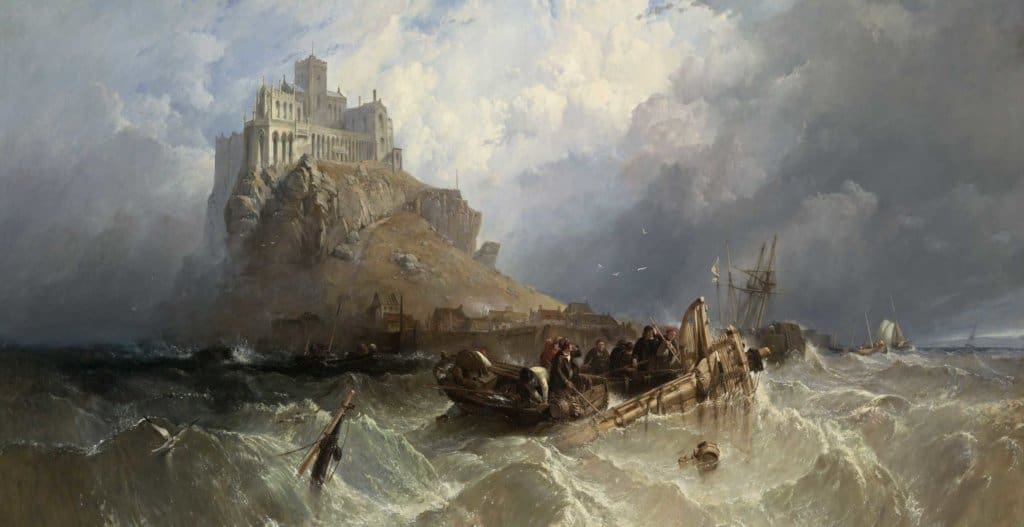
It’s a fun legend, first written down in the 1800s, that has no doubt changed in the telling over time. But the character of Bolster hints at the tale’s antiquity – giants feature prominently in similar coastal tales across the Celtic world, such as at St Michael’s Mount and the Giants’ Causeway in Northern Ireland. They seem to be stock characters from myths that date back centuries, if not millennia. And the giving of blood, fantasised though it is, might also be an ancient element in the story, a fossilised memory of pagan rituals?
Along with nearby St Agnes village, the story roots Agnes firmly in the local area. Agnes was originally a Roman saint – but perhaps her name was plastered over that of an earlier, Cornish heroine? Maybe this folktale is the much-altered remnant of a pre-Christian local legend, doctored to be acceptable in a Christian age?
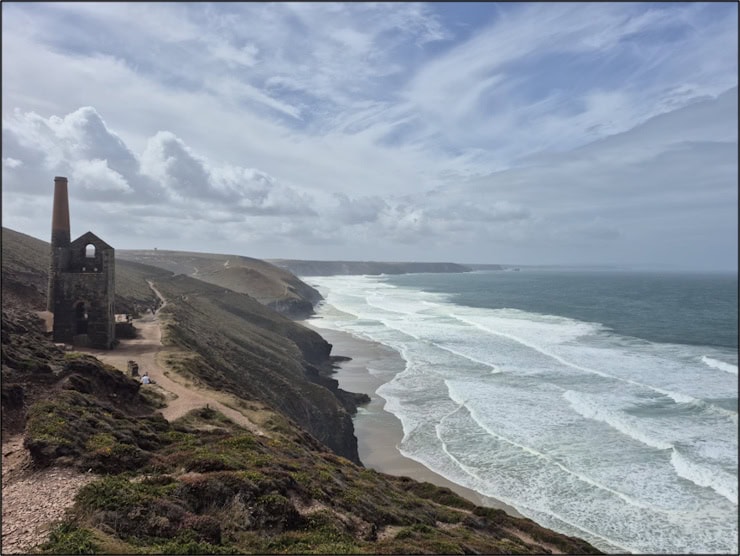
Maybe, but that is just speculation – the intersection of folklore and history is fascinating, but it rarely offers firm conclusions. What does seem certain is that Chapel Porth remained a place of Christian worship for centuries, perhaps serving local fishermen (who may have given the sheltered inner beach the ‘Porth’ part of its name). It is unknown when the chapel fell out of use – the Black Death? the Reformation? simple drift of the population elsewhere? – but by the time Borlase noted it in 1750, it was already a ruin. At that time, tin mining on the nearby clifftops had already been underway for decades. In 1802 Wheal Coates Tin Mine opened on the cliffs above the beach, the smoke-belching Towanroath engine house dominating the skyline like a latter-day Bolster. Miners spilling out of Towanroath would have taken shelter in the hut built from the remains of the chapel, probably unaware of what their sanctuary had once been.
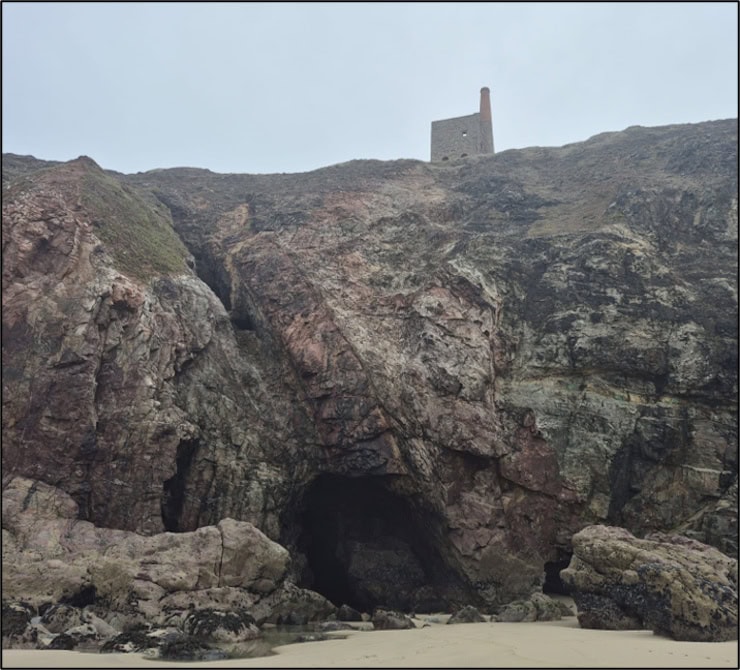
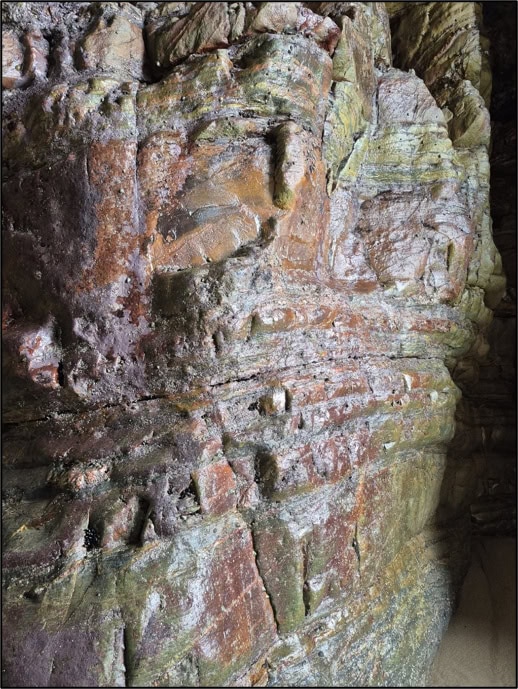
But unlike like the hauling wheels of the mine, the wheel of history never stops turning. Today, Wheal Coates is itself a relic, with Towanroath standing silent, a dramatic, picture-postcard memorial to Cornish mining. Immediately below the engine house, down the cliffs on the windblown beach, the rocks open into a cave accessible only at low-tide. Inside, the rocks run with a rusty hue. Locals will tell you that this is the cave of Bolster’s blood, still stained a ruddy red colour all these years later. Which begs the question: did that small ditch, into which Agnes convinced Bolster to bleed, eventually become Wheal Coates Tin Mine?
Well, come and decide for yourself! The National Trust run the beach car park, with a welcome café, making Chapel Porth very accessible. Just be careful of the treacherous tide, which has been known to leave unsuspecting beachgoers requiring rescue. Explore safely, and as you do, consider the centuries of history and folklore that lie beneath this beautiful Cornish beach.
Mike Edwardson is a history writer and researcher with an MA from The University of Sheffield. Passionate about uncovering the lesser-known stories of British history, Mike combines his enthusiasm for exploring with a love for storytelling to bring the past to life.
Published: 7th September 2026.