

I can remember when I learned the word codpiece. We were studying King Lear in English class. At one point, Kent comes in, and the Fool observes Marry, here’s grace and a codpiece. The textual explanation said the Fool means that Kent is both handsome (grace) and well-endowed (codpiece).
I was still confused, but it was a convent school and I had the sense that the nun who taught the class wouldn’t welcome questions. So I consulted an illustrated dictionary.
I don’t recall the exact definition it gave for codpiece. But it was probably close to the current Oxford English Dictionary entry which says: A piece of cloth, usually decorated, attached to a man’s lower clothing and covering his genitals. It also supplied the information that the word came from the old English word cod, meaning scrotum.
The only cod I knew came fried with chips, but the picture spoke a thousand words. The black and white drawing showed a man from the waist down, with a large lump where I knew his unmentionables were. Furthermore, the item was covered in more ribbons and jewels than my Auntie Marge at her wedding.
I won’t say that there and then began my interest in underwear, but it certainly had an influence.
Adam, we are told, fashioned himself an apron of leaves, but prehistoric man is usually depicted wearing animal skins draped like a sort of toga. However, cave paintings show him mostly as a naked stick figure, sometimes with evidence of a type of skirt or loin cloth.

Greek and Roman artefacts usually show people in robes, though athletes and the lower orders appear in loincloths, or naked. The loincloths were simply lengths of linen passed between the legs and wound around the waist. There is no indication that they were fastened other than by being tucked in, and I’ve often wondered how they managed to do any sports dressed like that. That’s probably why most Greek and Roman sports figures are naked. I can just imagine them saying, “Oh me miserum,” as their loincloth fell off for the hundredth time, and they tossed the annoying thing away.

By the medieval period, braies had been developed. These were the forerunner of shorts, joined up the sides, so you could step into them, and tied around the waist. They generally hung down to the knees or calves. They were open in front and the wearer’s modesty was preserved simply by folds of the cloth. The word braies comes from Old French, from Latin braccae (pants), which is the same root as the word breeches.
This medieval image is curious. Of the three men working, one has his braies tucked up high so they look like a nappy, one is wearing the more normal elongated braies rolled at the waist and laced up the sides, and one is delicately holding his robe up out of the way, with no braies to be seen. Either he couldn’t afford them, or, to judge from his expression, he was too modest to display his undies.
 Maciejowski Bible, c. 1244–1254, The Morgan Library & Museum, MS M.638. Public domain, via Wikimedia Commons.
The image of a captured king or noble demonstrates that the well-to-do wore braies under a loose robe or tunic, while the other image shows that for the poor, or in this case, prisoners, they might be their only garment.
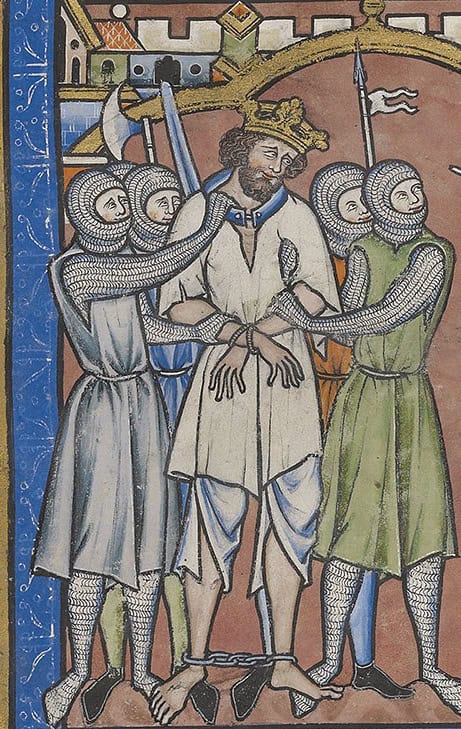
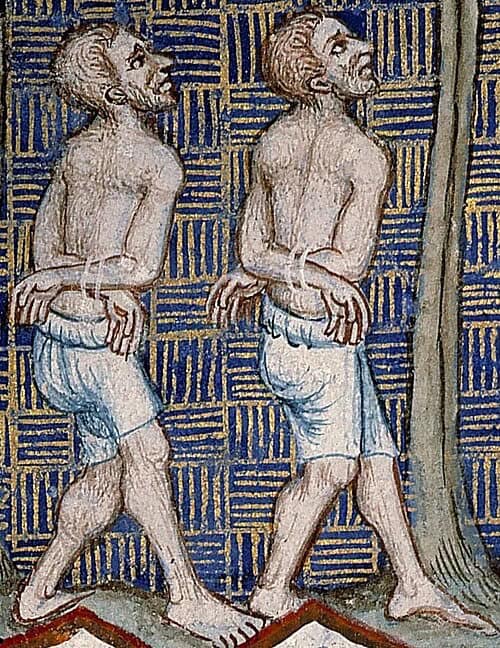 Both images from Maciejowski Bible, c. 1244–1254, MS.M 638. The Morgan Library & Museum. Public domain, via Wikimedia Commons.
As the centuries passed and outer clothing became more fitted, braies became less voluminous and, for those who could afford it, more fancy. But the big change came in the early 1500s, when robes disappeared in favour of tops and bottoms: a garment like a skirt, topped with a jacket. Men’s legs became important. They were covered with tight fitting hose. History tells us that those with spindle shanks stuffed their hose with sawdust to improve the shape of their legs. But now braies had to fit closely without extra fabric for modesty, and the hose were simply long stockings, not joined together like pantyhose. Mind the Gap!
Here enters the codpiece. As the convent dictionary had told me, it was originally a modesty flap. But it soon became a padded and decorative fashion accessory by which the wearer demonstrated his masculinity. It was, literally, a way of showing that mine is bigger than yours.
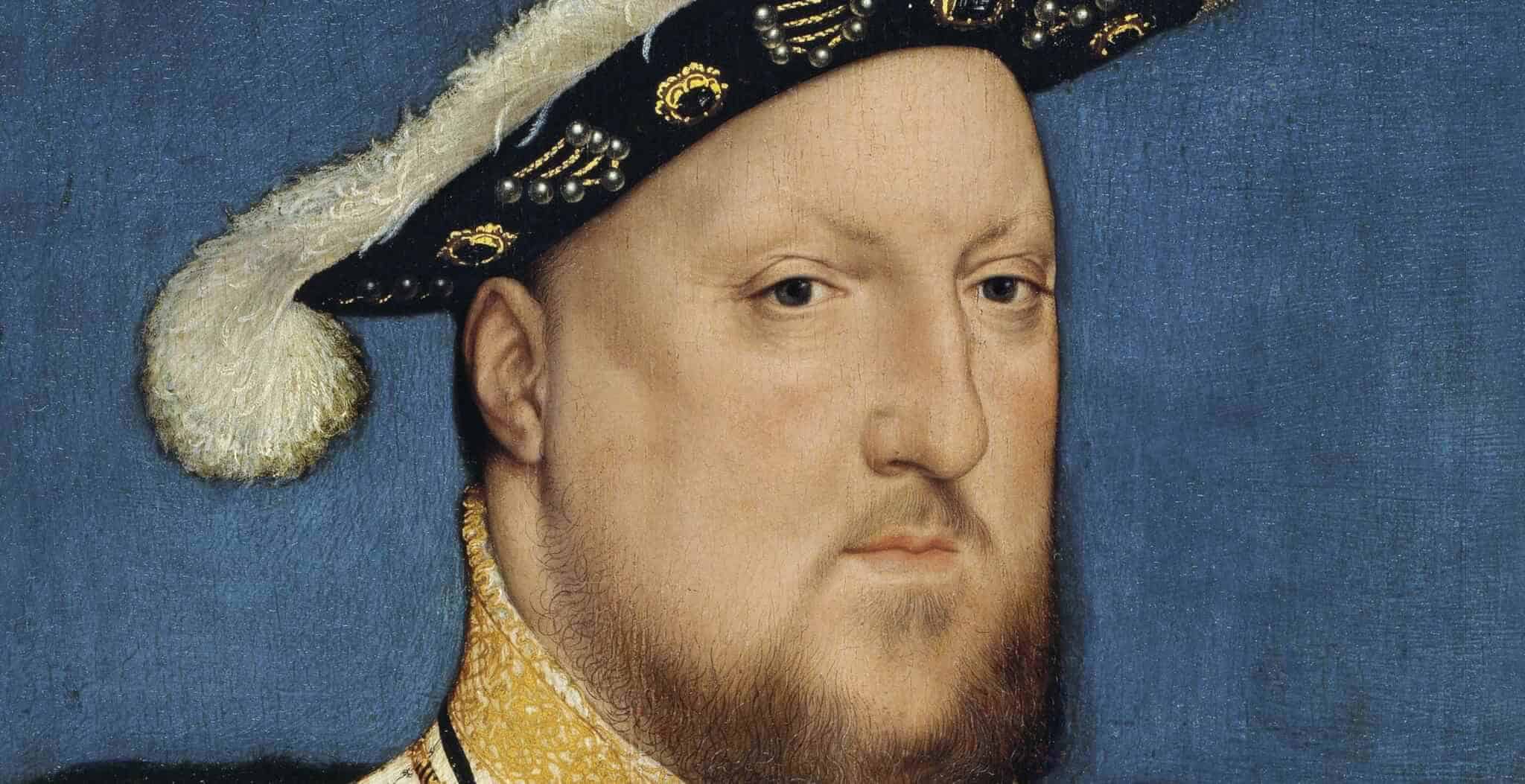
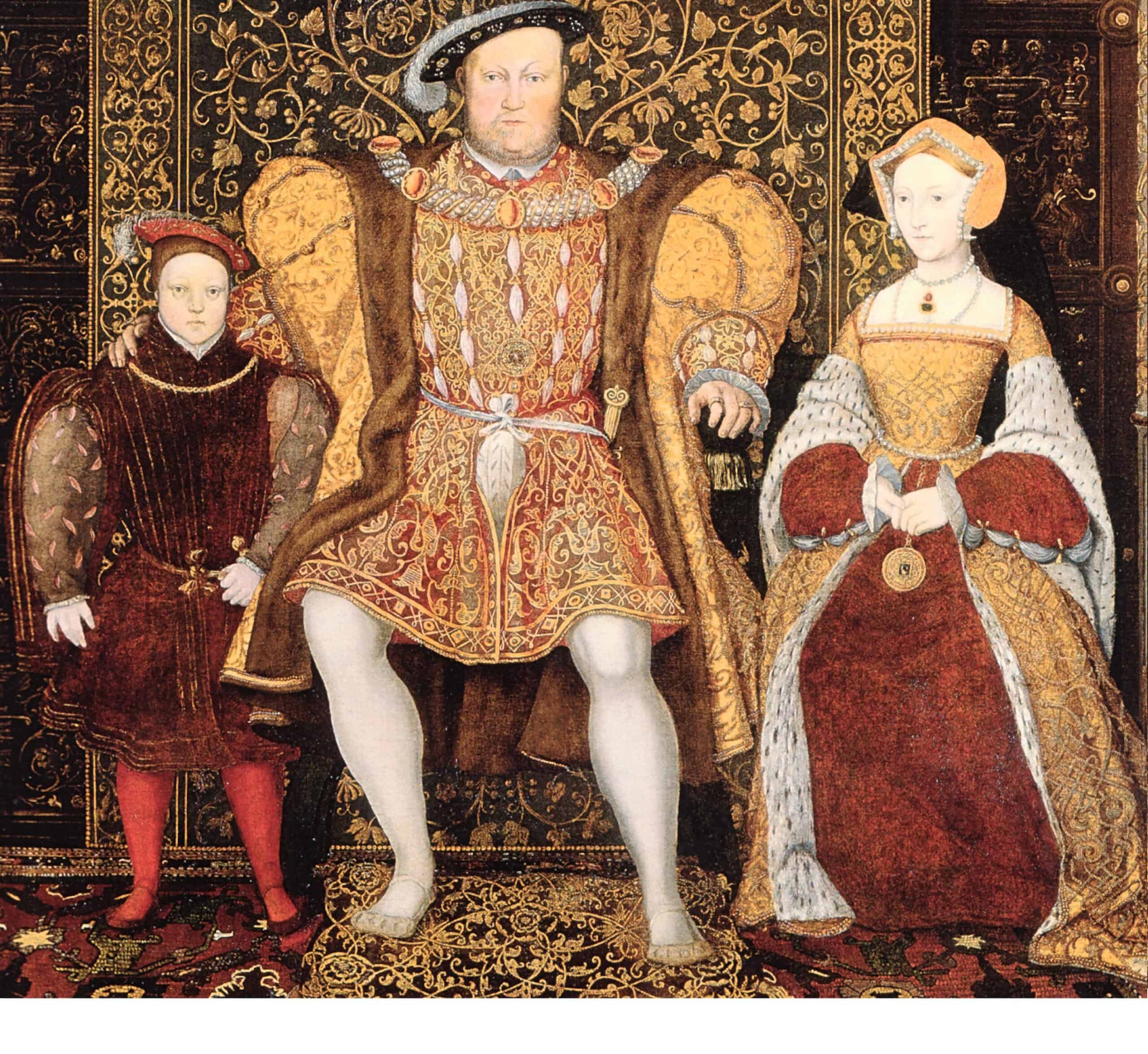
Henry VIII, not surprisingly, was a big codpiece man.
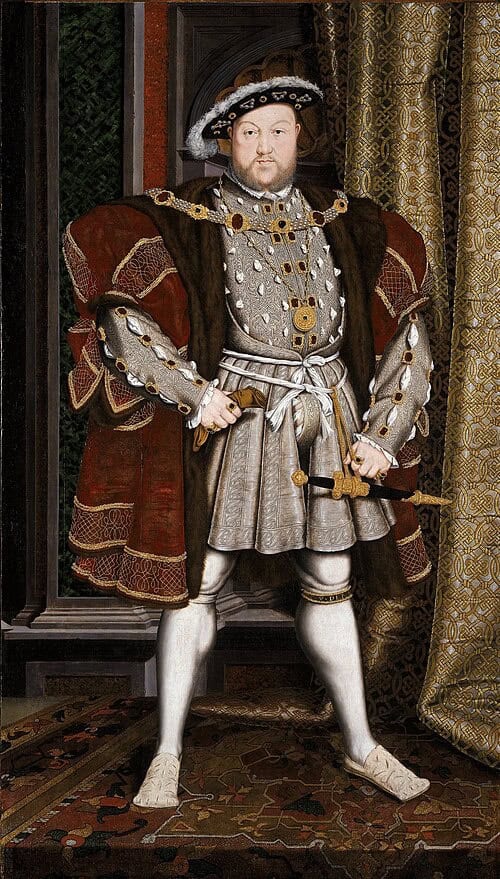
Even suits of armour were built with a codpiece, though you’d think that would be the last part of the body a man would wish to be so prominent in battle. In fact, most codpiece-enhanced armour was only ceremonial. Henry’s armour so effectively demonstrated the King’s virile power that as late as the 18th century, when it was put on show, visitors would stick pins into its lining in hopes of improving their fertility.

The codpiece enjoyed a long reign, but by 1570 it had all but disappeared. Under Elizabeth I, men’s clothing had shorter tops with pointed stomachers and even shorter bottoms to reveal yet more shapely leg. The original use of the codpiece was forgotten. It became smaller, and was sometimes used as a purse. It also became an object of ridicule. What the textual note in my school Shakespeare didn’t tell me was that when the Fool calls Kent a codpiece, he is making fun of him, in the manner of “Here he is, all mouth and trousers”.

Meanwhile, braies were replaced by narrower drawers, buttoned in front and laced in the back for a snug fit. These were still issued to British troops in WW2, although Combinations – the all-in-one undergarment buttoned up the front with a flap in the back – which appeared in the 1860s, were also issued.

By contrast, American troops were issued undershorts with elastic waistbands, which had been developed in the 1930s. These didn’t become common in the UK until the late 50s, and were never as popular here as Y-Fronts, also an American invention.
But good things come to those who wait. I’m happy to report that the codpiece has been reincarnated! It’s now called a padded thong or string, but Henry VIII would recognize it.

Who says history doesn’t repeat itself?
GL Robinson is a retired French professor who has had a lifelong interest in history – not so much the big events, but the the everyday lives of everyday people. She began writing Regency Romances when she was 72, and, now approaching her 80th birthday, has published 21 so far. Her novels are available on Amazon. More information is available on her website: https://romancenovelsbyglrobinson.com.
Published: 6th November 2026