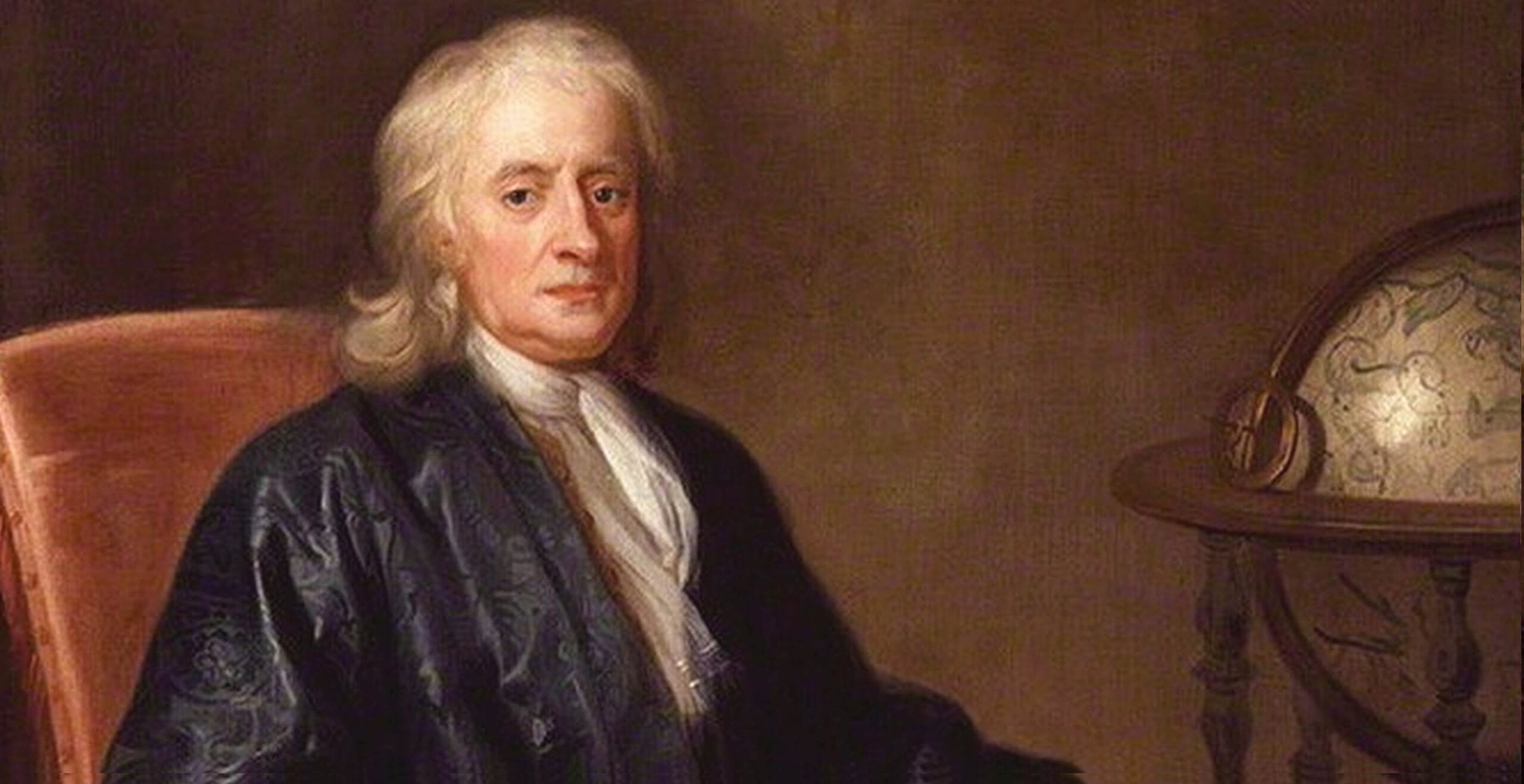


Most people across the globe will have heard of Albert Einstein. Well, good ole’Albert displayed just three portraits on his study wall: the images of the great British scientists Sir Isaac Newton, James Clerk Maxwell and Michael Faraday. So, who this Michael Faraday that so impressed Einstein?
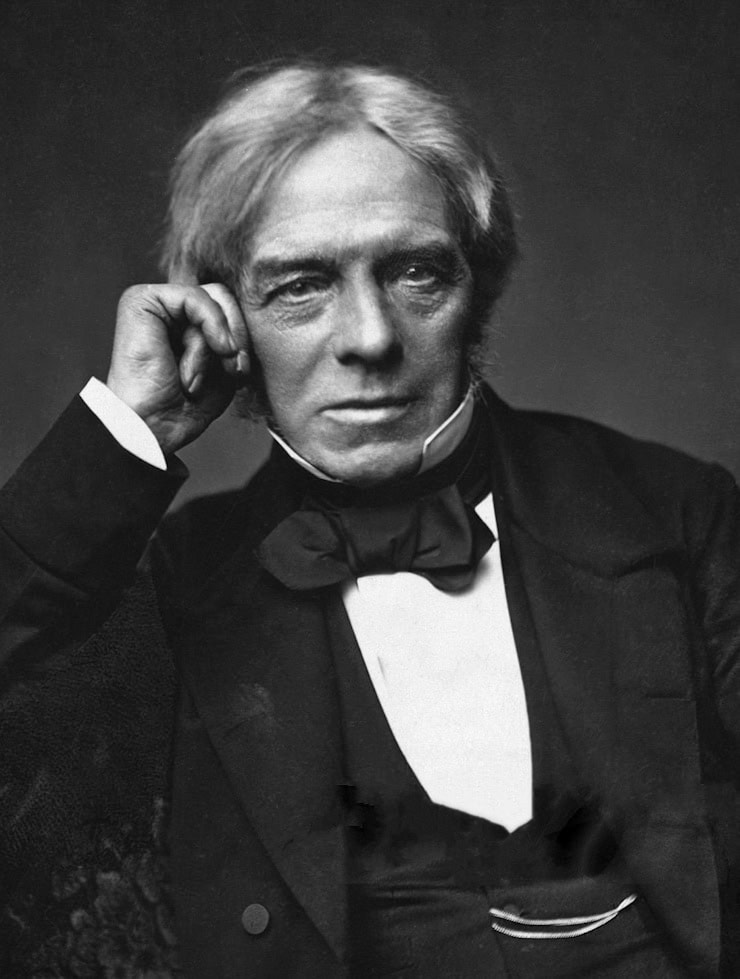
Michael was born on 22 September 1791 in Newington Butts, now part of the London Borough of Southwark. His family were relatively poor. His father, James, was a blacksmith, but bouts of sickness often prevented him from working. The third of four children, the young Michael received only the most basic school education and subsequently had to educate himself.
Luckily for Michael it appears that somebody was watching out for him, as at the tender age of 14 he found gainful employment as an apprentice to a local bookbinder and bookseller.
During his seven-year apprenticeship, Michael had all the books he needed to learn about his favourite subject, science. During this period, Michael also attended lectures about various subjects at the City Philosophical Society, keeping his ever-enquiring mind well fed.
In 1812, at the age of 20 and having completed his apprenticeship, Michael attended lectures by the distinguished English chemist Humphry Davy of the Royal Institution and the Royal Society. Michael had been gifted the tickets by one of members of the Philosophical Society. Listening intently, Michael scribbled notes and later sent Davy a 300-page book that he had compiled from the lectures.
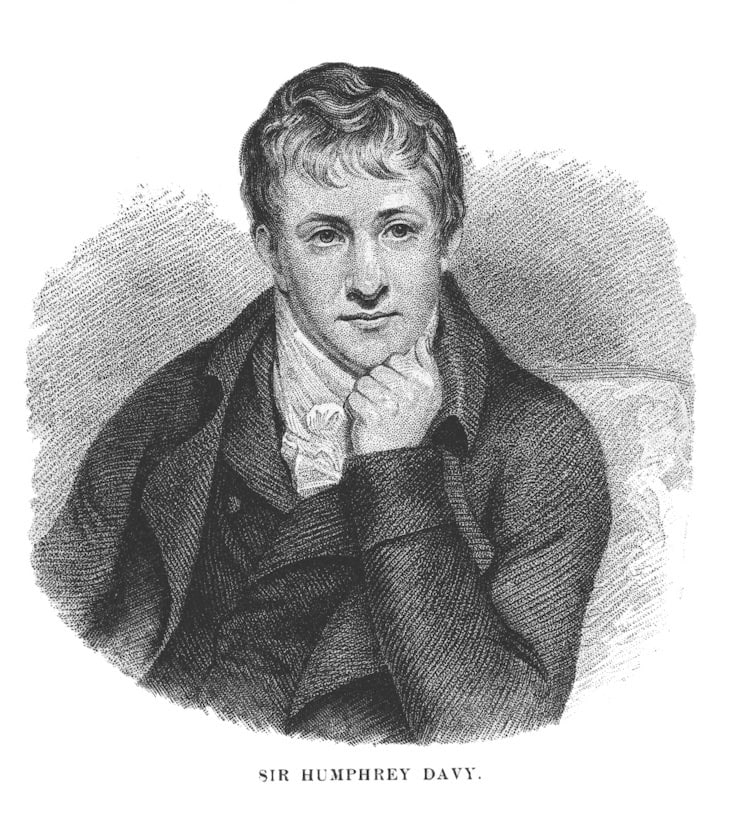
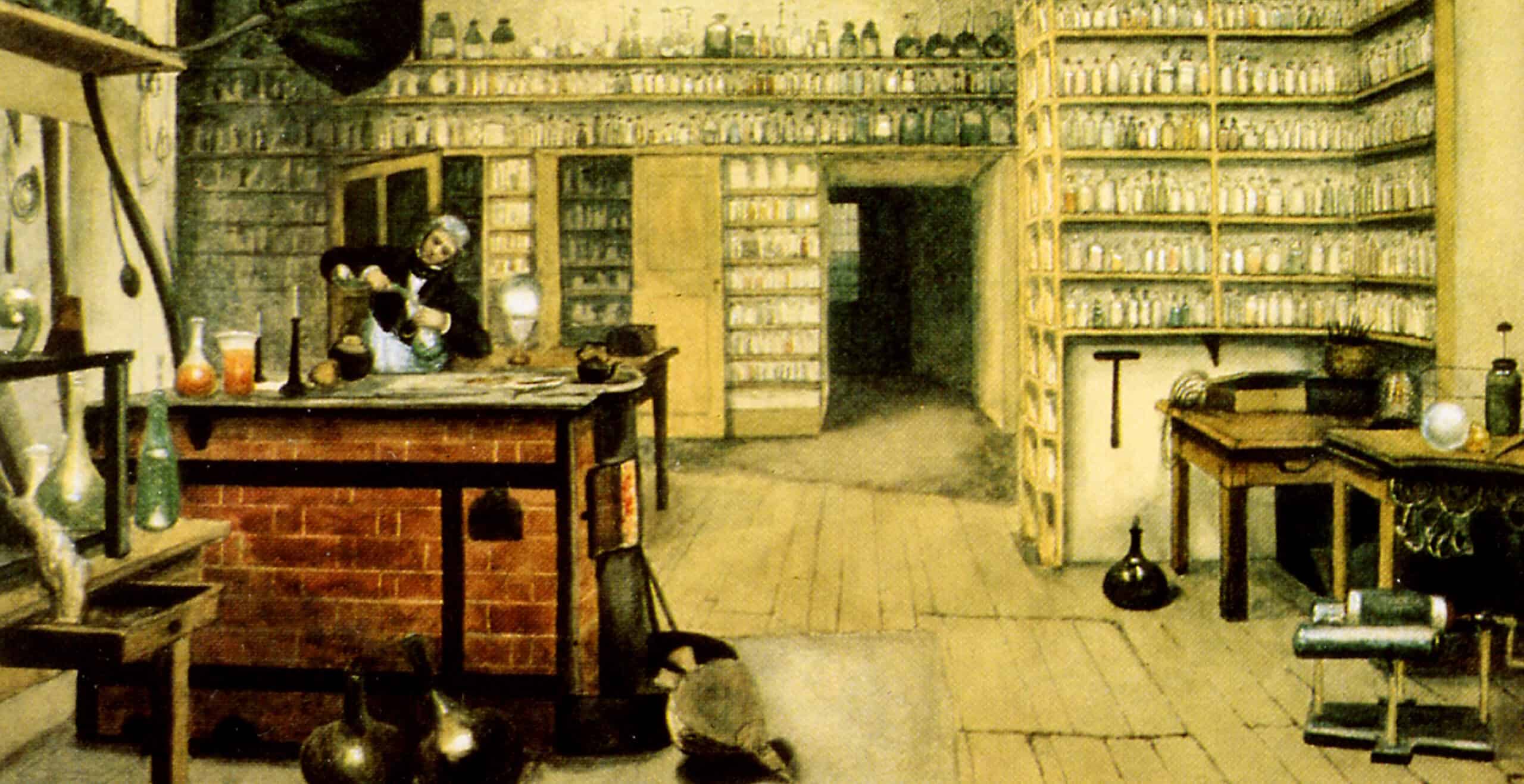
Davy was obviously impressed as he immediately offered Michael a position as a Chemical Assistant at the Royal Institution. During his time as an assistant, Michael invented what we all recognise today as the Bunsen burner; his extensive work in the field of chemistry led to the discovery of new elements such as Benzene. He also contributed significantly to the liquefying of gases such as chlorine. Oh, and not forgetting that he also helped to add some important names to the dictionary such as anode, cathode, electrode and ion.
Michael is however, best known for his work on electricity and magnetism. His early experiments and inventions laid the foundation of modern electromagnetic theory. His education was greatly enhanced when he accompanied Davy on an 18-month tour of Europe. It was during this trip that Michael was introduced to the research of fellow European scientists, such as Ampere, Arago, and Oersted, who were also working on electromagnetism.
On their return in 1815, Michael continued to work at the Royal Institution and in 1821, he published his work on electromagnetic rotation (the principle behind the electric dynamo, the ancestor of modern power generators and the electric motor).
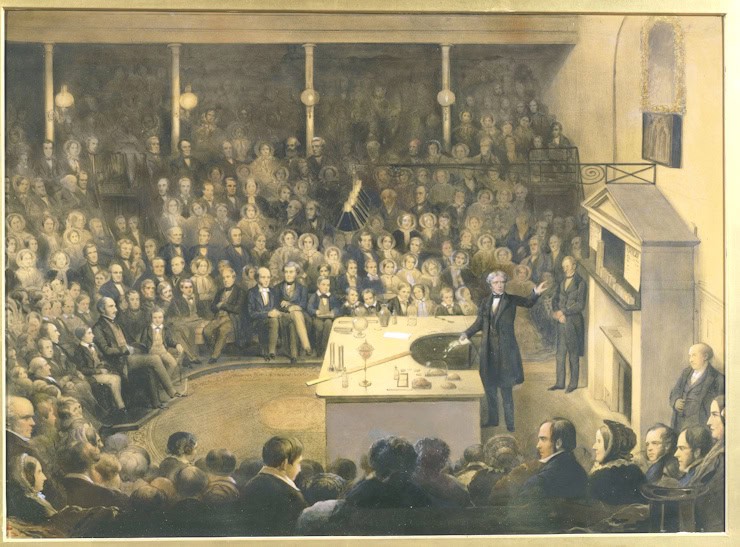
In 1826, he founded the Royal Institution’s Friday Evening Discourses and in the same year the Christmas Lectures for young people, both of which continue to this day. He himself gave many lectures, establishing his reputation as the outstanding scientist of his day.
Two years after the death of Davy in 1831, Michael recorded in his laboratory diary that he was “making many experiments with the great magnet of the Royal Society”. This was also the year that Michael discovered electromagnetic induction, the principle behind the electric transformer and generator, which consisted of a copper disk rotating between the poles of a magnet. This discovery was crucial in allowing electricity to be transformed from a mere scientific curiosity into a powerful new force.

Drawing of Michael Faraday’s 1831 experiment showing electromagnetic induction between coils of wire, using 19th century apparatus, from an 1892 textbook on electricity. On the right is a liquid battery that provides a current that flows through the small coil of wire (A) creating a magnetic field. When the small coil is stationary, no current is induced. However, when the small coil is moved in or out of the large coil (B), the change in magnetic flux induces a current in the large coil. This is detected by the deflection of the needle in the galvanometer instrument (G) on the left.
In 1836, Michael demonstrated his now famous Faraday Cage. Faraday cages work because an external electrical field will cause the electric charges within the cage’s conducting material to be distributed in a way that cancels out the field’s effect inside the cage. Amongst many other uses, car and airplane passenger compartments are essentially Faraday cages, protecting passengers from electric charges such as lightning.
Beyond his scientific research into areas such as chemistry, electricity and magnetism at the Royal Institution, Michael undertook numerous other projects for private enterprises and the British government. The list is far too long to cover in this short biography, however they included:
Investigations into explosions in coal mines
Operation of the lighting for lighthouses.
Protection of ships hulls, and
Advising the National Gallery on the cleaning and protection of its art works.
A devout Christian, when asked by the government to advise on the production of chemical weapons for use in the Crimean War (1853–1856), Michael refused to participate, citing ethical reasons.
Michael married Sarah Barnard (1800–1879) on 12 June 1821, but they had no children.
As Michaels’s health began to deteriorate, he did less research and eventually died on 25 August 1867, aged 75, in his grace and favour home at Hampton Court. Michael had been given the official lodgings in recognition of his significant contribution to science.
Having had some years before turned down an offer of burial in Westminster Abbey upon his death, Michael was finally put to rest at Highgate Cemetery in London.
Published: 24th November 2026