

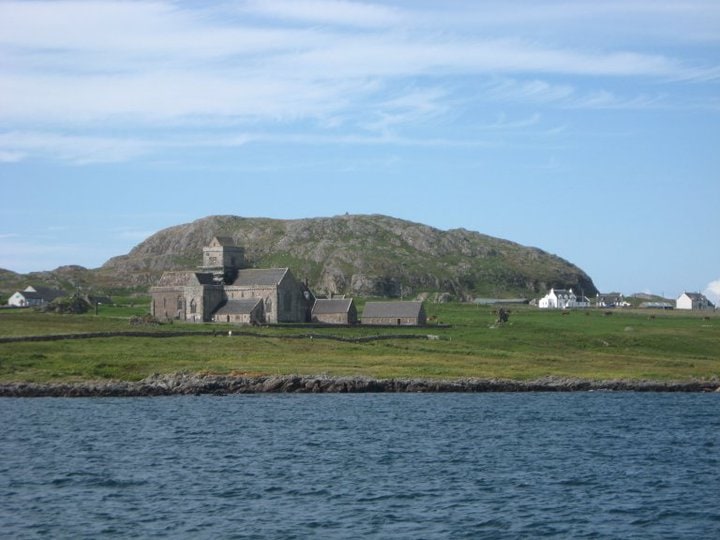
Lying off the west coast of the Isle of Mull the tiny Isle of Iona, barely three miles long by one mile wide, has had an influence out of all proportion to its size on the establishment of Christianity in Scotland, England and throughout mainland Europe.
Iona’s place in history was secured in 563 AD when St. Columba arrived on its white sandy beaches with 12 followers, built his first Celtic church and established a monastic community.
Once settled, the Irish monk set about converting most of pagan Scotland and northern England to the Christian faith. Iona’s fame as a missionary centre and outstanding place of learning eventually spread throughout Europe, turning it into a place of pilgrimage for several centuries to come. Iona became a sacred isle where kings of Scotland (48), Ireland (4) and Norway (8) were buried.
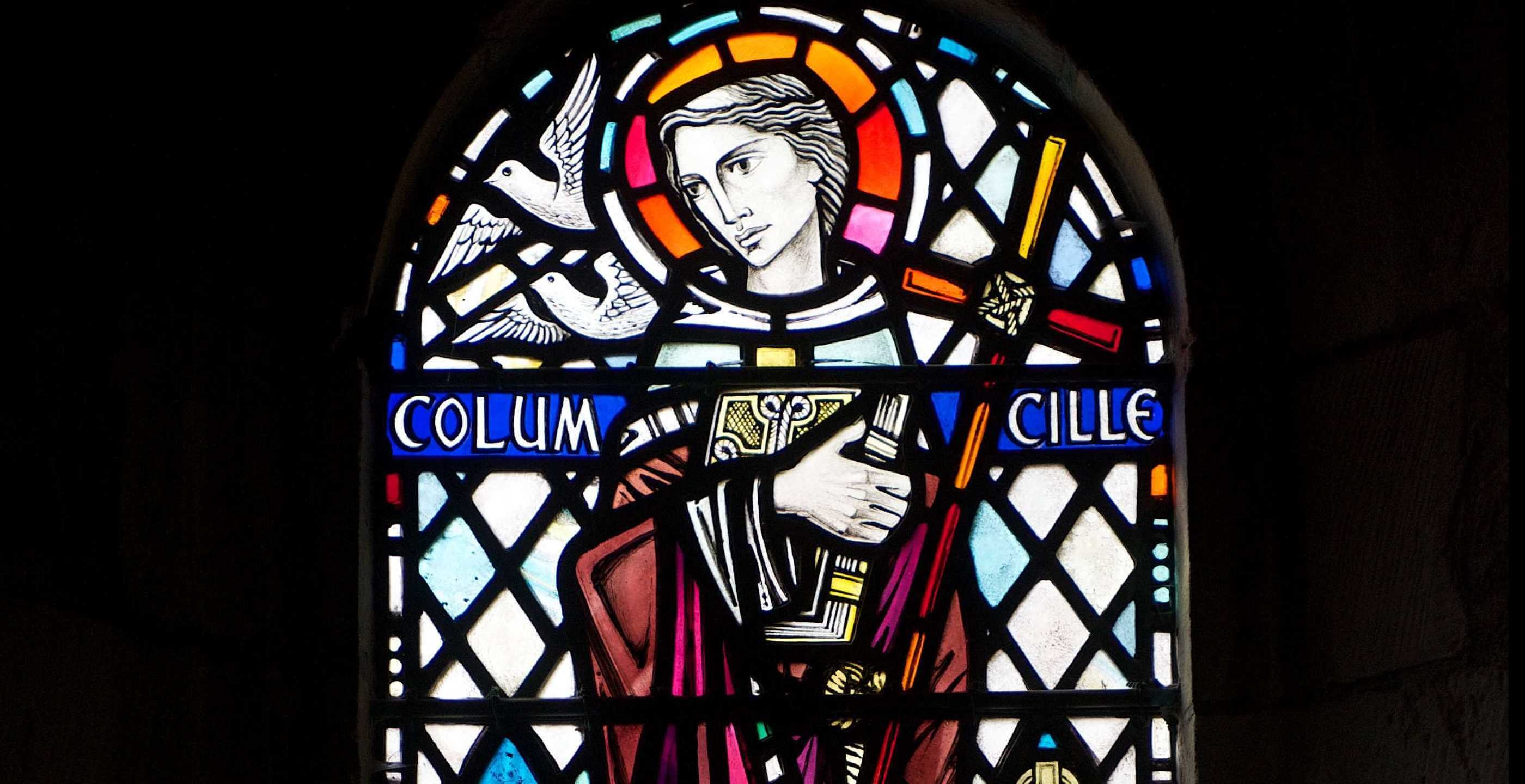
So who was St. Columba or Colum Cille in Gaelic…? Born of royal blood in 521 AD in Ireland, or Scotia as it was then called, he was the grandson of the Irish King Niall. He left Ireland for Scotland not as a missionary but as an act of self-imposed penance for a bloody mess he had caused at home. He had upset the king of Ireland by refusing to hand over a copy of the Gospels he had illegally copied, this led to a pitched battle in which Columba’s warrior family prevailed. Full of remorse for his actions and the deaths he had ultimately caused he fled, finally setting on Iona as the first place he found from where he couldn’t see his native Ireland. One of the features on the island is even called “The Hill with its back to Ireland”.
St. Columba however, was not the shy retiring type and set about building Iona’s original abbey from clay and wood. In this endeavour he displayed some strange idiosyncrasies, including banishing women and cows from the island, claiming that “where there is a cow there is a woman, and where there is a woman there is mischief”. The abbey builders had to leave their wives and daughters on the nearby Eilean nam Ban (Woman’s Island). Stranger still, he also banished frogs and snakes from Iona. How he accomplished this feat is not as well documented.
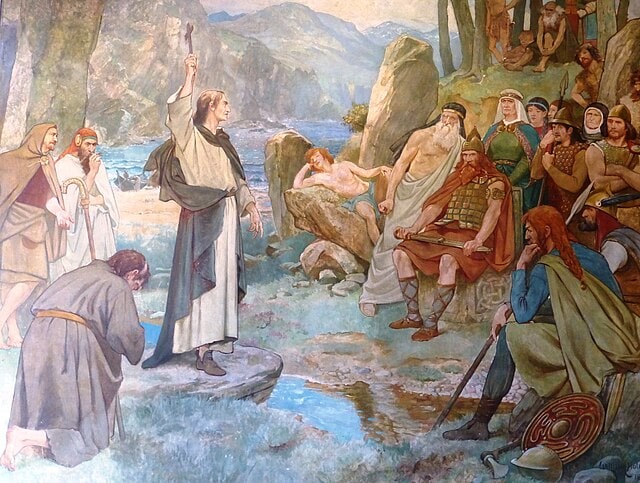
The strangest claim of all however is that Columba was prevented from completing the building of the original chapel until a living person had been buried in the foundations. His friend Oran volunteered for the job and was duly buried. It is said that Columba later requested that Oran’s face to be uncovered so he could bid a final farewell to his friend. Oran’s face was uncovered and he was found to be still alive but uttering such blasphemous descriptions of Heaven and Hell that Columbus ordered that he be covered up immediately!
Over the centuries the monks of Iona produced countless elaborate carvings, manuscripts and Celtic crosses. Perhaps their greatest work was the exquisite Book of Kells, which dates from 800 AD, currently on display in Trinity College, Dublin. Shortly after this in 806 AD came the first of the Viking raids when many of the monks were slaughtered and their work destroyed.
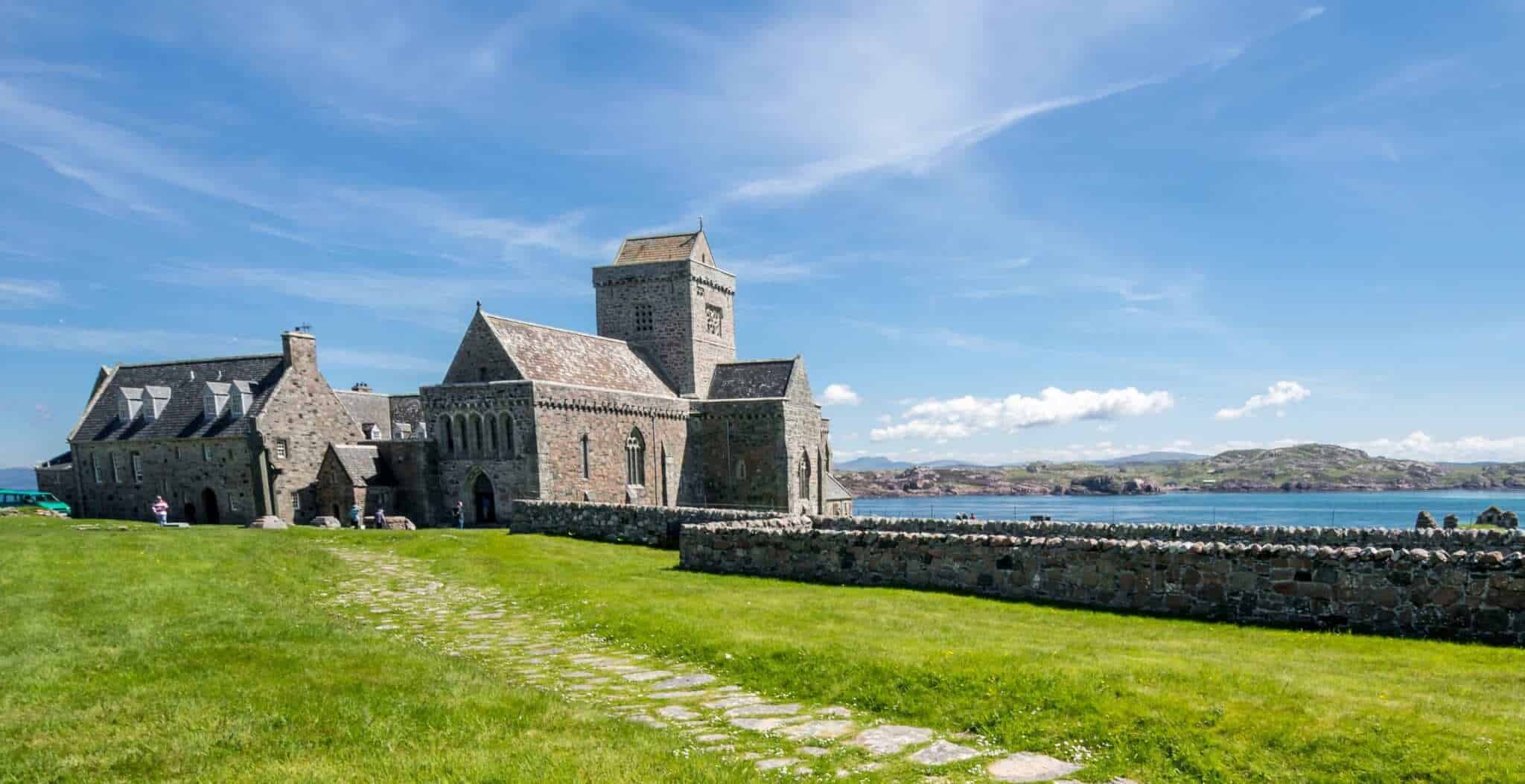
The Celtic Church, lacking central control and organisation, diminished in size and stature over the years to be replaced by the much larger and stronger Roman Church. Even Iona was not exempt from these changes and in 1203 a nunnery for the Order of the Black Nuns was established and the present-day Benedictine Abbey was built. The Abbey was a victim of the Reformation and lay in ruins until 1899 when its restoration started.
No part of St. Columba’s original buildings have survived, however on the left hand side of the Abbey entrance can be seen a small roofed chamber which is claimed to mark the site of the saint’s tomb.
How to get there:
Passenger ferry form Fionnphort on the Isle of Mull. Ferries to the Isle of Mull from Oban, Lochaline and Kilchoan on the Ardnamurchan peninsular.