

Why is it that when Scotland’s national drink is enjoyed and revered the world over, its national dish is often the butt of the national joke?
Ask any Scotsman the age old question “What is a haggis?” and his typical response would be something like…“It’s a small four legged creature that lives in the Highlands and has two legs shorter than the others so it can run around the mountains without toppling over. It can easily be caught by running around the hill in the opposite direction.”
Well it appears that the national joke is now beginning to backfire a little, as according to a recent on-line survey, one-third of American tourists visiting Scotland thought that a haggis was a wild animal and almost a quarter arrived in Scotland thinking they could catch one!
So, if you wish to preserve your belief in little furry creatures, or if you have just purchased tickets for a “Wild Haggis Hunt”, please do not read any further!
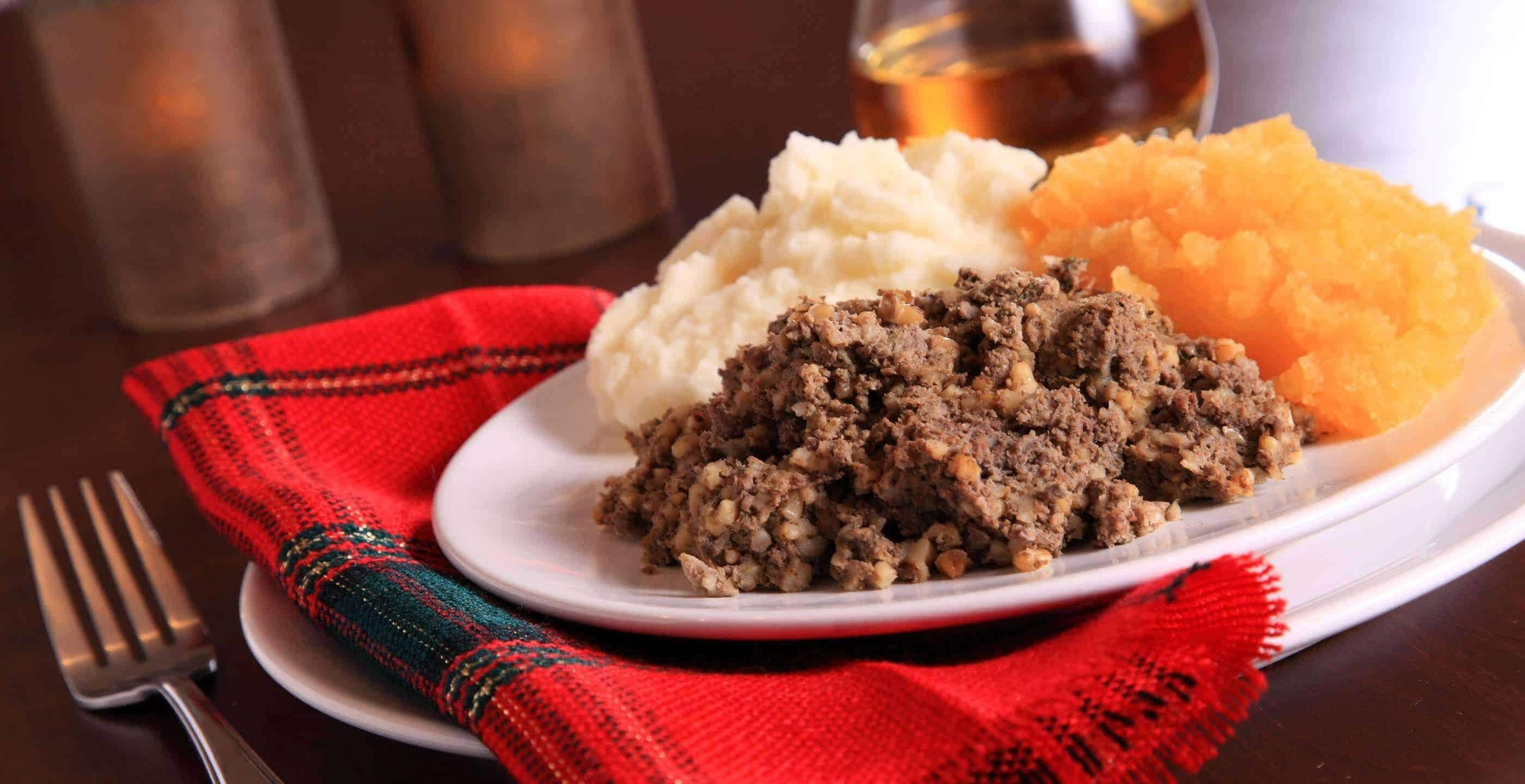
Perhaps it is because the truth is a little more frightening than fiction, and too much for a Scotsman to admit that his national dish consists of a sheep’s stomach stuffed with diced innards. Haggis is typically served with root vegetables; otherwise known as haggis with mashed tatties (potatoes) and neeps (turnips).
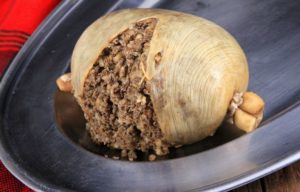
To be a little more precise, a haggis is normally made up of the following ingredients: a sheep’s ‘pluck’ (its heart, liver and lungs), minced with onions, oatmeal, suet, salt and spices, all mixed with a stock and traditionally boiled in the animal’s stomach for around an hour. As unpleasant as this may sound, the end result is a culinary masterpiece which should of course be washed down with a ‘dram’ of the national drink.
The exact historical origins of this great national dish appear to have been lost in the mists of time. Some claim that the dish originates from the days of the old Scottish cattle drovers, when the men would leave the Highlands to drive their cattle to market in Edinburgh and the women would prepare a ‘ready meal’ for them to eat on the long journey through the glens. Others have speculated that the first haggis was carried to Scotland aboard a Viking longboat.
Yet another theory ties the dish to pre-historic origins, as a way of cooking and preserving offal that would otherwise quickly spoil following a hunt. This was done by dicing the ‘pluck’ and then stuffing this and whatever other ingredients were available into the stomach, immersing the bundle in the water contained within the skin of the beast and then boiling for an hour or two. Nice and tidy, no washing-up required!
Traditionally a Clan Chieftain or Laird may have had an animal or two killed for a particular feast, the offal being passed to the slaughterman as his payment. Haggis was always a popular dish for the poor, cheap cuts of nourishing meat that would otherwise have been thrown away.
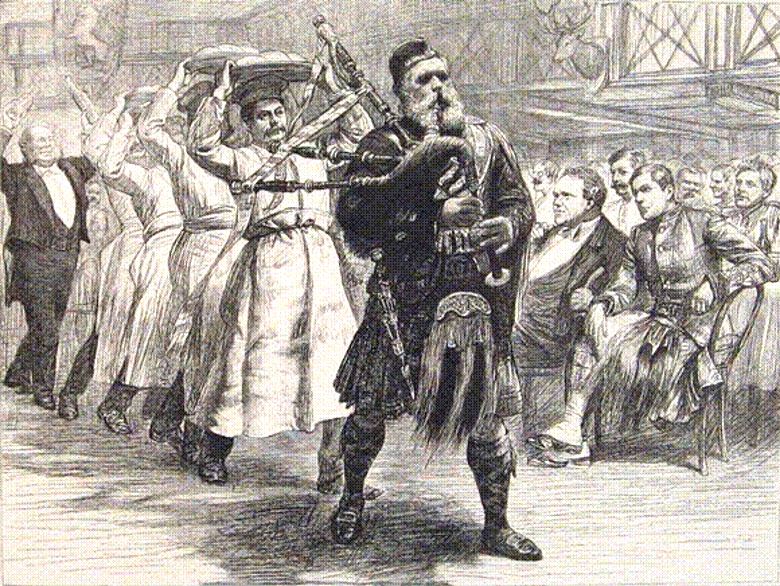
Whatever its historic origins, the haggis is now as firmly established as a Scottish national icon as the much revered whisky, and much of this fame can be directly attributed to Scotland’s national poet.
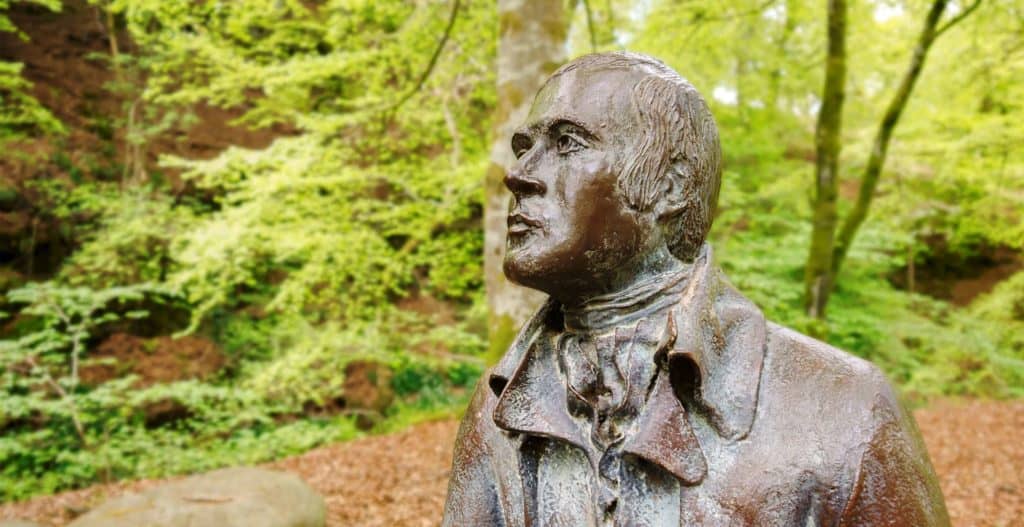
Haggis forms an integral part of the Burns supper celebrations that take place around the world each year on 25 January, when Scotland’s national poet Robert Burns is commemorated. Burns immortalised the haggis in his poem Address to a Haggis, which starts “Fair fa’ your honest, sonsie face, Great chieftain o’ the pudding race!”.