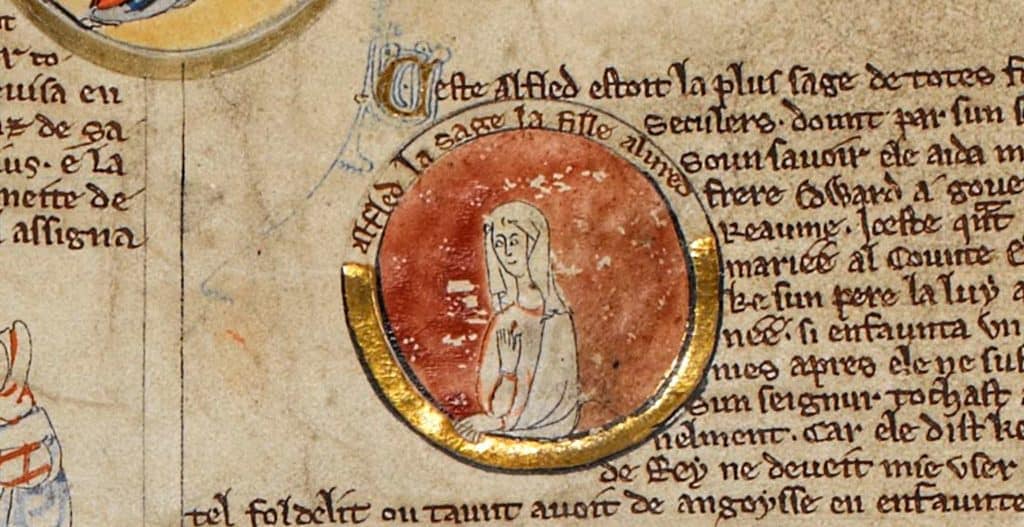

The battle that defined Britain.
When you think of pivotal battles that shaped the course of Britain, what first comes to mind? The Battle of Hastings and the Norman invasion in 1066? The Battle of Agincourt? Perhaps it’s the Battle of Bosworth Field that ended the Wars of the Roses in 1485? Whatever it might be, the chances are that The Battle of Brunanburh wasn’t the first that sprung to mind!
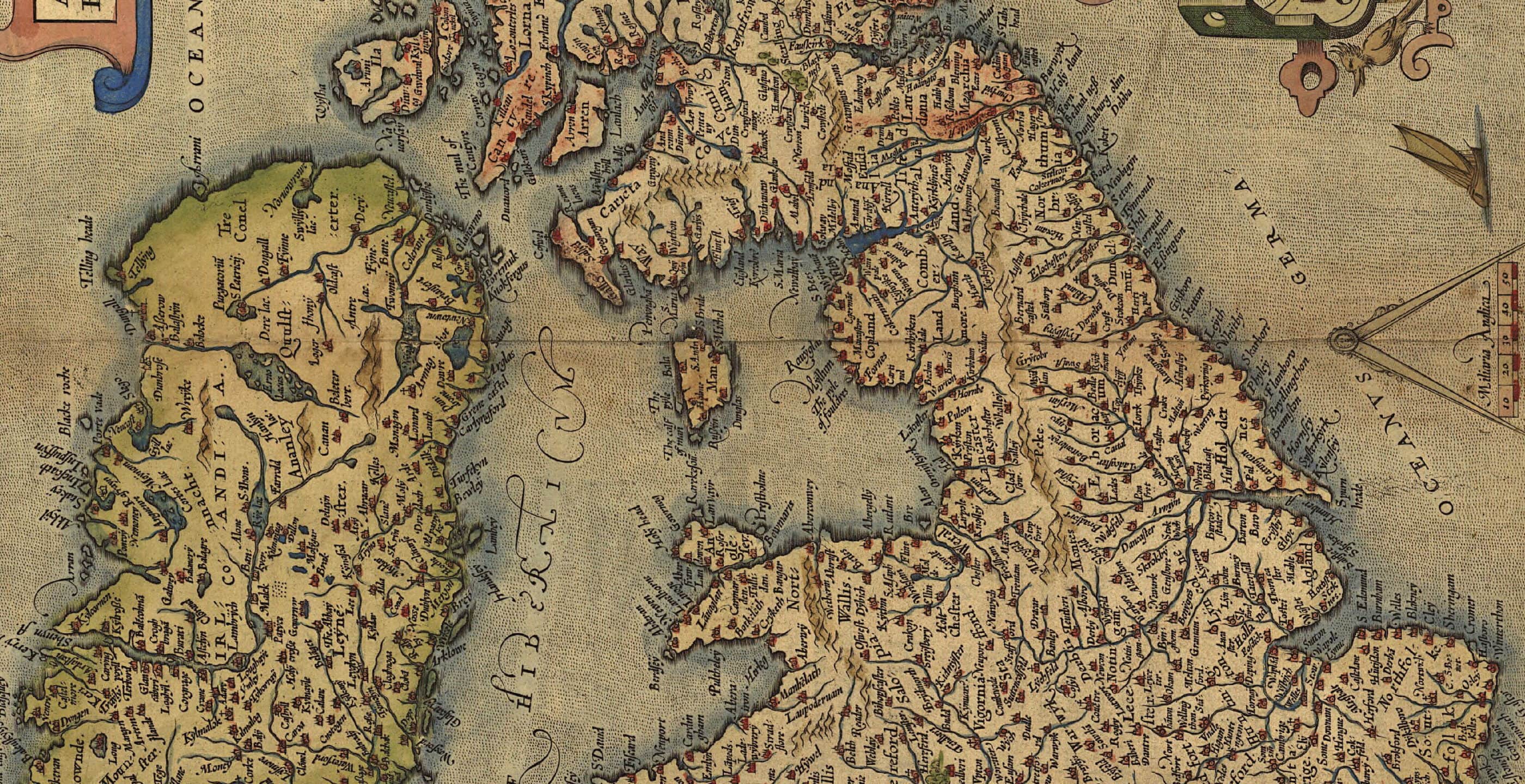
Curiously, it was The Battle of Brunanburh that defined the countries that we now know as England, Scotland and Wales. At the time of the battle in 937, Britain was a divided nation, ruled by several Kings and Earls all vying for land and power. In the far north there were the Celts, divided into two main Kingdoms; Alba (mainly in Scotland) led by King Constantine II, and Strathclyde (nowadays SW Scotland, Cumbria and parts of Wales) ruled by Owein (aka Owain and Owen).
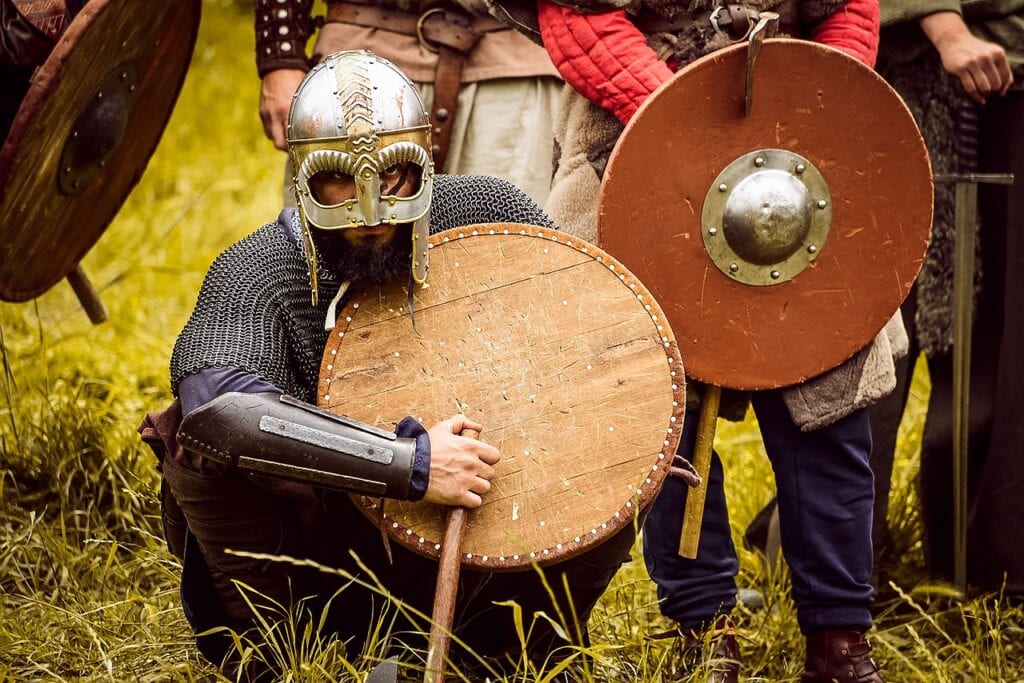
At the same time, Northern England was ruled by a set of Norse Earls of Viking decent, together known as the Earls of Northumberland. The Norse also held power over much of Ireland and were led by Olaf Guthfrithsson, the King of Dublin.
The final group, the Anglo Saxons, controlled the majority of central and southern England. Headed up by King Aethelstan of Wessex, the Anglo Saxon fiefdoms at this time were merely an alliance and not yet united under a single King.
Since the late 8th century, invading Vikings from Scandinavia had been pushing southwards and encroaching into Anglo-Saxon territory. At the same time, the Anglo-Saxons had been consolidating their territory in the south, forging alliances between the fiefdoms, holding the Vikings back from the north and pushing the Celts further into the west. All of this came to a head in 928, when the Anglo Saxons led by Aethelstan attempted to repel further Viking encroachment by taking a pre-emptive strike against the Viking Kingdom of York.
The battle was a victory for the Anglo-Saxons, although this led the nearby Celtic King Constantine II to become increasingly concerned over his monarchy; after all, if Aethelstan had attacked the Vikings at York, what would stop him continuing north and challenging Celtic territory? He immediately reacted, and began forging links with neighbouring kingdoms. To build links with the Norse, Constantine married his daughter to Olaf Gutherfrithsson, the King of Dublin. This in turn brought both the Irish and Northumbrian Norsemen under his alliance.
Building links with the neighbouring Celtic kingdom was much easier, as Owein of Strathclyde was related to Constantine and took little persuasion to join in a pre-emptive strike against Aethelstan.
Constantine had built an army…
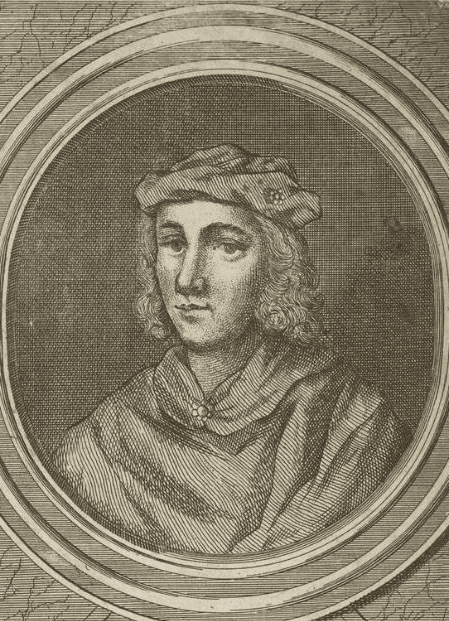
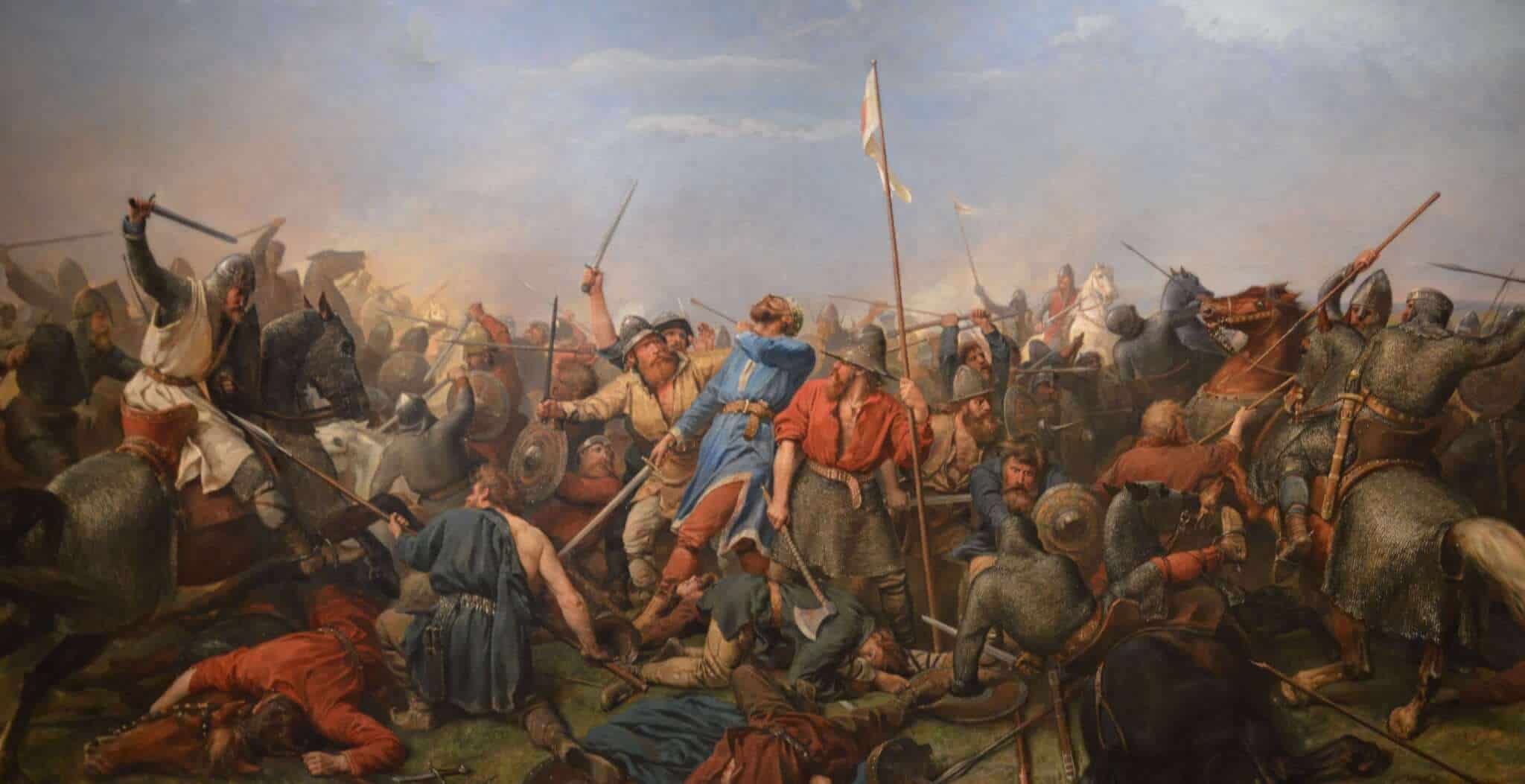
In 937 this newly formed Celtic/Norse army began marching south into England, seeking battle against Aethelstan. At the same time, and in no doubt due to years of previous alliance building, Aethelstan was able to bring together the Anglo Saxon noblemen and armies with relative ease. It was in the summer of 937 that the two armies met at Brunanburh for what was to be one of the bloodiest battles ever held on British soil, as detailed in the Anglo-Saxon Chronicle:
Much is still unknown about the battle – historians are even divided on where Brunanburh is actually located! Many suggestions for the location have been made, ranging from Bridgnorth in Shropshire, to Doncaster in South Yorkshire; from close to the Wyre Estuary in Lancashire, to somewhere in Northamptonshire. The strongest contender for Brunanburh however seems to be the village of Bromborough on the Wirral, where the Viking longships from Dublin could perhaps more easily have put ashore.
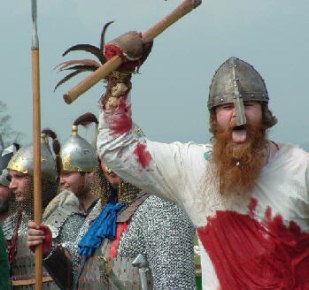
We do know however that the Celtic/Norse army dug themselves into the battlefield with timber-fortified trenches, although these defences were quickly overrun. What is also interesting, albeit hotly debated, is that the Battle of Brunanburh may well have been the first instance of a British Army ever using cavalry in battle, although this has yet to be indisputably proven.
Accounts do say that the fighting at Brunanburh lasted all day, however the English slowly gained the upper hand and the invaders finally broke and fled. Aethelstan and his army pursued them until nightfall… ‘hewing the fugitives grievously from behind with swords sharp from the grinding’. Anlaf made for the safety of his ships and sailed home with what was left of his army, arriving back in Dublin in the spring of 938. Constantine escaped to Scotland and abdicated a few years later, it is likely that Owein was also killed in the battle. Five minor kings along with seven Viking earls and one of Constantine’s sons were killed together with many of their followers.
What is known is that Aethelstan and the Anglo-Saxon armies had sealed victory, securing the northern borders of England and containing the Celts to the west. The English had also paid a heavy price for their victory; two of Aethelstan’s cousins had been slain, along with two bishops and what the Annals of Ulster described as ‘a multitude’ of lesser men.
Perhaps even more importantly, Aethelstan had united the two major Anglo-Saxon kingdoms of Wessex and Mercia, thus creating a single and unified England, a nation that has remained until this very day.
Published: 25th November 2014. Edited: 24th August 2025.