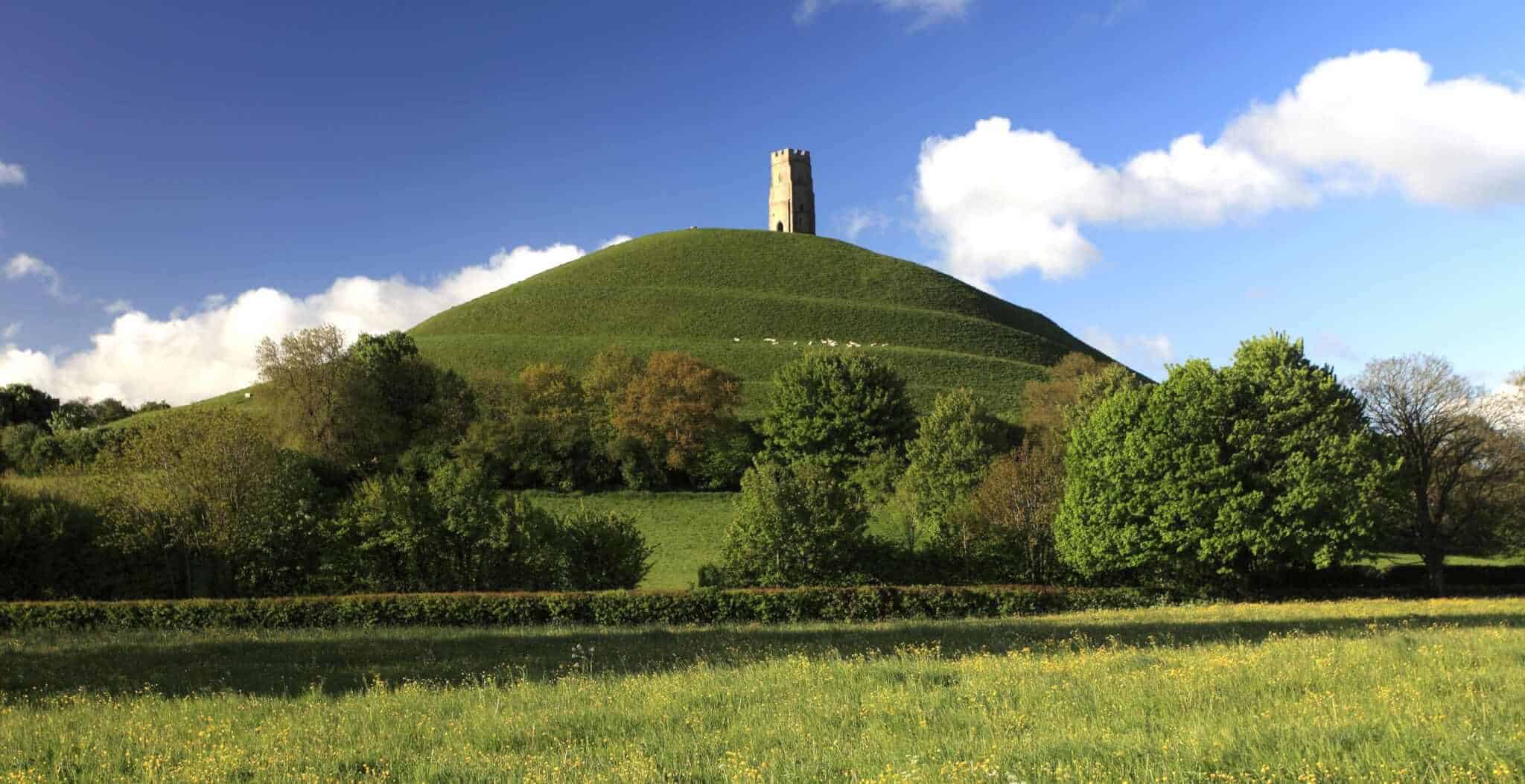


Dominating the skyline in this part of the beautiful county of Somerset you will find dramatic Glastonbury Tor.
In Glastonbury, history, myth and legend combine in such a way that most visitors cannot fail to feel the “vibes” and powerful atmosphere of the town. For not only is Glastonbury the cradle of Christianity in England but is also reputed to be the burial place of King Arthur.
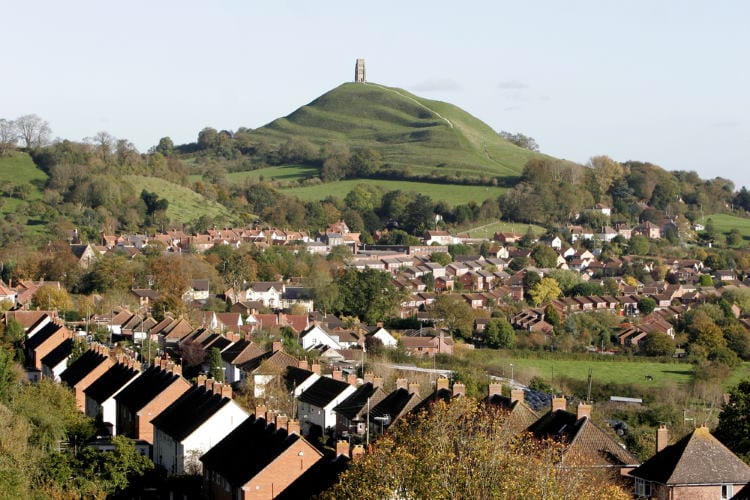
Glastonbury is thought to have been a site for pre-Christian worship, perhaps because of its location by the Tor, the highest of the hills surrounding Glastonbury and a superb natural viewpoint. As can be seen from the photograph, there is a form of terracing around the Tor which has been interpreted as a maze based on an ancient mystical pattern. If so, it would have been created four or five thousand years ago, around the same as time as Stonehenge. There is a ruined medieval church at the top of the Tor, the tower of which remains.
Two thousand years ago, at the foot of the Tor was a vast lake called “Ynys-witrin”, the Island of Glass. It is partly from this that the association of Glastonbury with legendary Avalon comes about, as in Celtic folklore Avalon was an isle of enchantment, the meeting place of the dead.
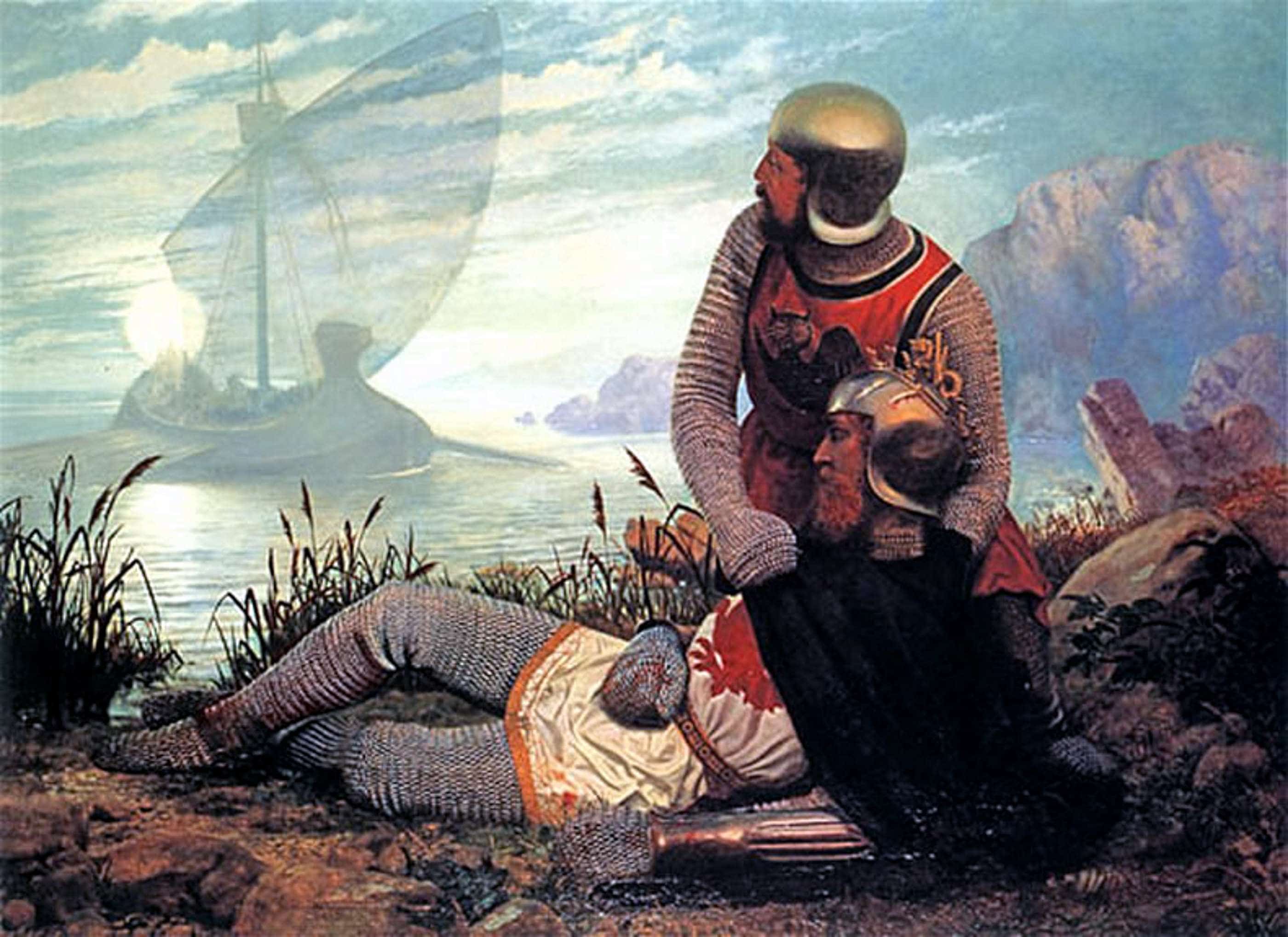
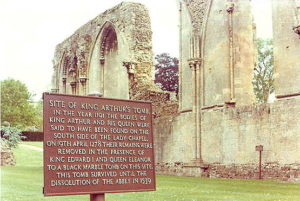
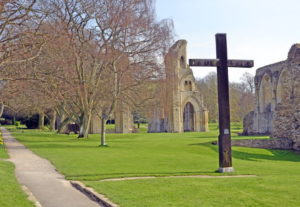
Legend has it that King Arthur, along with his wife Guinevere, are buried in the grounds of Glastonbury Abbey, south of the Lady Chapel, between two pillars. The monks of the Abbey, having heard the rumours, decided to excavate the site and unearthed a stone slab, under which was found a lead cross inscribed in Latin, “Hic iacet sepultus inclitus rex arturius in insula avalonia”, “Here lies buried the renowned King Arthur in the Isle of Avalon”. Also found were a few small bones and a scrap of hair.
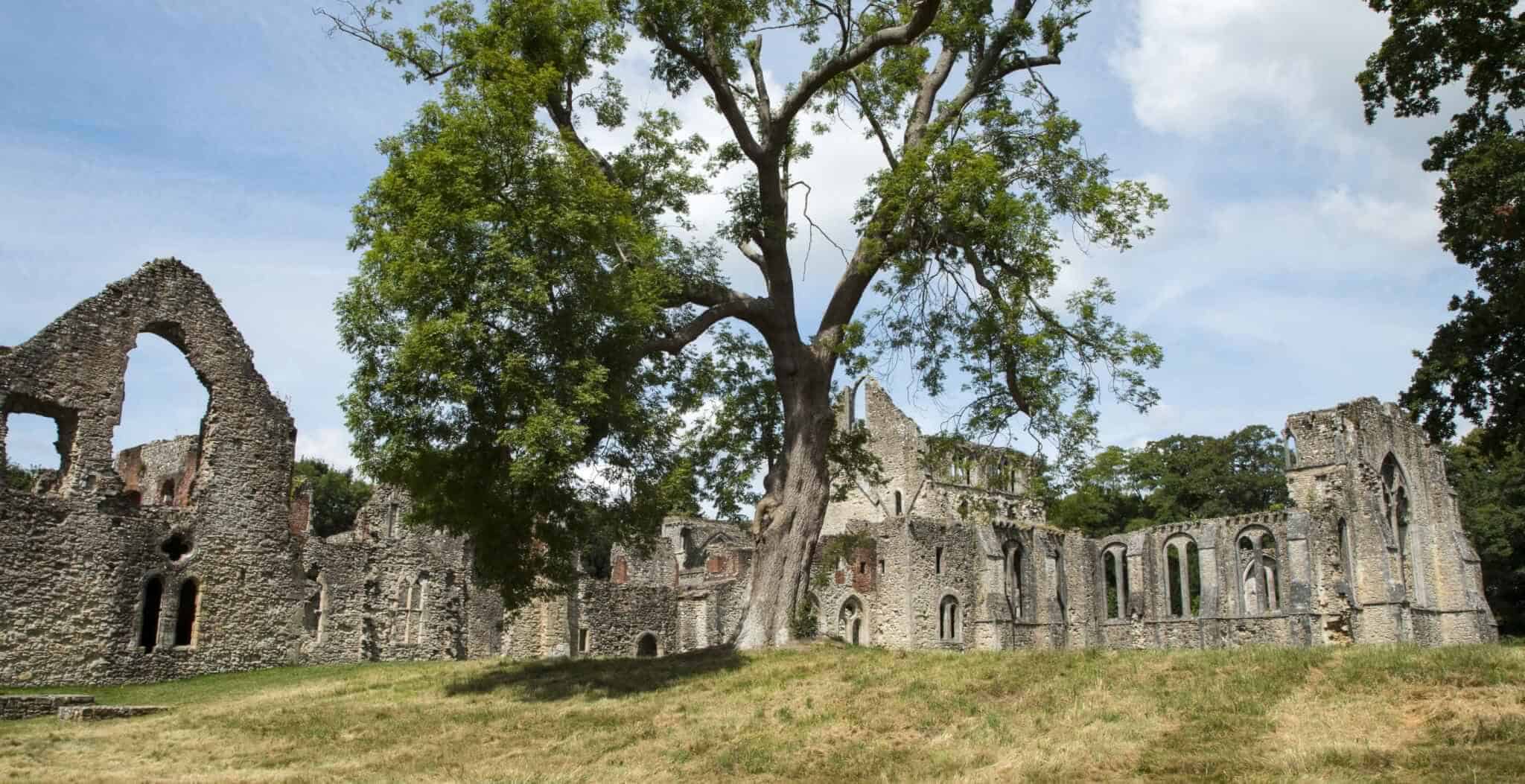
The bones were put in caskets and during a visit to the Abbey by King Edward I, were entombed in a special black marble tomb in the main Abbey Church. During the Dissolution of the Monasteries when the Abbey was sacked and largely destroyed, the caskets were lost and have never been found. Today a notice board marks the spot of Arthur’s final resting place.
The legend of the Holy Grail brings together the myths and legends of King Arthur and the story of Joseph of Arimathea building the first church at Glastonbury.The Glastonbury legend has the boy Jesus and his uncle Joseph of Arimathea building the first wattle and daub church on the site of Glastonbury Cathedral.
After the crucifixion, lore has it that Joseph travelled to Britain with the Holy Grail, the cup used by Christ at the Last Supper and later by Joseph to catch His blood at the crucifixion. Upon arriving on the isle of Avalon, Joseph thrust his staff into the ground. In the morning, his staff had taken root and grown into a strange thorn bush, the sacred Glastonbury Thorn.
Joseph is said to have buried the Holy Grail just below the Tor, where a spring, now known as Chalice Well, began to flow and the water was supposed to bring eternal youth to whoever would drink it.
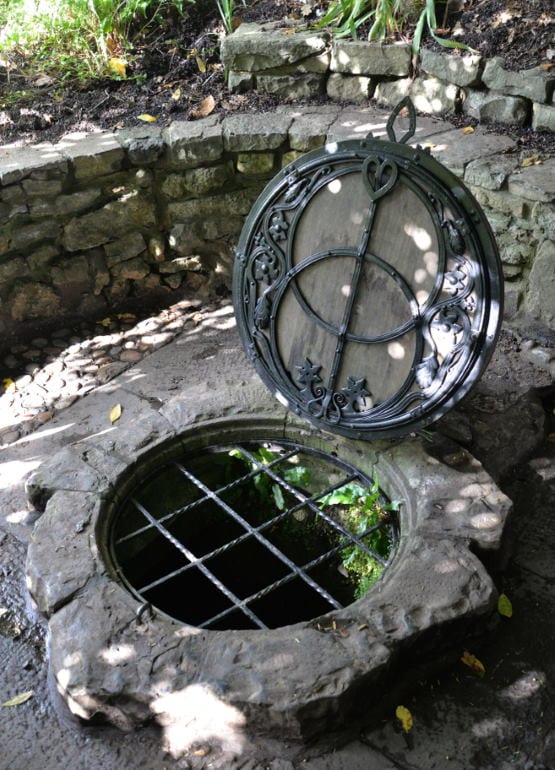
It is said that many years later, one of the quests of King Arthur and the Knights of the Round Table was the search for the Holy Grail.
The spectacular, extensive and majestic ruins of the Abbey are situated just off the town’s main High Street, where many of the shops are involved in the sale of mystical objects and artifacts. Glastonbury with its myths, legends and ley lines has become a centre for New Age culture and spiritual healing.
The town is rich with historic buildings. The Tourist Information Centre and Lake Village Museum are located in the Tribunal, a 15th century building thought to be an Abbey Court House. The Somerset Rural Life Museum is centered around a 14th century barn.
Useful Information
Tours of Historic Glastonbury
For more information concerning tours of historic Glastonbury, please follow this link.
Glastonbury Abbey, Abbey Gatehouse, Magdalene Street, Glastonbury, BA6 9EL.
Telephone 01458 832267
E-mail: info@glastonburyabbey.com
Opening hours: Winter 9.00 pm to 4.00 pm. Spring and Autumn 9.00 pm to 6.00 pm. Summer 9.00 pm to 8.00 pm.
Somerset Rural Life Museum, Abbey Farm, Chilkwell Street, Glastonbury, BA6 8DB.
Telephone 01458 831197
Opening hours: 1st April to 31st October Tuesday to Friday, Bank Holiday Mondays. Weekends 2.00 pm to 6.00 pm. Closed Good Friday. 1st November to 31st March Tuesday to Saturday 10.00am to 3.00pm. Museum shop and tea room open 22nd March to 28th September. Facilities for the disabled, baby-changing area. Free car park and coach lay-by.
The Museum of Pagan Heritage 11 -12 St Johns Square, Glastonbury, BA6 9LJ.
Telephone 01458 831 666
Getting here
Easily accessible by road, from Bristol there is a local bus to Glastonbury, please try our UK Travel Guide for further information.