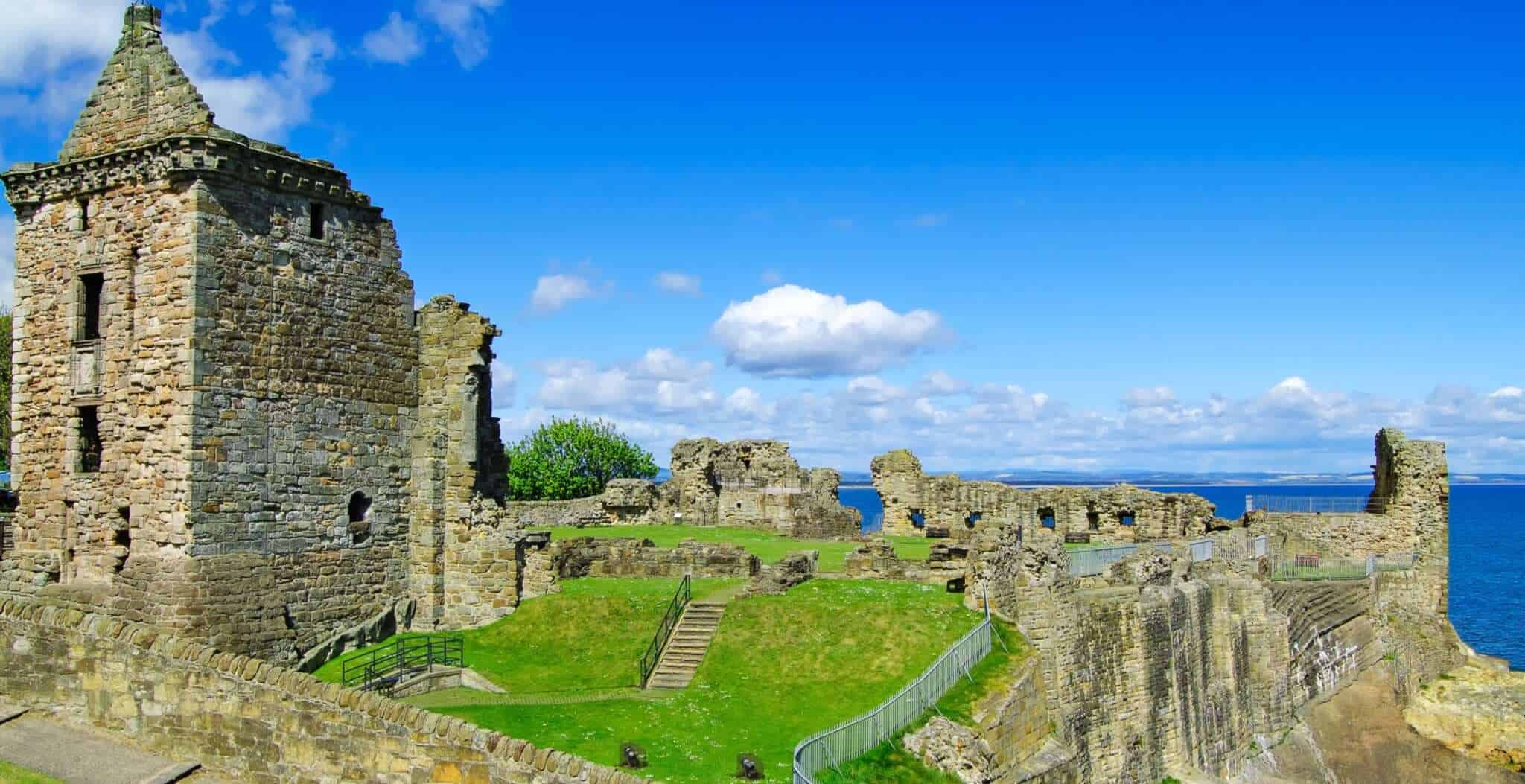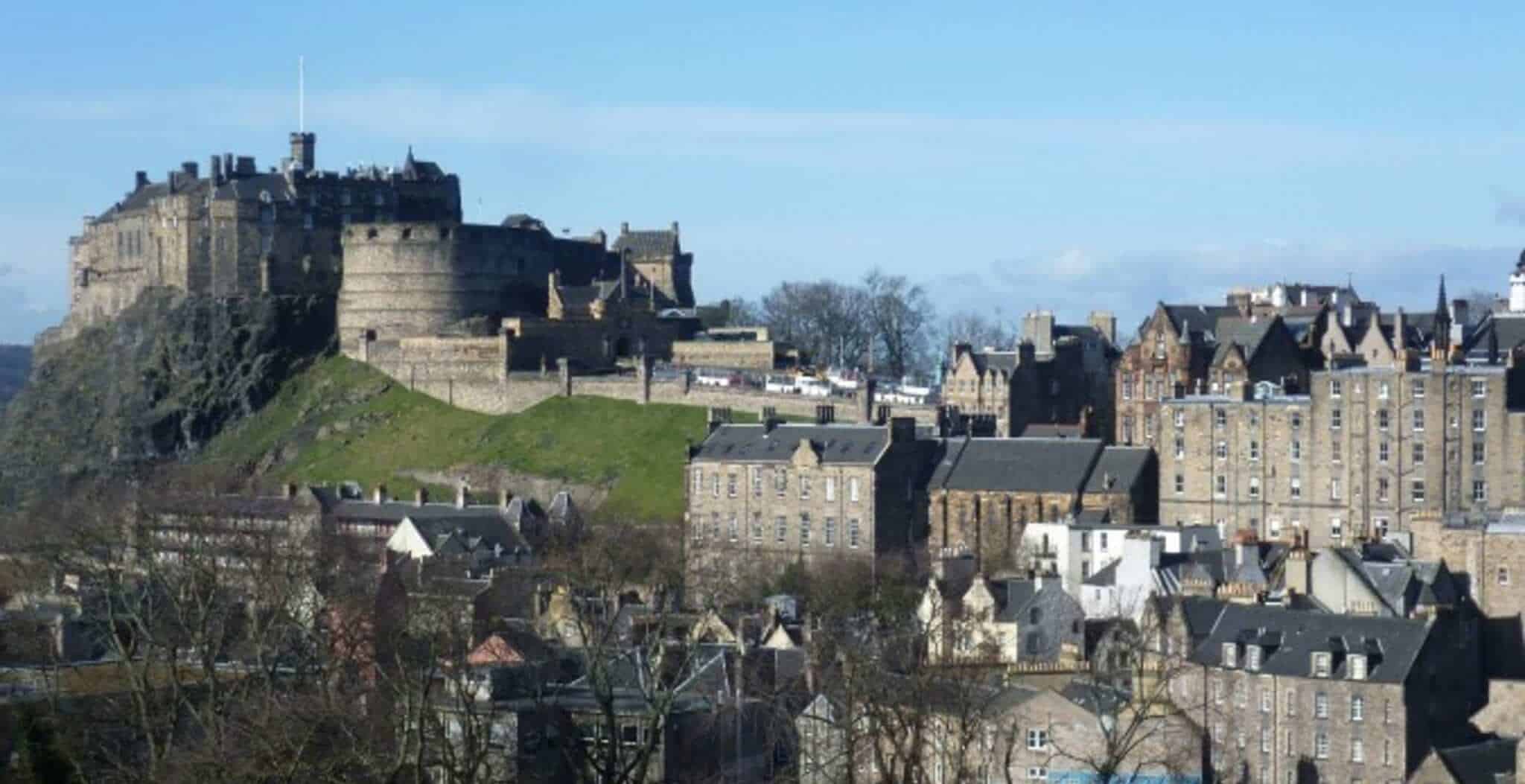


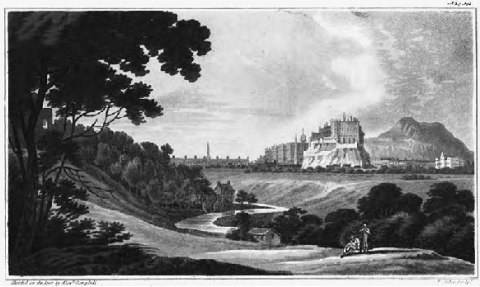
Edinburgh city lies on the east coast of Scotland, on the south bank of the Firth of Forth (the estuary that opens into the North Sea). Geologically, the Firth of Forth is a fjord, carved by the Forth glacier at the Last Glacial Maximum. The famous Edinburgh Castle is situated on the top of a volcanic rock intrusion which was resistant to erosion by the ice sheet, and so stands above the surrounding area; a perfect defensive site! The volcanic rock sheltered an area of softer bedrock from the erosive forces of advancing glaciers, creating a “crag and tail” feature where the tail is a tapering strip of the softer rock. The Old Town runs down the “tail” and the castle stands on the “crag”. The site of the city of Edinburgh was first named as “Castle Rock”.
The name “Edinburgh” is rumoured to originate from the old English of “Edwin’s fort”, referring to the 7th century King Edwin of Northumbria (and “burgh” means “fortress” or “walled collection of buildings”). However, the name probably preceded King Edwin so this is unlikely to be true. In 600 A.D. Edinburgh was referred to in the form “Din Eidyn” or “Fort of Eidyn”, when the settlement was a Gododdin hillfort. The city is also affectionately named by the Scottish as “Auld Reekie” (Reekie meaning “Smoky”), referring to the pollution from coal and wood fires that left dark smoky trails from chimneys through the Edinburgh skies. It has also been named “Auld Greekie” or the Athens of the North due to its topography; the Old Town plays a role similar to that of the Athenian Acropolis.
“Auld Greekie” also refers to Edinburgh’s role as Scotland’s intellectual and cultural centre. While most cities expanded and developed heavy industries during the industrial revolution, the expansion in the Forth region happened at Leith, leaving Edinburgh relatively untouched and confined. The history of Edinburgh has therefore survived and guaranteed Edinburgh a title as a UNESCO World Heritage Site (1995).
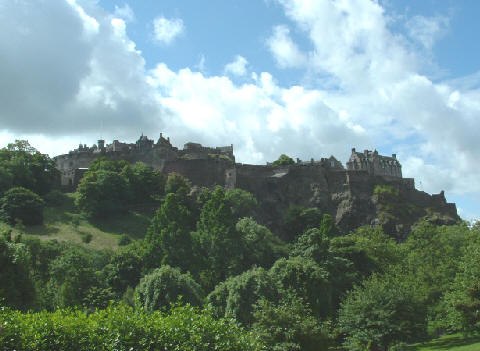
Edinburgh is defined as being the Old Town and the New Town. The New Town developed beyond the old city walls, during a time of social reform and prosperity after the Jacobite rebellions. In response to problems caused by an increasingly densely populated Old Town (the city had remained, until then, confined to the volcanic rock on which it was born), expansion north was begun. All the excess soil that was generated from the construction of the New Town was unloaded into the post-glacial Nor Loch, which mounted up and has become what is now known as The Mound. The National Gallery of Scotland and the Royal Scottish Academy Building were built on top of the Mound and tunnels have been carved through it, leading to the famous Waverley Station.
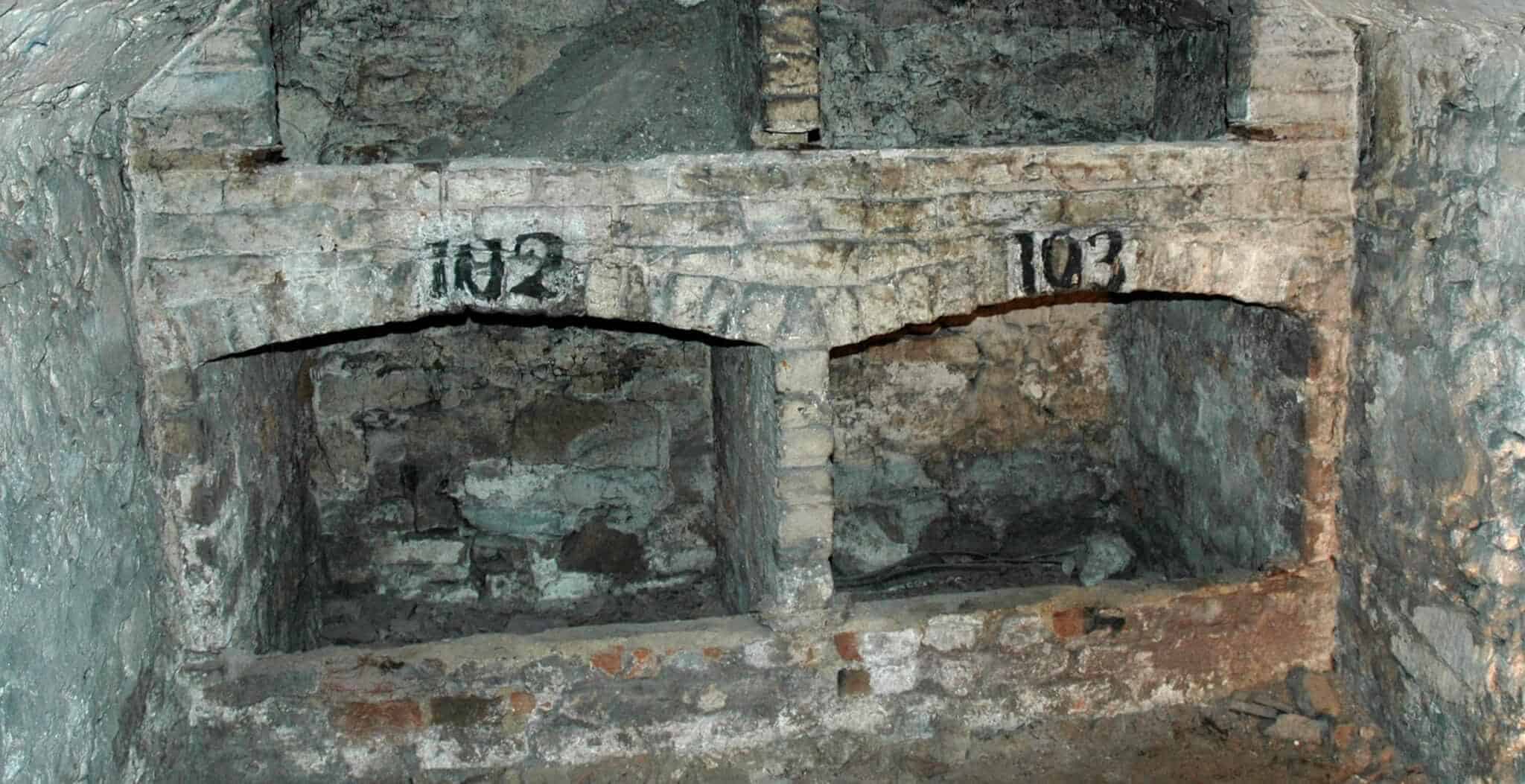
The Old Town, which is located along the “tail” from the crag, on which the Castle stands tall, is preserved in the medieval street plan. It is down the tail from the castle that the famous “Royal Mile” runs. Due to the tapering of the tail, space was a problem with an expanding population in the 1500’s. Their immediate solution (before the expansion into the New Town, after the Jacobite rebellions) was to build high rise residential areas. Ten and eleven story blocks were typical for these buildings but one even reached fourteen stories! The buildings were often extended below the ground too, to accommodate immigrants to the city, which is where the legends of Edinburgh’s “underground city” have grown from. Apparently it was the rich who resided on the upper floors of these buildings and the poor were kept to the lower sections.
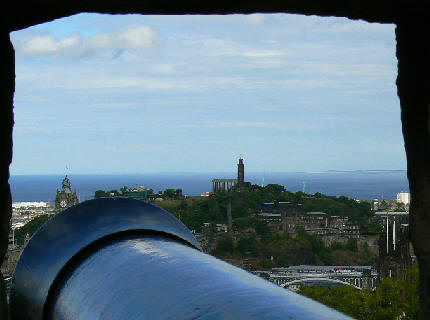
Edinburgh has been the capital of Scotland since 1437, when it replaced Scone. The Scottish Parliament resides in Edinburgh. However, in the past, Edinburgh Castle was often under English control. Before the 10th Century, Edinburgh was under the control of the Anglo-Saxons and Danelaw. Because of this previous Anglo-Saxon ruling, Edinburgh was often, along with the Border counties of Scotland, involved in the disputes between the English and the Scottish. There was a long string of clashes between these two in these regions as the English tried to claim Anglo-Saxon domains and the Scottish fought for land to the north of Hadrian’s Wall. When in the 15th century Edinburgh had been under Scottish rule for a significant period of time, King James IV of Scotland moved the Royal Court to Edinburgh, and the city became the capital by proxy.
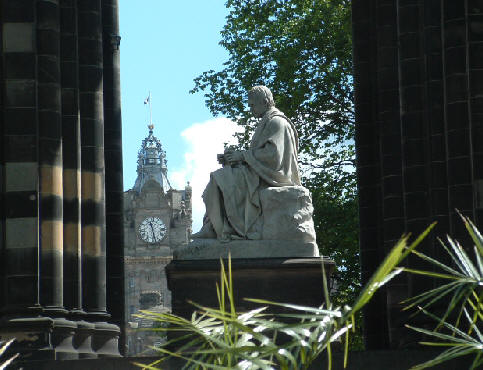
Culturally, the city is thriving too. The world-wide famous Edinburgh Festival (a series of arts festivals held in the city in August) draws thousands of visitors to the city annually, and has thousands more who wish to go but haven’t yet made it. Amongst these events is the Edinburgh Fringe Festival, originally a small sideline from the initial Edinburgh International Festival but now pulls one of the largest crowds and boasts being the first break for many acts.
Tours of historic Edinburgh
For information concerning tours of historic Edinburgh, please follow this link.
Museums
View our interactive map of Museums in Britain for details of local galleries and museums.
Castles
View our interactive map of Castles in Scotland for the most complete lists of castles in Scotland on the internet.
Getting here
Edinburgh is easily accessible by both road and rail, please try our UK Travel Guide for further information.