

Welcome to part two of our Fashion Through the Ages series. Starting from medieval fashion ending at the swinging sixties, this section covers British fashion during the 16th and 17th centuries.
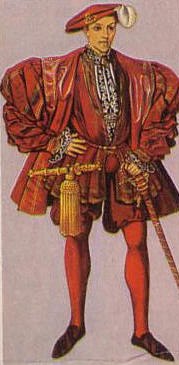 |
Man’s Formal Clothes about 1548 This gentleman wears an over-gown with full upper sleeves adding breadth to his shoulders, fashionable from about 1520. His doublet is loose with a seam at the waist and skirts, and his upper stocks (breeches) are separate from his hose for greater comfort. He has a padded ‘cod piece’ and his shirt is embroidered in black silk with small frills at the neck, which eventually will develop into the ruff. His cap is softer and wider and his shoes are less broad in the toe than in the early years of Henry VIII |
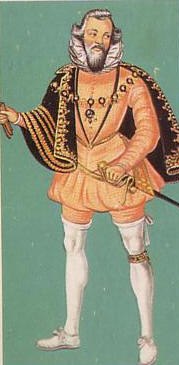 |
Man’s Formal Clothes about 1600 (left) This gentleman (pictured left) wears a padded doublet with pointed waist and short padded breeches, with tapering ‘canion’ at the knee, over which the stocking is pulled. His ‘Spanish’ cloak is heavily embroidered. Possibly Sir Walter Raleigh threw down a similar one to protect Queen Elizabeth from the mud! He wears a starched and gathered ruff, developed from the shirt neck frill after about 1560. His jewellery includes the collar of the Order of the Garter. His hat would have been conical. |
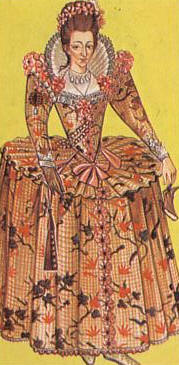 |
Lady’s Formal Dress about 1610 This lady shows the dress which first appeared in the later portraits of Queen Elizabeth about 1580 and remained fashionable in the reign of James I. The bodice is very long, pointed and stiff, and the wide skirt is supported by hip ‘boulsters’ of the ‘drum farthingale’. The sleeves are wide and the neckline low, with ruff open to frame the face. It is trimmed with lace newly introduced from Flanders and Spain. Her pleated fan is a new fashion from China. Fashionable ladies no longer wore a cap and her uncovered hair is dressed high with ribbons and feathers. |
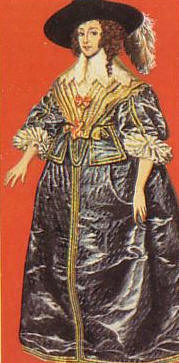 |
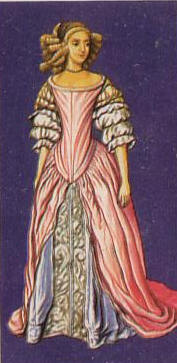
Lady’s Day dress about 1634 This lady wears a soft satin walking dress with the short waist and full flowing skirt fashionable from around 1620. Her bodice is cut almost like a man’s doublet and equally masculine are her wide-plumed hat and long ‘lovelock’ on her short hair. She wears a fine wide Flemish lace collar veiling the gold braid on her bodice. For formal occasions the neck would be left bare, and the hair dressed with jewels. Ordinary women’s dress was similar but they, except when riding, wore a close lace-trimmed cap. Of course riding side-saddle helped to preserve the ladies’ modesty. |
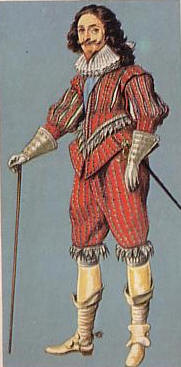 |
Man’s Day Clothes about 1629 This gentleman wears a suit with the new softer line. The short-waisted doublet with long skirts has slits on the chest and sleeve, allowing for movement. The knee-length breeches, full but not padded, are supported by hooks inside the waistline. The ribbon ‘points’ at waist and knee are decorative survivors of the lacing hose supports of late medieval times. The lace-trimmed ruff falls to the shoulders and the hair is long with a ‘lovelock’. Boots and gloves are of soft leather. |
The period 1642 – 1651 was a time of conflict known as The English Civil War (although there were actually three civil wars) between King Charles I and his followers (often referred to as Cavaliers) and Parliament (the Roundheads). This was the second period of civil war in England’s history, the first being the Wars of the Roses fought between 1455 and 1487.
King Charles I was beheaded in 1649. The Third Civil War was fought between supporters of his son Charles II and Parliament and ended at the Battle of Worcester on 3rd September 1651. The period after the Civil War is known as The Commonwealth and lasted until the restoration of King Charles II in 1660.
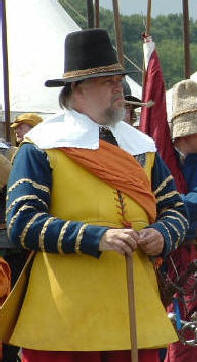
English Civil War Officer – mid 17th century
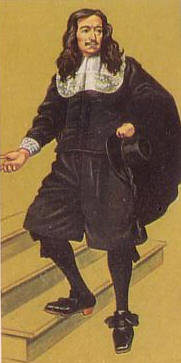 |
Man’s Day Clothes about 1650 This gentleman wears a suit based on the Dutch fashions then popular. It has a short unstiffened jacket and wide breeches hanging loose to the knee. Dark colours were generally worn and not confined to followers of Parliament. Matching braid provides trimming. About 1660, ribbons became popular trimmings and hundreds of metres could be used on a suit at shoulder, waist and knee, and for the bows on the square-toed shoes. He wears a fine square lace collar fashionable around 1650 – 70, a cloak and a narrow-brimmed conical hat. |
 |
|
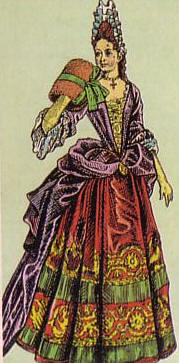 |
Lady’s Formal Dress about 1690 Late 17th century dress had become stiff, formal and based on French court fashions. The dress has become an over-gown pinned over the stiff corset to show the ‘stomacher’ and gathered back at the hips to show the embroidered petticoat. Lace frills on the shift show at the neck and sleeves. The most characteristic feature is the hair, beginning to be dressed high in the 1680’s. This style was named after Mlle. de Fontanges, a favourite of Louis XIV, who is believed to have originated it. This tall headress was formed of several rows of folded lace and ribbons, rising one above the other and supported on wires. The fashion of wearing on the face black patches of various shapes was still in fashion, small circular patch-boxes being carried so that any that fell off could be replaced. This fashion was ridiculed at the time: |
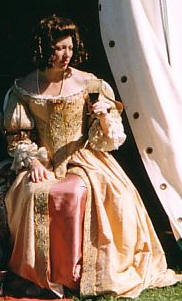 This lady wears a formal dress showing how long the waistline had become since 1640. Her bodice is low and stiffened and the short sleeves show much of her lace and ribbon-trimmed shift. The skirt is made to wear open, displaying the elaborately trimmed petticoat. False curls were sometimes added to the wide-dressed hair.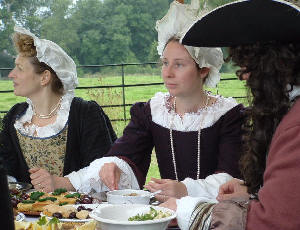
1690’s picnic, Kelmarsh Hall “History in Action” 2005
Related Links:Part 1 – Medieval Fashion |