

Murder most Mabel.
If half the reports of Mabel de Bellême turned out to be true, it was wise not to thwart her; not if you had a mind to staying alive, or keeping your facial features intact, that is. However, once she’d taken a dislike to someone it wasn’t that easy to flee her lethal gaze. It would be hard to escape even by legging it across much of France and crossing the English Channel (La Manche). That’s because Mabel de Bellême, or members of her close family, owned large chunks of land on both sides. What’s more, they were never averse to acquiring even more, by fair means or foul. Mostly foul, as it turns out.
Mabel de Bellême was born around 1026. If those present at her birth had known how infamous she would become, they’d probably have made a better note of the date. The daughter of William I Talvas (William the Shield) and his first wife Hildeburg, Mabel and her family were living examples of the kind of disfunction that usually only occurs in the weirdest and ickiest of folk ballads.
From its earliest days, the House of Bellême exhibited all the characteristics of a family living on a contested border (deep suspicion of outsiders, instant and violent reactions, and the ability to constantly sow the seeds of instability among their neighbours). They first governed from their castle at Bellême as fiefholders to the Counts of Maine. They managed to obtain some more prime real estate, at Alençon, from Duke Richard I of Normandy, and built another castle at Domfront. From these two strategic locations in northern France, the Bellêmes attempted to manipulate the more powerful families of the region, the counts of Anjou and the counts of Maine.
The family’s reputation began with Mabel’s grandfather, William I de Bellême. After years of feuding with the counts of Maine, William decided to take on Duke Robert of Normandy in 1027 and found his castle at Alençon under siege as a result. Forced to walk in humiliation wearing a saddle on his back to submit to Robert’s will, William was lucky on this occasion since Robert decided not to fall out further with the powerful Bellêmes, but instead restored his castles and land to him.
The Bellême family seem to have been subject to the same kind of fits of rage that were attributed to Henry II of England. A brief overview of the fates of William de Bellême I’s family provides an insight into the unique qualities of these feuding feudal folk. Fulk, William’s eldest, was killed during a failed raid into Normandy, the news of which caused his father to die suddenly in a fit. William’s second son Warin, apparently a chip off the old block, had randomly beheaded a knight because this person was pleasant to him. Warin then died suddenly, allegedly of apoplexy, or possibly simply because someone decided he was currently top of the murder to-do list.
Thus, third son Robert became lord of Bellême. Not long afterwards he was chopped to death in a prison cell by the sons of the murdered William fitzGiroie, members of a vassal family that would become the great enemy of the Bellêmes. Younger brother Yves, who became Bishop of Séez and Lord of Bellême, did somewhat better, using his violent brother William Talvas to ensure he gained a lot of land during his time as lord. Benoit, the youngest son, made probably the wisest decision of all and became a monk, thus avoiding being the latest green bottle to “accidentally” fall from the wall.
In time, and after much feuding, chopping, and fits of rage, it was the turn of Mabel’s father William II Talvas to show his mettle. Along his path to power in the service of brother Yves, William had managed to arrange the strangulation and mutilation of his first wife when on her way to church, in revenge for her disagreeing with him. He had also arranged for another William FitzGiroie, lord of Echauffour, to be horribly mutilated by having his eyes gouged out and his ears and nose cut off. To make things worse, this happened at the second marriage of William Talvas. Willliam FitzGiroie then became a monk.
With a background like this, it’s perhaps not surprising that Mabel turned out the way she did.
When her brother Arnulf decided to turf out her father from his lands for his misdeeds, Mabel chose to accompany William Talvas. Another half-brother by William’s second wife, Oliver, was apparently excluded from the family inheritance. Perhaps he wasn’t choppy and stabby enough despite having been a soldier, or perhaps he received a very large hint to drop any claims he might have.
Mabel was not only her father’s heir, but also his co-conspirator in the family business. In true Jane Austen fashion, Mabel and her father decided that there must be a wealthy man out there in need of a wife, a wife who would be wealthy herself if only they could seize that land and money back from Arnulf who had turned out to have such unusual scruples over a mere case of matricide. (Incidentally, things didn’t end well for Arnulf, either. He died in mysterious circumstances after stealing, killing and eating a nun’s pet pig. Don’t ask.)
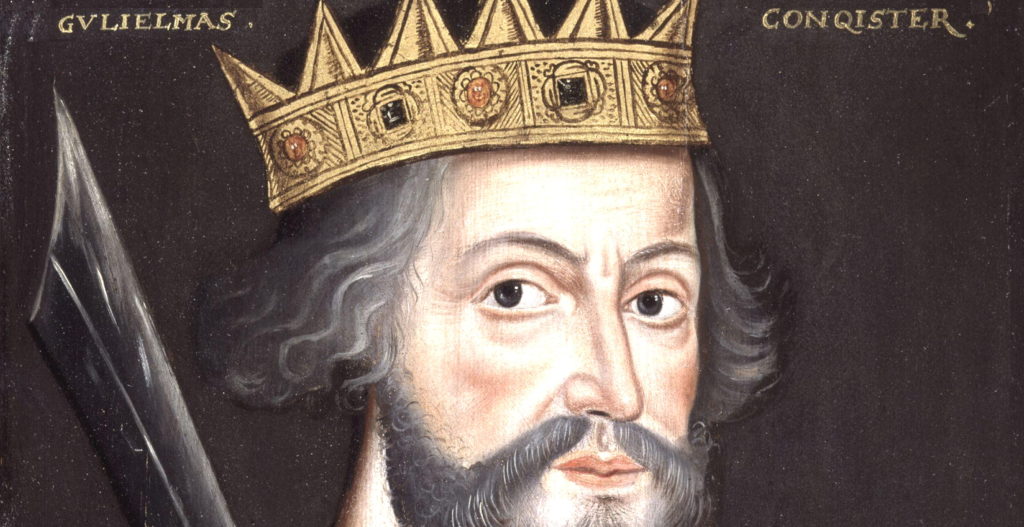
Enter Sir Roger de Montgomery. Sir Roger was well-connected, being related to Duke Richard of Normandy, the family whose best-known offshoot was William the Conqueror. What’s more, he was the inheritor of much land in Normandy, and about to become even more well-endowed with land in England after the Norman Conquest. He was a keen supporter of William the Conqueror (not so affectionately known as William the Bastard in England) and one of his main advisors. It was a match made in, if not exactly heaven, then whatever peculiar paradise inhabited the minds of William Talvas and Mabel.
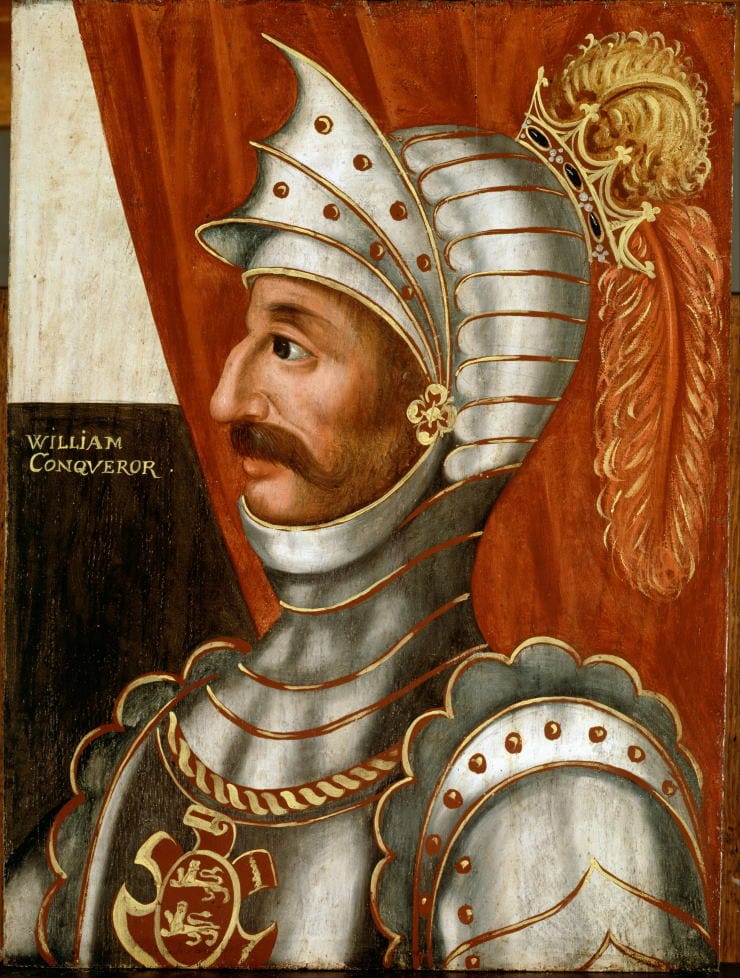
While it’s not certain whether Sir Roger took part in the decisive battle at Hastings (according to some sources, he was on the right flank, according to others he stayed home to mind Normandy), he certainly benefitted from the Norman Conquest of England.
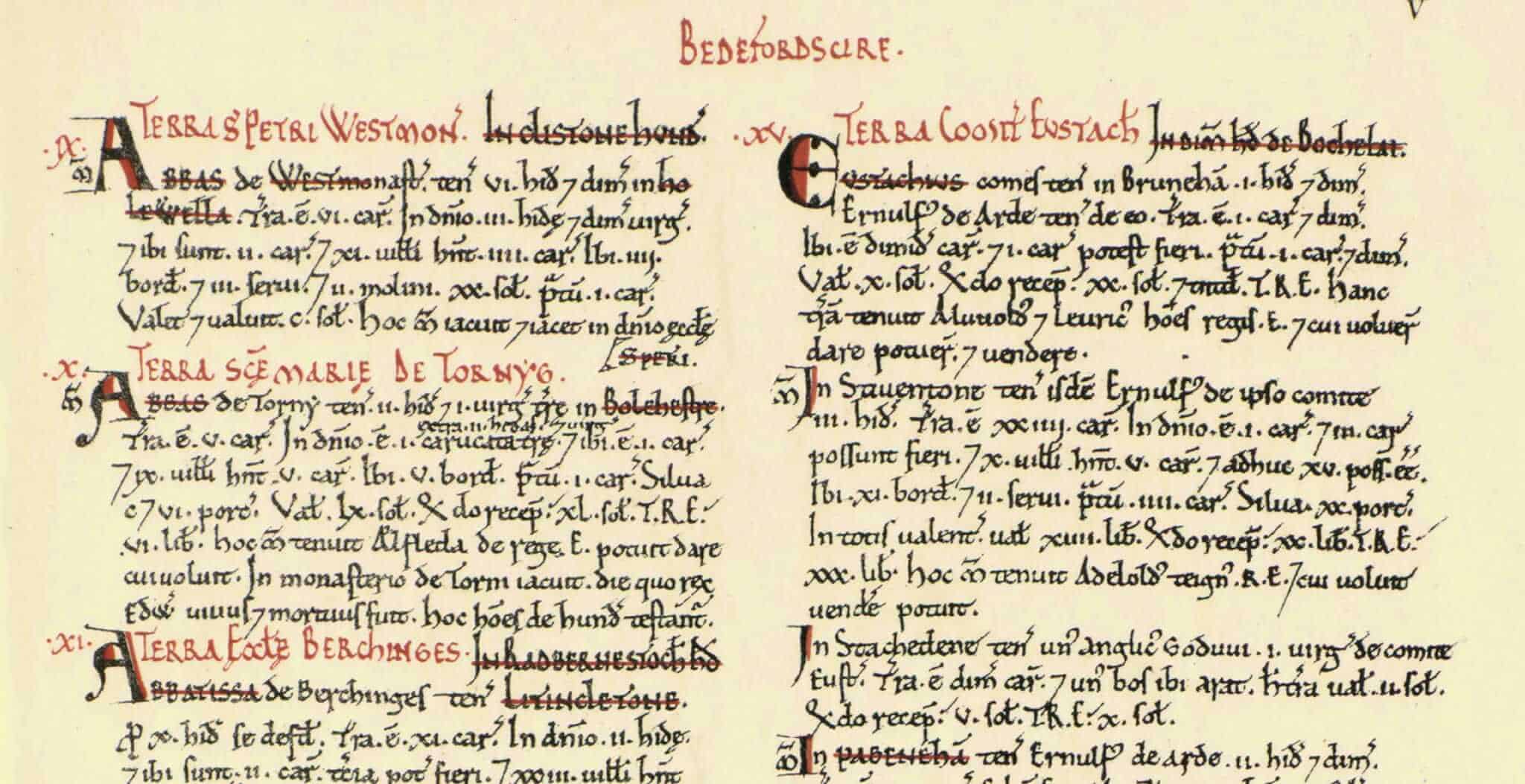
William awarded Sir Roger 83 manors in the county now known as West Sussex, most of Shropshire, quite a bit of Gloucestershire, Surrey, Hampshire, Wiltshire, Middlesex … the list goes on. Substantial parts of what would become the wealthiest shires in England, in other words. He was made Earl of Shrewsbury, which meant Mabel was now Countess of Shrewsbury, and the pair were in control of a good chunk of the wealth of not so merrie England. This meant they were also gratifyingly frequently name-checked in the Domesday Book.
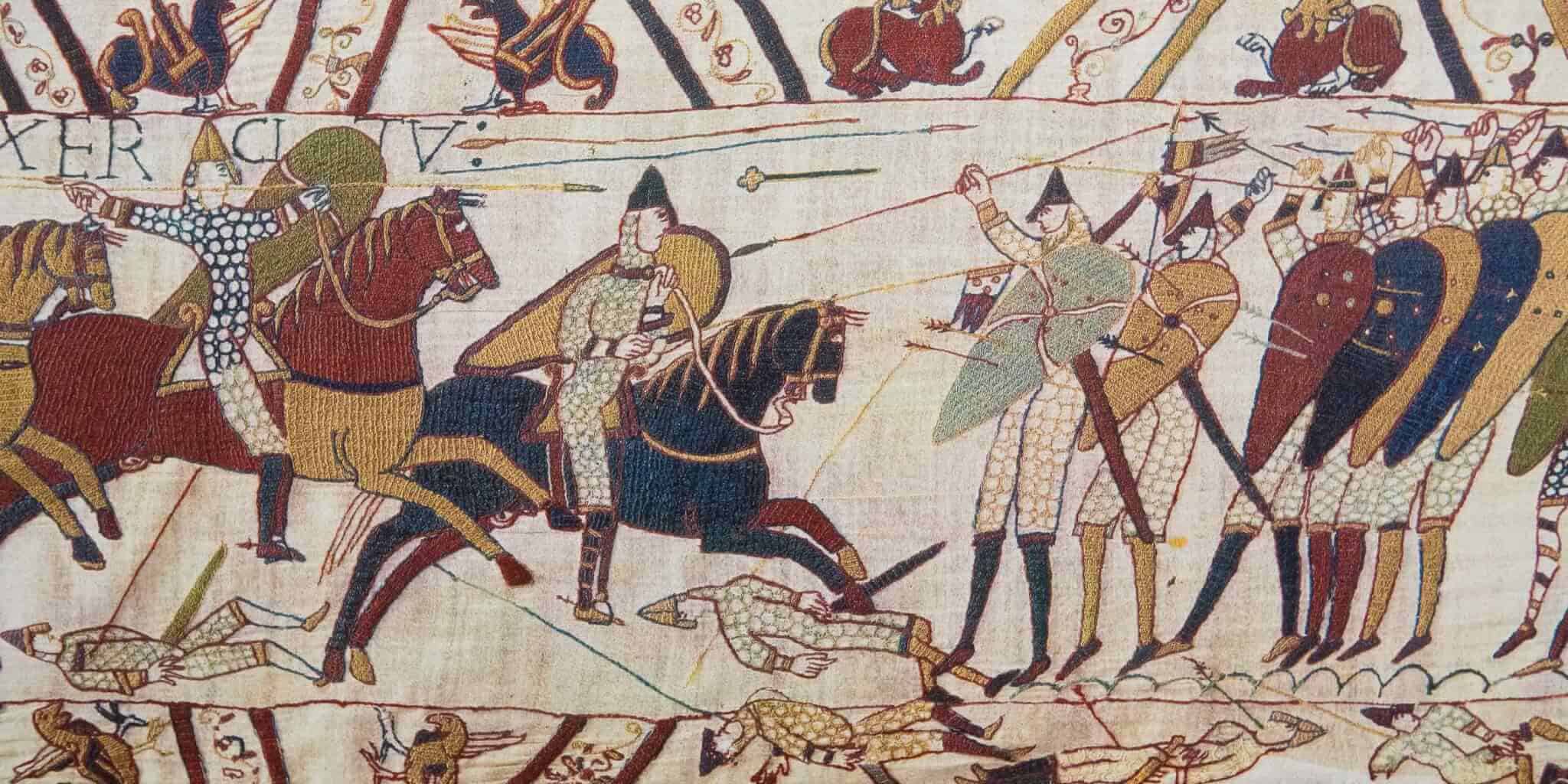
Sir Roger had allegedly provided ships for William’s invasion fleet, and no doubt enjoyed pointing them out in the Bayeux Tapestry whenever he visited France: “And this one, I call the ‘Jolie Roger’, heh heh.” In the meantime, Mabel had already added a number of titles in France and was increasingly wealthy in her own right. She inherited not only her father’s goods and land (those brothers had turned out to be SUCH a disappointment) but those of her Uncle Yves, who had added to the family estates.
The designs of Geoffrey Martel on de Bellême lands had been well and truly seen off by William the Conqueror when he was still Duke of Normandy (cue more hacking and chopping). By 1070 Mabel was Dame de Alençon, de Séez, and Bellême, as well as Countess of Shrewsbury and Lady of Arundel in England. Apart from a trip in 1067 to claim her titles, perhaps fortunately for her English tenants Mabel seems to have preferred to spend her time in France.
There was so much to do there. To begin with, by 1063 she had already dealt with the descendants of that insufferable Giroie family, including Arnold de Echauffour, the son of mutilated William fitzGiroie. Arnold’s big crime was to have lands that Mabel wanted. Using her husband’s influence with Duke William she managed to get her hands on the Giroie property. However, perfidious William then forgave Arnold and gave returned his lands to him.
Nothing daunted, Mabel decided the way to deal with Arnold was to remove him permanently. Nothing so gross as decapitating or chopping would do for Mabel of course. A nice glass of poisoned wine was the way to do it, administered during an apparently friendly visit by Arnold to the Shrewsburys. Unfortunately, the glass was grabbed by Roger’s own brother Gilbert, feeling thirsty while he was sitting on his horse after a tiring ride. Gilbert later expired. Nothing daunted, Mabel eventually collected Arnold too, via the same method, having infiltrated his household by bribing a senior servant.
Mabel’s relationship with the church was … interesting, to say the least. She seems to have got on fairly well with Theodoric, abbot of the abbey of Saint-Evroul, a foundation supported by her husband. However, she managed to drain the abbey’s resources by visiting it for long periods with a large retinue which all needed feeding and housing. Ticked off by Theodoric for this greedy behaviour, she retorted that next time she would bring even more. Theodoric warned her that she was heading for trouble in the form of illness, and so it proved. Mabel herself was taken seriously ill. However, she still hadn’t learned her lesson.
In 1077, Mabel finally met her match in the Brunel family, whose lands she stole. Two years later, Hugh Brunel, head of the family, and his brothers managed to make their way into the castle of Brures in Normandy which was hosting Mabel. Accounts say she had just taken her bath (which at least proves that yes, people in medieval times DID take baths), when the Brunels broke into her room. Hugh quickly decapitated her and he and his brothers fled the scene.
Thus Mabel’s demise was as bloody as any of her family’s enemies. She exerted power like the men of her family and died as they might have done. Since the main account of her life comes from Orderic Vitalis, supporter of the Giroie family and arch enemy of the Bellêmes, it is hardly an unbiased one; yet sufficient other evidence exists to indicate a core of truth.
From Vitalis we are left with an impression of a small clever chatterbox with an evil sense of humour who was always prepared for another cunning, vicious exploit. Even after her death, there was always the upcoming generation of Robert, Hugh, Roger, Philip, Arnulf, Sibyl, Emma, Matilda and Mabel.
Mabel de Bellême: the O.G. (Original Gangsta)? Mabel would undoubtedly have taken it as a compliment.
Dr Miriam Bibby FSA Scot FRHistS is a historian, Egyptologist and archaeologist with a special interest in equine history. Miriam has worked as a museum curator, university academic, editor and heritage management consultant.
Published: 15th September 2025
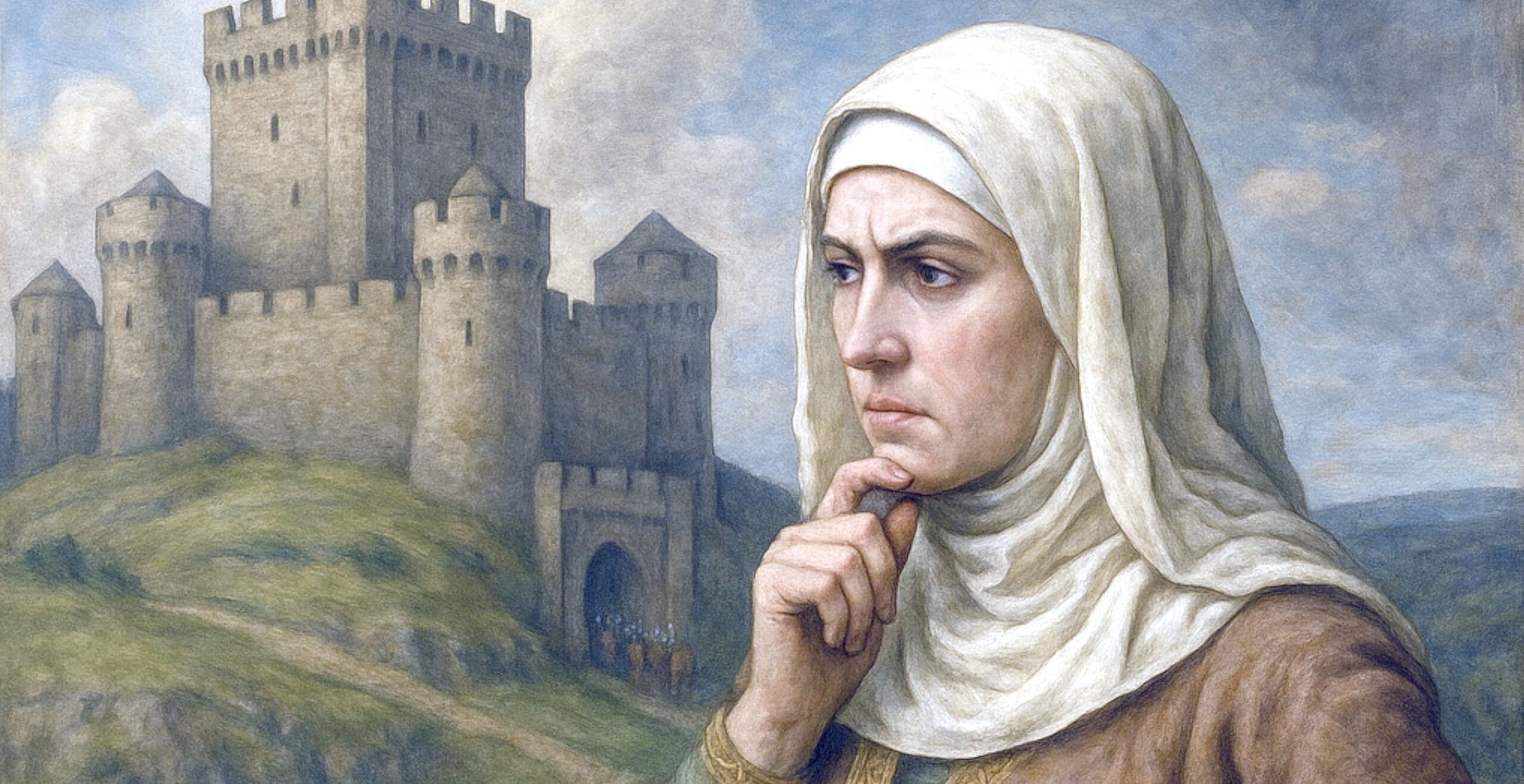
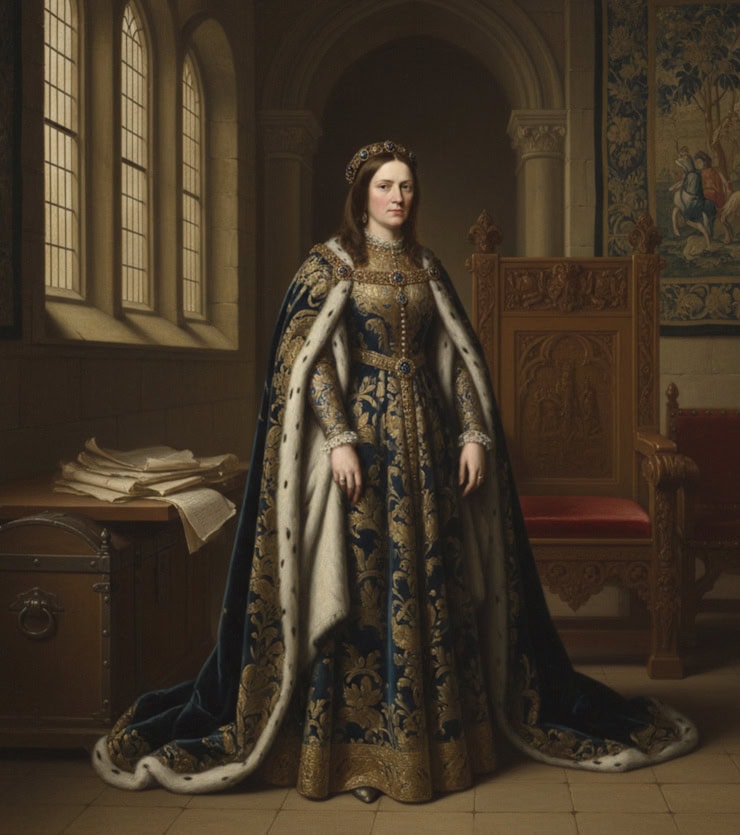
(Images of Mabel are created by A.I. as no known portrait of Mabel de Bellême exists).