

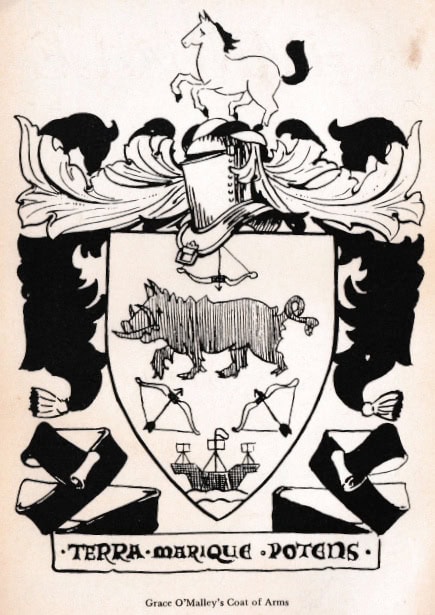
The O’Malley coat-of-arms is intended to impress, and it does. At its top is a rearing stallion. Below the horse is a sinister-looking helmet set in bars. A fearsome-looking boar with arrows on three bows drawn at it dominates the centre. To the left of the lower bow is a galley, its oars clearly visible. At the base is the motto: “Terra Mariq Potens”, with the name O’Maille below that.
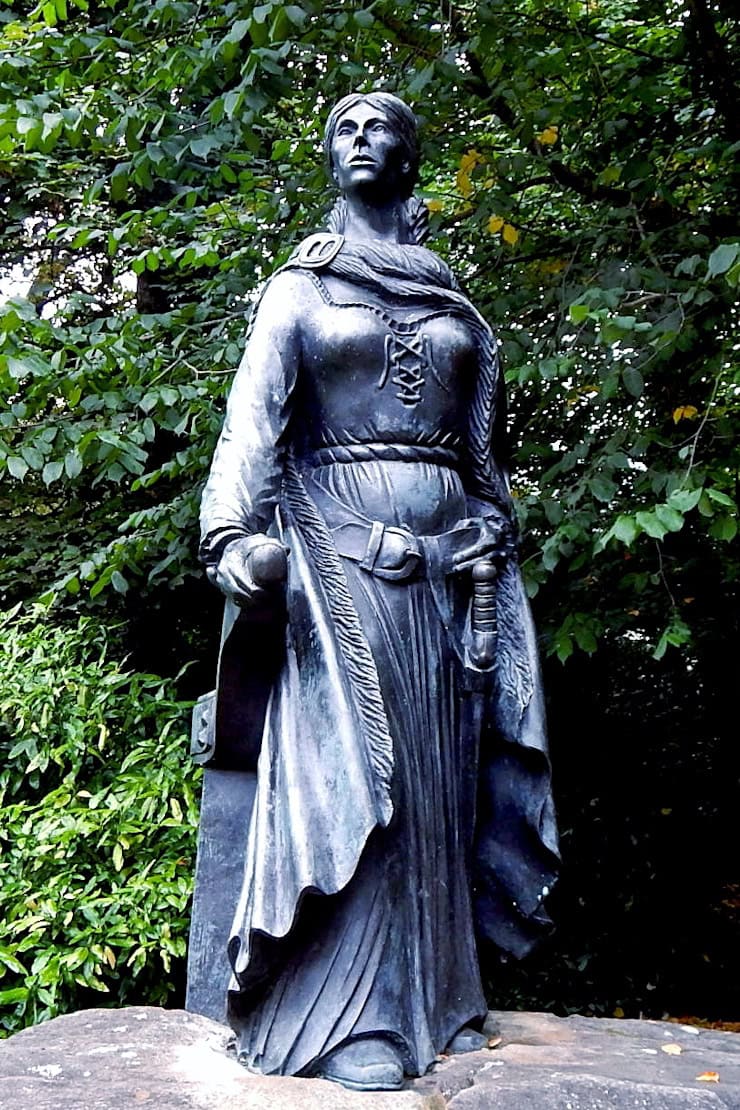
The O’Malley clan certainly lived up to their motto of “Powerful by Land and Sea”, and few were more feared and commanding than Gráinne Ní Mháille, known to the English as Grace O’Malley (ca. 1530-1603).
The sixteenth century was a time of powerful women rulers such as Mary I and Elizabeth I in England, Mary Queen of Scots in Scotland, and Catherine de Medici in France. Nor did a woman need to be royal to be wield power. Characters such as Bess of Hardwick rose to prominence and proximity to the throne through strategic marriages and the strength of their own personalities.
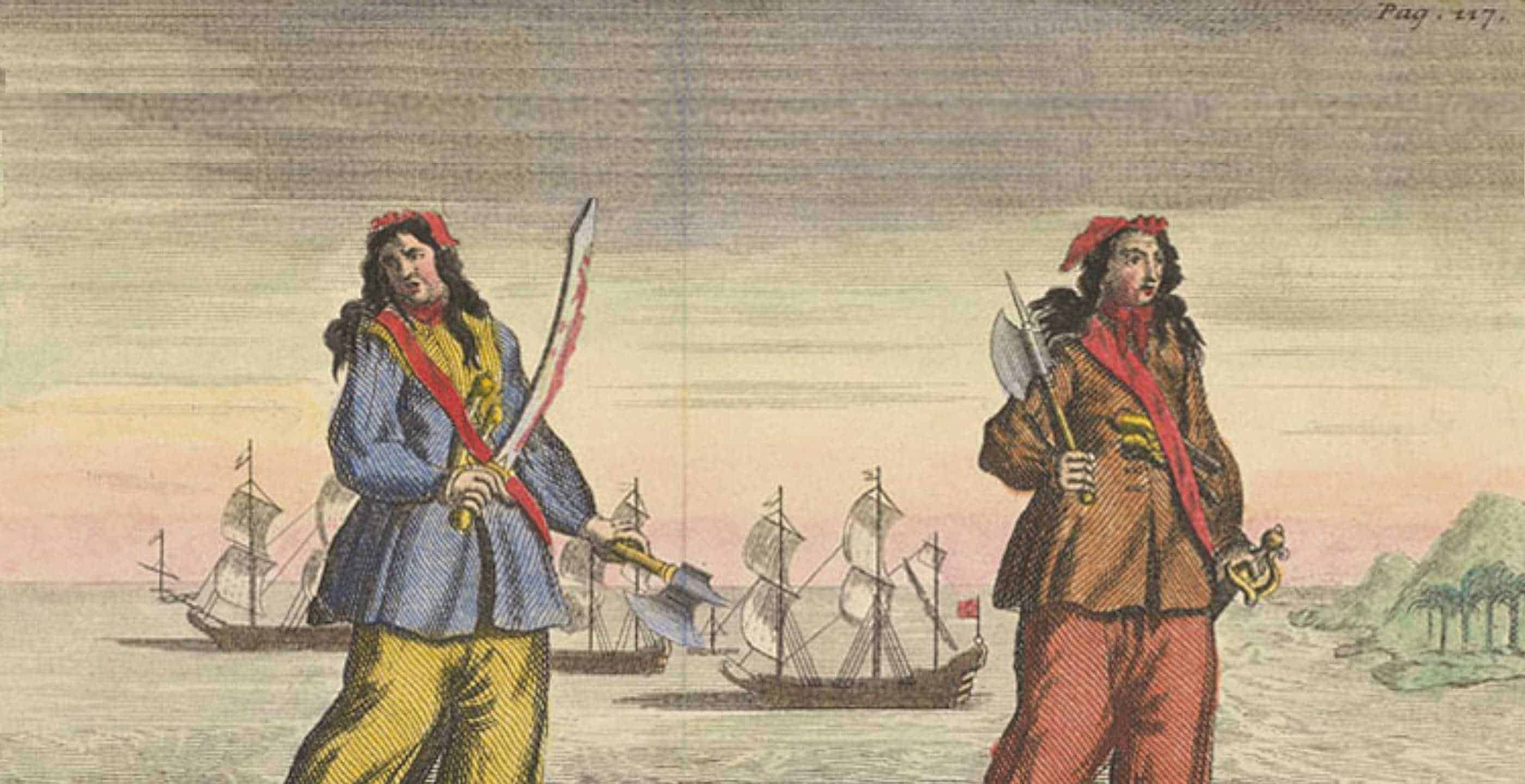
Robber and highwaywoman Moll Frith swaggered through the streets of London dressed in men’s clothing, sword at her side and smoking a pipe, flipping the bird at the morals of the time. Grace O’Malley is more than worthy to be reckoned to be among this company of queens, successful personal empire builders, and roguish women.
Grace was the woman who dominated the west coast of Ireland with her own fleet of vessels for decades, before meeting with Elizabeth I in London and petitioning her for assistance.
The petition, which today has a surprisingly modern sound to it, was on the topic of women’s rights, specifically widow’s rights, within marriage. The two women, both in their 60s, met one another in 1593. While she listened with sympathy to the story of a widowed Irish woman who had spent long years fighting and sailing her own ships only to end up with little to show for it, Elizabeth may have reflected with relief on her own unmarried status, while also remembering the various fates of her father’s wives.
Grace O’Malley was a close contemporary of Elizabeth. While the precise location and date of her birth are unknown, it is likely to have been in one of several properties belonging to her parents, Eoghan Dubhdara O’Malley and his wife Margaret O’Malley, who was an O’Malley by birth not just marriage, from a different family to Dubhdara.
Her father’s name means “Black Oak” and as one of a number of epic English reinterpretations of Irish names and places, Dubhdara became phonetically spelled as “Doodarro” and he ultimately became “Owen” from Eoghan. English secretaries and scribes had particular trouble with Grace’s name, or possibly nickname, most likely pronounced “Granuaile”. Grace appears in the documentation as Grainemhaoil O’Maille, Grany Nimaly, Grany ny Mally, Grania O’Malley, and many more variations. One of Grace’s biographers, Anne Chambers, suggests that the name Granuaile is most likely “a corrupt amalgam of the Gaelic Grainne Ui (Ni) Mhaille, or Grainne Umhaill (Grace of the Umhalls)”. “Ni” was a feminine form indicating a daughter of a descendant of a clan, while “Ui”, indicated the person was “of”, or a descendant of, a particular clan.
The O’Malley family laid claim to being one of the most ancient on the island of Ireland, tracing their ancestry back to the High King of Ireland and King of Connaught, Brian Orbsen, who died in battle in 388 CE. At the time of Grace’s birth, their landholdings were the barony of Murrisk, known as the Umhall (territory) of Uachtarach, and the barony of Burrishoole, or Umhall Iochtarach, and together these made the Umhall Ui Mhaille, the territory of the O’Malleys. Most importantly for this sea-going family, the west coast territory included several small islands that could be readily defended, and the castles of the O’Malleys were of the defensive tower house type, similar to those seen on the Anglo-Scottish border.
From the thirteenth century onwards, O’Malley lands had been occupied by the Normans, specifically the de Burgos family, whose name became over time Burke or Bourke.
Eventually the de Burgos would adopt the traditions of Ireland and take the chiefly title MacWilliam Iochtar, marrying into local families such as the O’Malleys, who lost none of their authority.
Although nineteenth century perceptions of the west coast of Ireland were as an impoverished region, this was not the case in Grace’s day. The sea was one great source of wealth, and the O’Malley family knew how to exploit its riches.
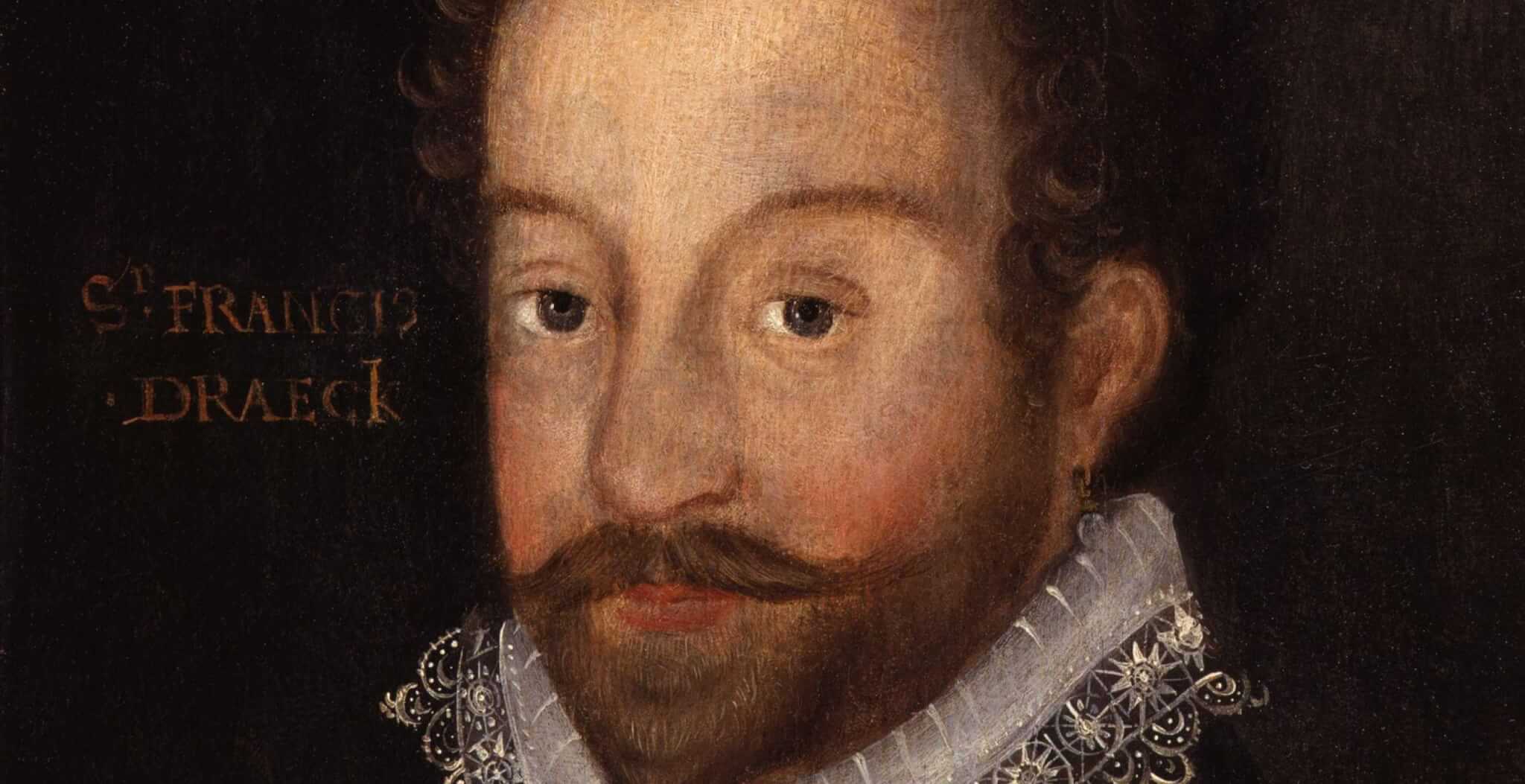
Using galleys as well as other vessels better designed for trade, they operated down to the coasts of Iberia and round to Ulster and Scotland. As well as trade, their activities included piracy and protection rackets, but then the same could be said for some of England’s great heroes of the sea such as Drake and Raleigh. Like many Irish clans, the O’Malleys used the services of hired soldiers from Scotland known as Gallowglasses and Redshanks.
Ireland beyond Dublin and its surroundings was a very different prospect from England. The ancient customs survived in Ireland; chiefs were elected, their successors the tanaists being chiefs-in-waiting, the judges, or Brehons, were hereditary, and family groups continued to reign like local kings over their territories, and to fight and make allegiances with each other.
While Irish history and mythology is full of independent-minded queens and goddesses, Grace’s world was a very masculine one in which the roles of men and women were clearly defined. It is all the more interesting that she should have decided that the strictly-defined role of wife and mother was never going to be her whole calling. It is unclear when Grace actually began her sea-going life, but most likely as a young woman with her father. One of the numerous stories around her name relates that Granuaile is from the nickname Grainne Mhaol, or “Bald Grace”, because when she was told she could not go to sea because she was a girl, she hacked off her hair in order to be more like a boy and take to seafaring.
However she learned her sea-craft, there’s no doubt that by the time she married her first husband Dónal an Chogaidh Ó Flaithbheartaigh (Donal O’Flaherty of the War), she was an experienced sailor. This was an excellent marriage from the perspective of both families, Donal being the tanaist for a potentially huge territory in Connaught and Connemara. The sea was not the only bounty; the west coast families were rich in cattle and horses, deer, hides and linen, rich mantels of fur, and other items suitable for trade. Grace was said to possess 1000 head of cattle and mares. There was fruitful farmland too, and the port of Galway, though it had an uncomfortable relationship with the O’Malleys, was the leading centre of trade.
Grace’s married life was not easy. As well as encountering complex local politics and fighting, including murder within her close family, and shifting relationships between clans, there were the English to take into consideration.
Both English and Scottish kings had claimed authority over Ireland for centuries, but this had not always manifested itself in direct rule over the country. Under the Tudors, English influence had begun to assert itself more and more over the territories “beyond the pale”, in other words outside the principal territory around Dublin. Grace’s husband Donal was a likely head of the clan O’Flaherty but lost this opportunity when Elizabeth granted it to his kinsman Murrough na dTuadh Ó Flaithbheartaigh. Donal died in an ambush and Grace remarried, to the wealthy Risdeárd an Iarainn (“Iron Richard”) Bourke, 18th Mac William Íochtar, who made his wealth and took his name from the iron veins that lay under his land. Grace continued to fight and sail as successfully as any man.
As is always the case, there were those who fought against the new authority, and those who negotiated with it. The tone of the relationship between English and Irish was set by the quality of its governors, and one in particular, Sir Richard Bingham, was an authoritarian with a particular animosity for Grace and her sons. By the time he arrived on the scene, Grace was in her fifties, and widowed twice. For Bingham, this tough, fighting woman had been “nurse to all rebellions in the province for this forty years”. In 1586, he nearly brought her to execution but released her on a pledge from her son-in-law.
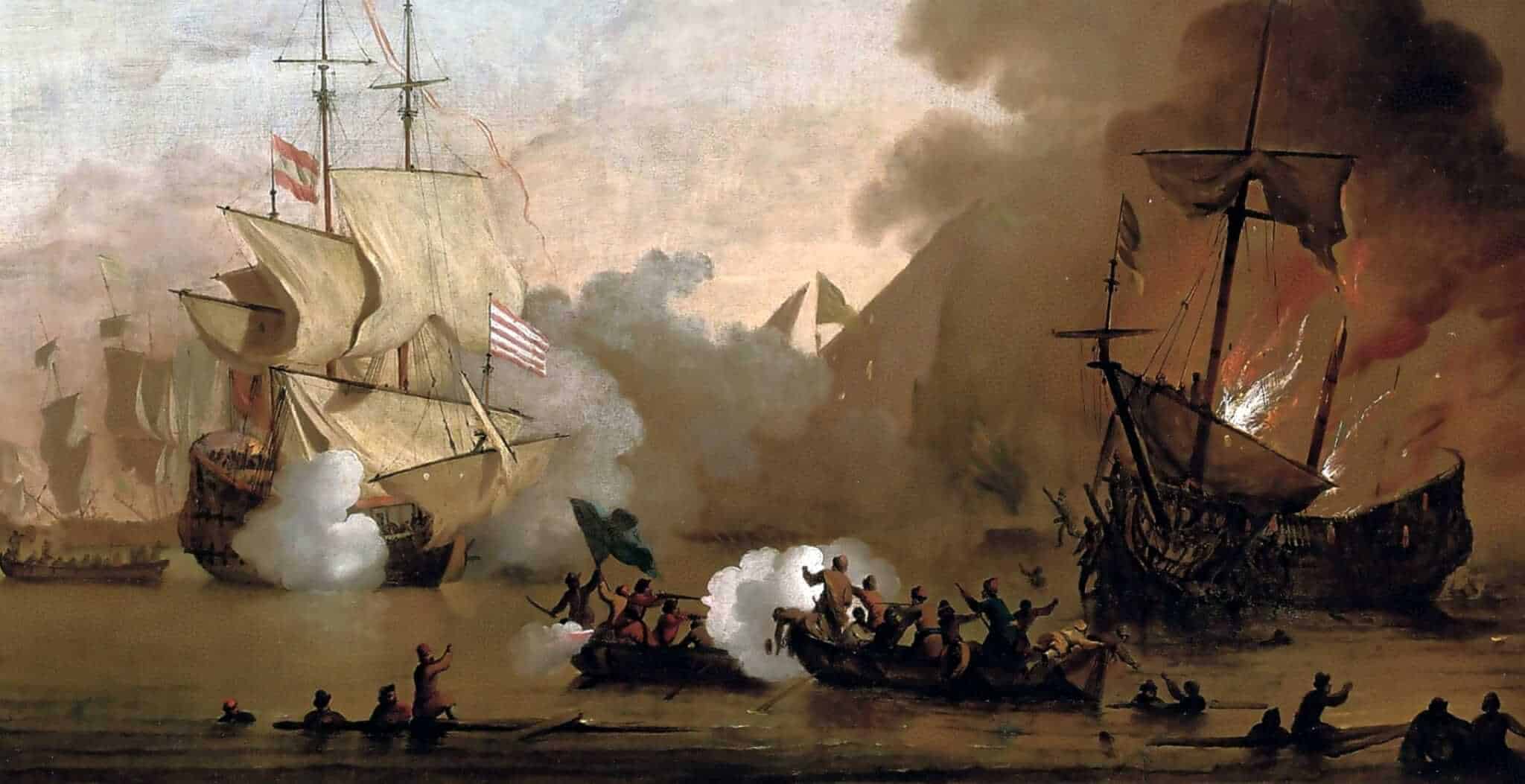
In 1593, Bingham took captive Grace’s two sons, Teabóid, or Tibbot, na Long Bourke, later Theobald Bourke, 1st Viscount Mayo, and Murchadh Ó Flaithbheartaigh (Murrough O’Flaherty) along with her half-brother. Tibbot was said to have been born at sea before his mother battled with Barbary corsairs! Bingham had already put to death Grace’s first born, Eoghan.
This was when Grace went to London to petition the queen, sailing her own ship, it appears, into the Thames. She had been given, and answered, an “interrogatory” that looked closely into her background, her marriages, and her family. She met Elizabeth as an equal who had found herself in need, asking the queen to grant her some respite for her remaining years.
She explained in her answers that “among the Irishry the custom is that wives shall have but her first dowry without any increase or allowance for the same” and that she felt this was an injustice. Even that was guaranteed; on widowhood or divorce, often there was no dowry left, just the debts of their husbands.
“At other times,” said Grace’s petition, “they are divorced on proof of precontracts; and the husband now and then without the lawful or due proceedings ‘do put his wife from him’.” After making her appeal, she offered her sword to fight the queen’s enemies.
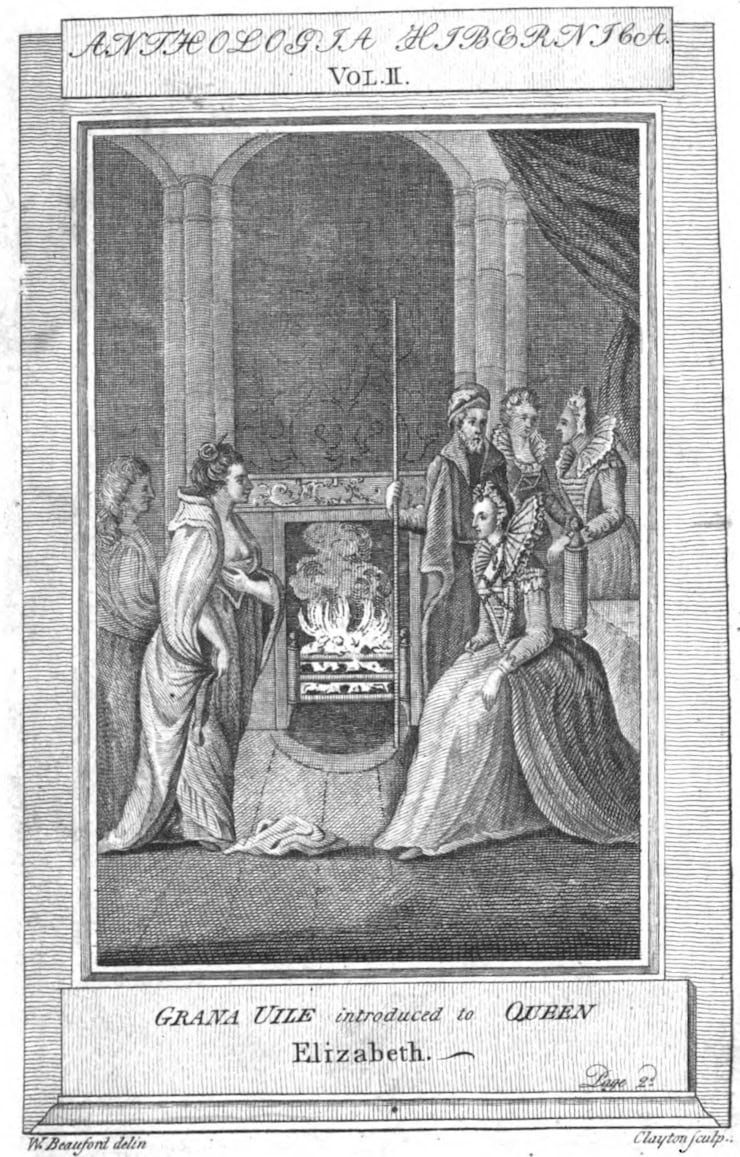
Elizabeth was impressed, and it would appear, sympathetic, and agreed to some support via income from the lands of her sons. Bingham was appalled, but eventually, after some considerable time, sulkily made an allowance available.
Grace immediately went back to building ships and her old piratical life on the open main. Her end is obscure, but it appears to have been around 1603, the same year as Elizabeth. It was most likely at her castle of Rockfleet, and she is possibly buried at Clare Island Abbey, somewhere near an impressive slab bearing the O’Malley coat of arms.
Did Elizabeth, as she saw this powerful, weatherbeaten woman sea-captain in front of her, perhaps feel some envy at the life she had lived? After all, Elizabeth’s adventures had been experienced vicariously through others at her court such as Drake, Raleigh, and Hawkins.
Elizabeth may have famously had “the body of a weak and feeble woman, but … the heart and stomach of a king”, but Grace had proved that women were capable of living that concept. All in all, Grace’s story provides a unique and unforgettable insight into Anglo-Irish relations in a complex time of great change on the two neighbouring islands.
Dr Miriam Bibby FSA Scot FRHistS is a historian, Egyptologist and archaeologist with a special interest in equine history. Miriam has worked as a museum curator, university academic, editor and heritage management consultant.
Published: 28th September 2026.
Top image created by AI.