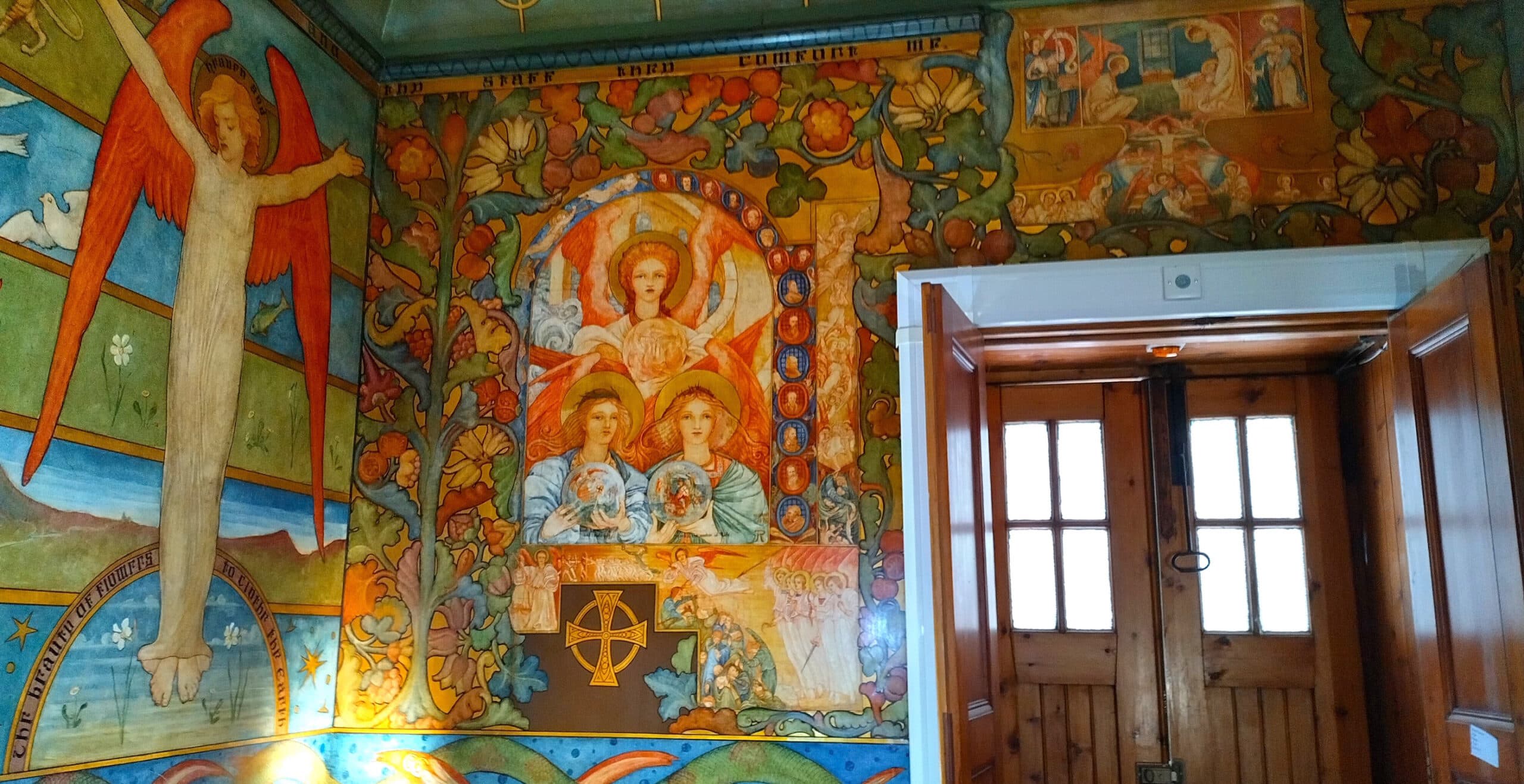


In May 2024, Scottish Wall Paintings Conservators undertook treatment on a unique murals’ conservation project in a highly-sensitive space – the ‘Category A’ listed Mortuary Chapel, in a Mortuary Building on the grounds of Edinburgh’s Royal Hospital for Sick Children (RHSC).

The Mortuary Chapel had functioned in its intended use from the 1890s, when the RHSC was first built on the south side of the Meadows, until June 2021 when the hospital relocated to modern premises in another part of the city. Developers immediately took ownership of the old hospital complex, and overnight the murals, along with the chapel, became obsolete. With the hospital context absent, the paintings had lost their raison d’etre: to sustain and comfort bereaved parents.
However, these mural paintings have had a rich, complex history, and this was not their first abandonment. The backdrop to their story begins in the 1860s, when the first children’s hospital in Scotland was established on the north side of Edinburgh’s Meadows. In 1885, Arts and Crafts artist Phoebe Anna Traquair (1852-1936) received her first professional commission – decoration of a tiny, disused coalhouse on Meadowside House hospital grounds, to create a suitable space where ‘bodies can be left reverently and lovingly for the parents before the burials.’ This modest chapel of rest provided an independent mortuary, improving upon what had existed until then – a corner of the autopsy room, in a building known as ‘The Dead House.’
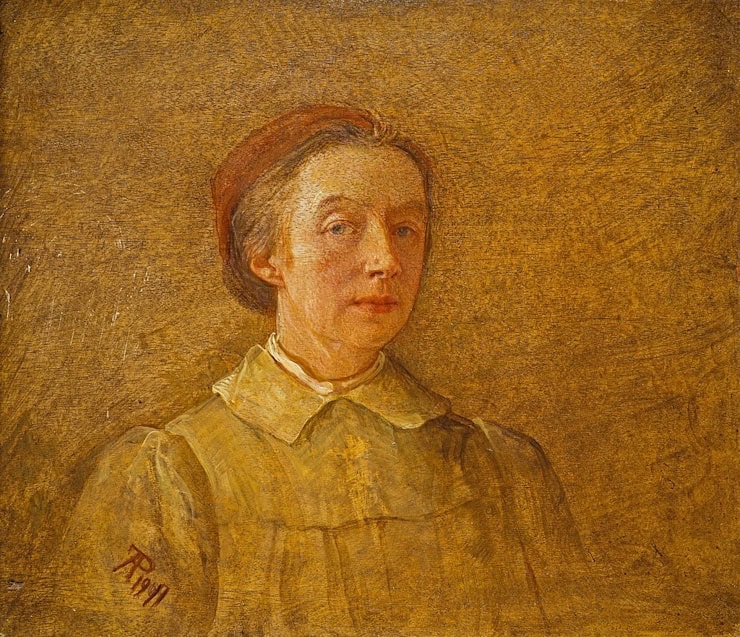
Phoebe Traquair’s commission was arranged by the philanthropic Edinburgh Social Union, founded by Patrick Geddes as part of a larger initiative to revitalise Old Edinburgh through art and social reform. While Phoebe Traquair’s paintings reflect a Christian response to bereavement typical of her era, they are a densely symbolic interpretation infused with her unique artistic creativity. The scheme represents, in essence, the passage of the soul through this lifetime and transfer of the spirit into the afterlife. As a mother of three children herself, the murals were specifically intended to comfort grieving parents, rather than simply provide ‘art for art’s sake.’ This was the first of Traquair’s three Edinburgh murals’ schemes, and as such, is of great artistic and historic importance both in Scotland and the wider Arts and Crafts context.
Unfortunately, within a few years of the murals’ completion there was an outbreak of typhoid fever at Meadowside House. It was agreed that a larger, more sanitary hospital should be built, and in 1891 the grand new ‘Royal Hospital for Sick Children’ (or Sick Kids, as it came to be known) was designed by Scottish architect George Washington Browne (1853-1939). Whilst the Meadowside House site was repurposed, the tiny coalhouse chapel was abandoned and marked for demolition. Phoebe Traquair was incensed, and led a determined campaign to preserve her beloved murals. In a letter to her nephew, dated 16 August 1891, she wrote:
‘…ought I not to have been pleased that so many have recognised what good there is in the Mortuary. I myself believe in some ways I shall never do better or maybe as well, and yet, do you know, they, the horrid Edinburgh little handful of bigots, who form the directors of the Hospital…want to pull it down…I feel as if my pet child was to be murdered.’
The artist eventually succeeded in her mission to have the paintings removed, although she remained reproachful of the hospital directors who ‘spent not a farthing…’ The Edinburgh Social Union had come to the rescue, taking on responsibility for the move at their own risk and great expense.

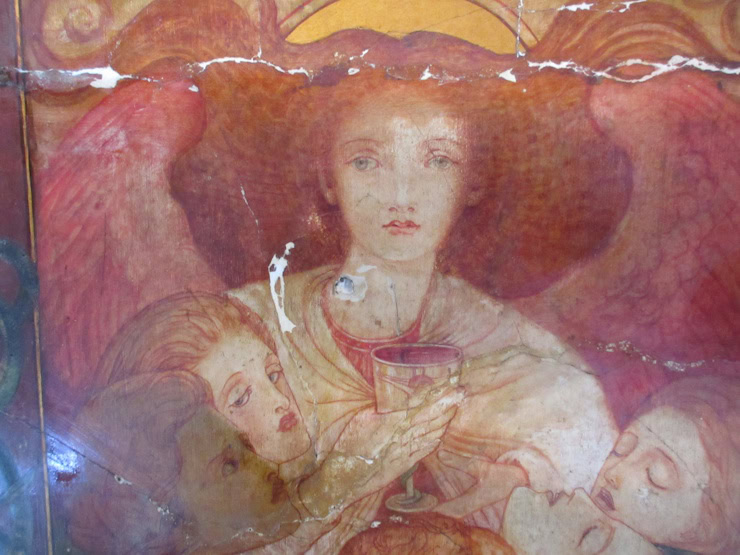
In 1895 Phoebe Traquair oversaw cutting of the wallpaintings from the building, an onerous task that involved sawing through not only lath and plaster but brick. Mural sections were transferred to a purpose-built mortuary chapel on the new hospital grounds. According to records in the National Library of Scotland’s (NLS) Special Collections Archive, much of the 1880s scheme failed to survive this aggressive intervention. Of those sections that did, the majority were too deep to be embedded in the new structure, thus deemed unusable. Flitting between her various artistic projects in the late 1890s, the ever-versatile Traquair extended the decoration to fit the new chapel’s dimensions, and restored her 1880s murals that ‘were so cracked and injured by the necessary handling…’
One of the primary ethical and aesthetic dilemmas posed for the conservation team was achieving a balance when cleaning a patchwork of paintings from different eras, cobbled together like some three-dimensional jigsaw puzzle: Traquair’s 1880s paintings; her 1890s paintings; the artist’s restoration of her 1880s paintings; and a late 20th century oil-painted reproduction panel (artist unknown).
Stylistically there are distinct differences between Traquair’s 1880s and 1890s murals. The earlier paintings are like enlargements of her own illuminated manuscript artwork – compact and jewel-like, with lively detailing. By comparison, her later work is looser, with an economy of detail and confidence of execution. Crucially, in spanning two distinct eras of her artistic career, the Mortuary Chapel murals bridge the evolution of Phoebe Traquair’s distinctive painting technique and style.
Traquair had developed and mastered a simplified version of the ‘spirit fresco’ technique made famous by Thomas Gambier Parry and Frederic Lord Leighton. Her murals in Edinburgh’s Mansfield Traquair Centre, begun in the late 1890s, were painted in ‘spirit fresco’ – oil paints mixed with beeswax dissolved in turpentine. Analysis of samples taken from the Mortuary Chapel’s 1890s mural panels found that they too were painted using the ‘spirit fresco’ technique.
By contrast, analysis of the 1880s paintings confirmed use of straightforward oil paints. Prior to extending the decoration, Phoebe Traquair had attempted to clean sooty black dirt and aged varnish from relocated panels, but this was not entirely successful and her 1890s restoration work was painted to match discoloured, partially-cleaned murals.
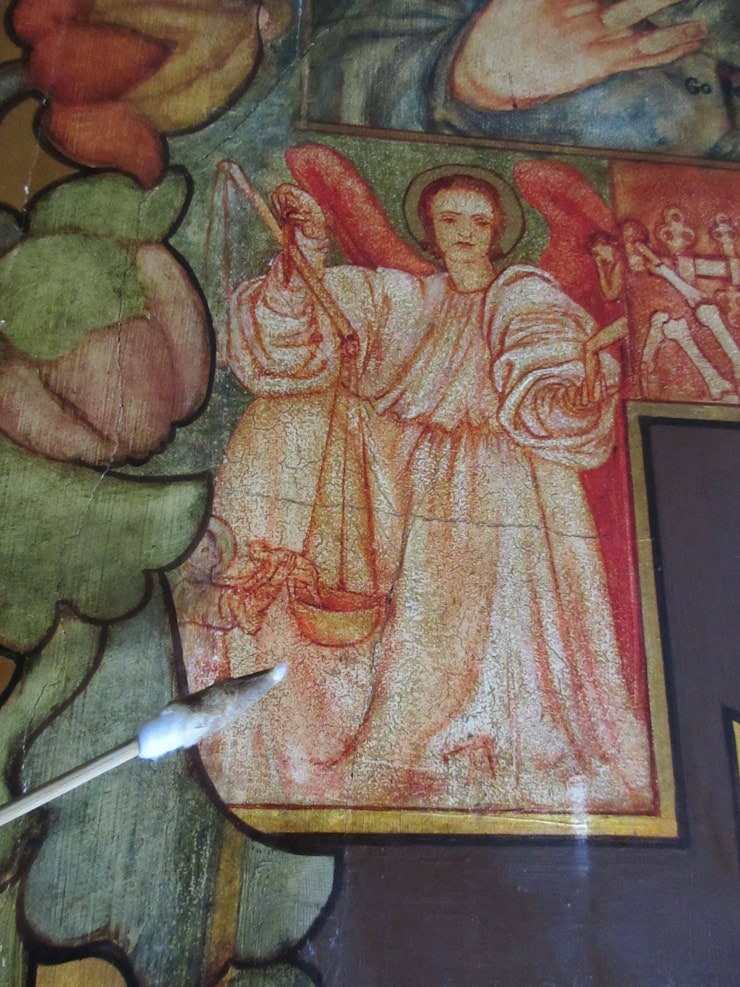
Most of the surviving 1880s paintings are on plastered lath (as are the 1890s murals that extend from their edges). However, one badly cracked, vulnerable painting is on plastered brick, which had been sawn through parallel to the paint surface to reduce its depth and fit into the new building.
Typically, cracks would be treated by firmly securing the plaster. However, there was an ethical dilemma: records in NLS Special Collections Archive revealed that Traquair wished her relocated murals to be ‘removable’ should this become necessary again. Thus, the 1880s murals had been cut out and enclosed in timber frames before being set into walls of the new building. The conservators’ approach to treatment involved securing cracks where they existed within the brick panel; whereas cracks that had developed at joins between different eras of painting were treated superficially to respect Traquair’s desire for ‘removability’ (in theory at least!) of her 1880s murals.
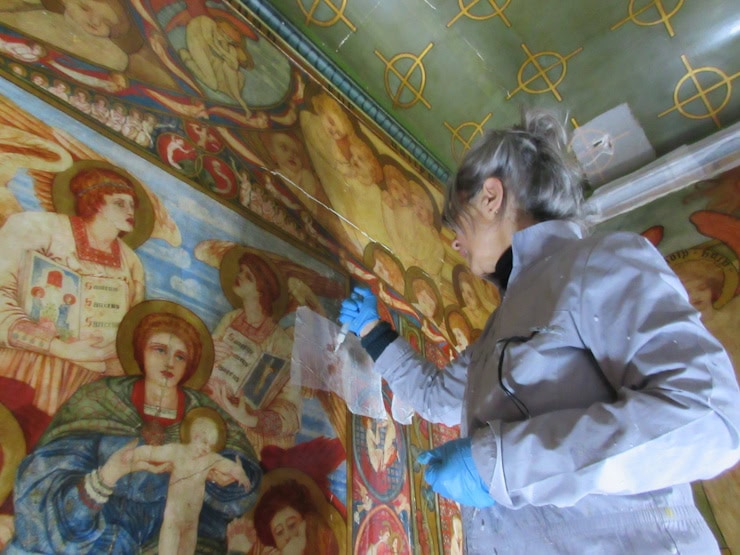
Future use of the chapel remains unclear; nevertheless, there are plans for public access to the conserved murals now that their legibility is restored. Visitors can enjoy searching for pentimenti (such as fragments of tiny trumpeting angels and serpents’ coils belonging to the earlier scheme) that are now visible where 1880s panels adjoin the extended decoration. And other mysterious details can be found, such as speech scrolls with lettering painted in reverse, mirror image and even upside down!
Karen Dundas (ACR) of Scottish Wall Paintings Conservators has been a freelance structural paintings conservator since 2005. She has considerable experience working with historic trusts, architects and private clients throughout Scotland. Karen is an Expert Member of ICOMOS International Wood Committee, and an ICON Specialist Advisor for Accreditation Assessments.
All images of the interior of the Mortuary Chapel are author’s own.
Published: 15th October 2025