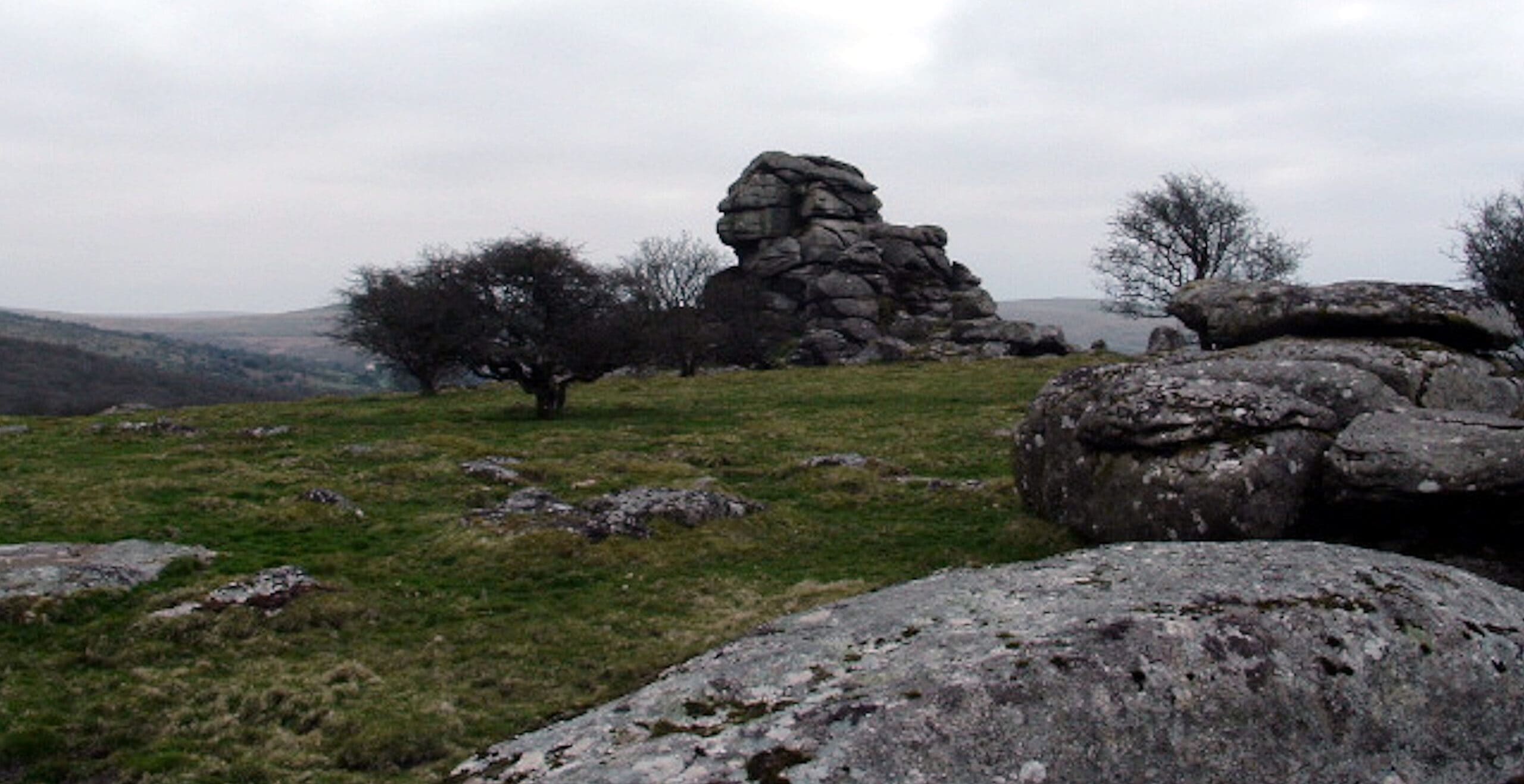


With clear country views stretching over miles of open moorland and an array of gorgeous natural features, Dartmoor is a National Park well worth visiting. But as well as scenic beauty, the moors are replete with ruins which tell the story of thousands of years of history…
Standing solitary on Dartmoor, an ancient site lies long abandoned. Its grey stone overgrown by moss, Dartmoor’s famous ponies graze on what must once have been its streets and courtyards. Nonetheless, when you back away, the plan of the old site is still clear. It is possible to put flesh on the stoney bones and imagine people living here, going about their daily lives for generations, and wonder why they abandoned this place to the elements. This description could apply to not just one, but at least three historic sites on Dartmoor: Merrivale, Grimspound, and Hound Tor. Taken together, they tell eerily similar stories of on-again off-again human habitation, environmental change, and the fickle nature of such a harsh yet beautiful environment.
 Two of Dartmoor’s iconic ponies enjoy some shade near the remains of Hound Tor Village, with the rocks of Hound Tor summit visible to the left. Photo by Mike Edwardson.
Merrivale is the oldest site of the three – here, on the western edge of Dartmoor, stands a series of intriguing Bronze Age monuments which defy easy explanation. A series of small stones have been placed in rows, forming two ‘avenues’ about 1 metre wide. The southerly avenue is about 263 metres long, with the northern avenue being slightly shorter. The south row is adjacent to a large subterranean tomb, of a type called a ‘kistvaen’ (from the Welsh ‘cist-maen’: ‘chest-stone’). Nearby, a lone upright stone, a ‘Menhir’, stands two metres tall as a solitary sentinel. A very small stone circle is also nearby, as are a number of cairns (burial mounds) which dot the landscape. The possible remains of Bronze Age stone dwellings also cluster nearby. People find it either charmingly intriguing or eerily confusing – what do these ancient patterns mean?
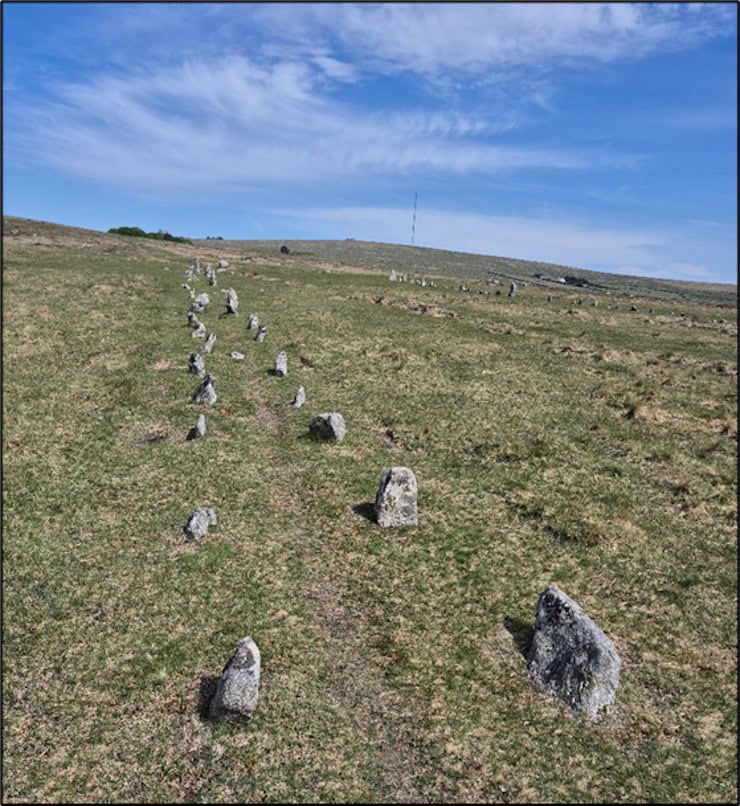 Part of Merrivale’s stone ‘avenue’, part of a ritual landscape which has survived for around 4,000 years. Photo by Mike Edwardson.
Merrivale is, most probably, a ritual landscape of some kind, created some 4,000 years ago. The stone ‘avenues’ may be what remains of a processional route, equivalent to Stonehenge’s larger, contemporary ‘avenue’. People may have marched down it carrying torches or venerated objects to mark special occasions. The other stone circles may have served ceremonial functions for the procession, while the burials may tell us that this area was the equivalent of a church, with significant people perhaps laid to rest here as a mark of honour and then honoured during the ceremonies. The site seems to have been worked on continuously for around 1,000 years, until the end of the Bronze Age around 1,000 BCE, when it appears to have been abandoned – a common pattern on Dartmoor, as we shall see.
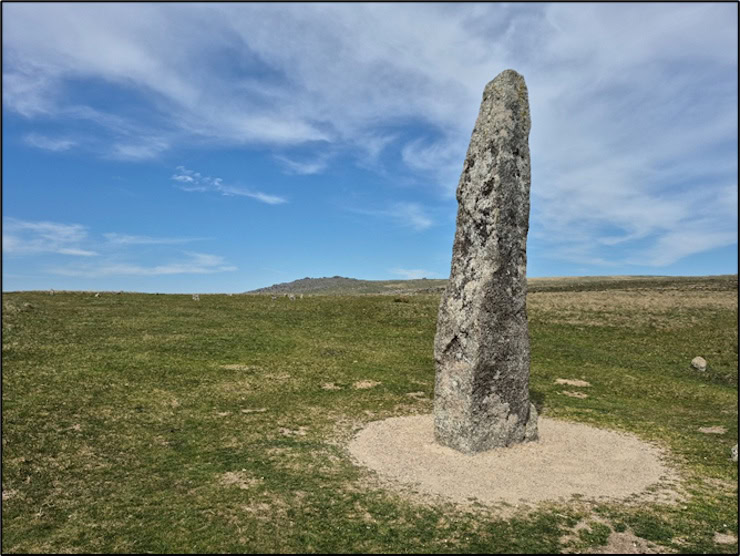 Merrivale’s solitary standing stone, known locally as a ‘Menhir’, with some of the stone ‘avenue’ visible in the middle distance. Photo by Mike Edwardson.
Journey just over 12 miles north-east by road, and you will find Grimspound. This site is perhaps more striking than Merrivale. It is a huge circular enclosure, remarkably well-preserved given it was built in the middle-Bronze Age, its large permitter wall standing since around 1,300 BCE. This granite wall would have been 1.7 metres high in some places, and protected at least 24 circular huts within its sanctum. Some of these huts are still clear to see, their doorways and front porches preserved, with artefacts such as pottery, scrapers and ‘pot boiler’ stones found within.
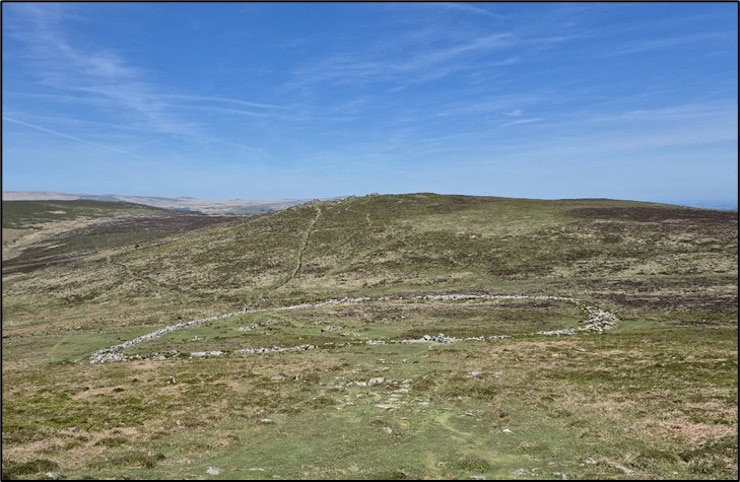 Grimspound’s circular enclosure seen from the nearby hill of Hameldown Tor. Photo by Mike Edwardson.
On first glance, Grimspound seems self-explanatory, mapping itself out on the landscape in an instantly understandable way. But on reflection, it becomes undoubtedly odd. The circular enclosure is small for a village, especially considering the 24 dwellings cramped within. Wouldn’t this have been uncomfortable? And the placement of the settlement, halfway down a slope on an exposed hillside, seems a strange siting choice. Yes, there is a stream running through it providing some water, but even so, wouldn’t people have preferred to live on lower, flatter ground with greater shelter and space?
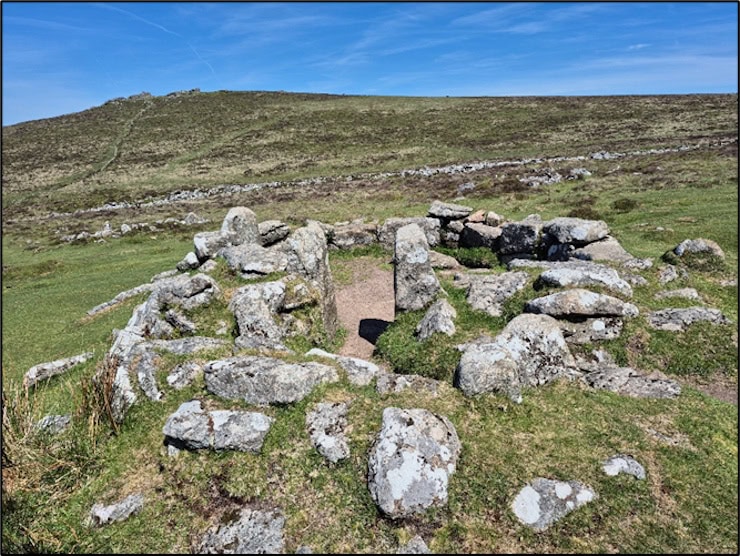 One of Grimspound’s Stone Huts, complete with the remains of a small ‘porch’ in the entranceway. Hookey Tor stands in the background. The fact that the site is built on a slope is clear in this picture. Photo by Mike Edwardson.
As such, it has been suggested that the site functioned primarily as an area to concentrate and protect livestock. But if so, why have so many small huts with domestic items inside? Others have interpreted it as a ‘fortified village’ where locals could shelter during times of threat. But if that were the case, why not build the fortress on one of the nearby hilltops, with better defensibility? Was it only occupied seasonally, a summer refuge for local herdsmen and their families? Maybe. The site defies easy explanation, and that is part of its attraction, a well-preserved but thought-provoking ruin.
What happened to Grimspound? Like Merrivale, it seems to have been abandoned at the end of the Bronze Age, around 1000 BCE. It’s original name long forgotten, it was Anglo-Saxon settlers of the 8th or 9th century who gave it the name ‘Grimspound’. They likely found the ruins as eerie as we do, hence the association with the menacing ‘Grim’ of Germanic mythology.
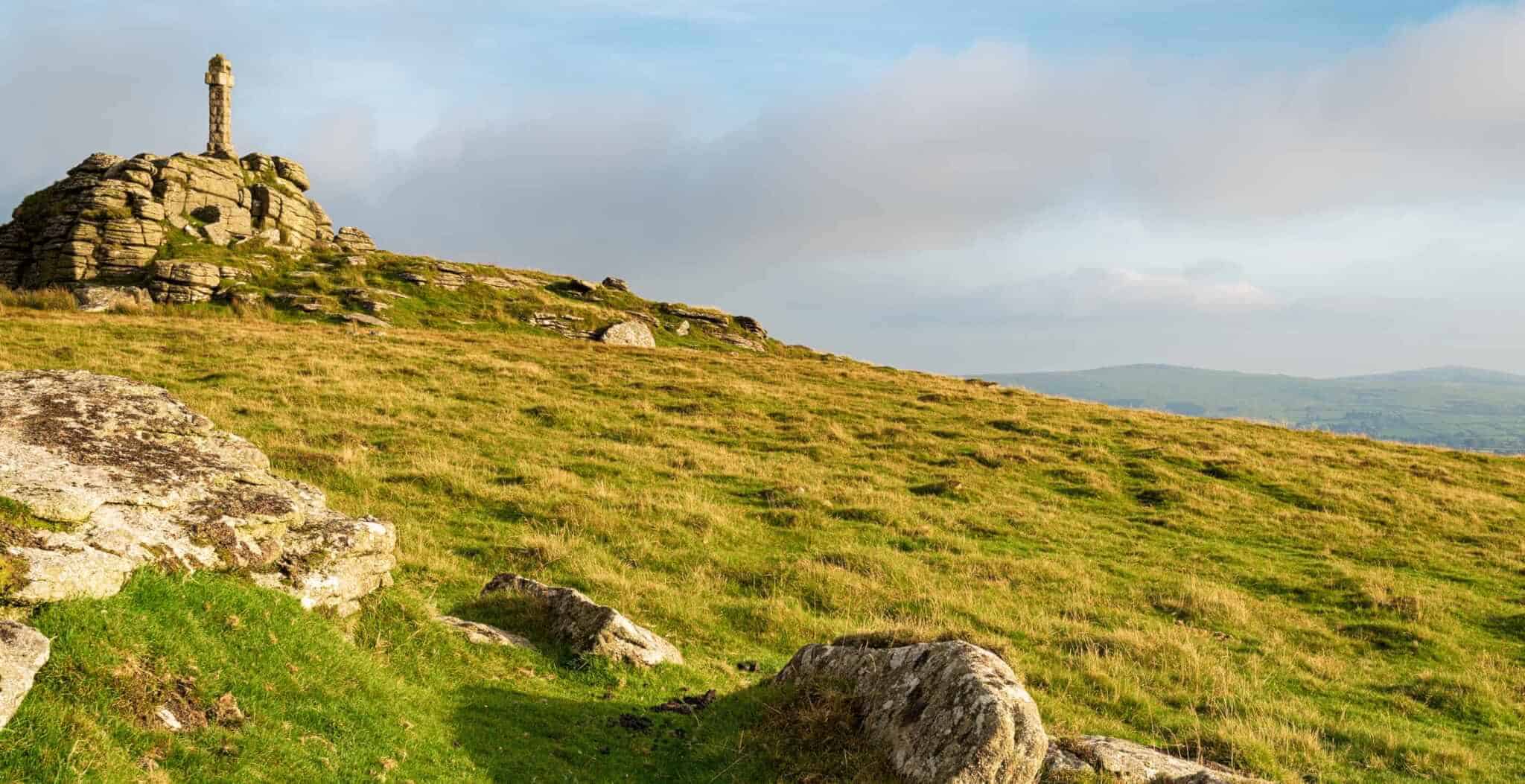
Finally, we travel a few miles south-east and more than 2,000 years in time. Hound Tor is a prominent rocky summit, its distinctive shape visible for miles across moor and valley. In its shadow lies the foundations of medieval buildings; low walls, living rooms and courtyards, overgrown with nature but unmistakeable all the same. These are the remains of four ‘Dartmoor Longhouses’, large farm buildings-come-dwellings distinctive to the region, which were once the central buildings of Hound Tor village.
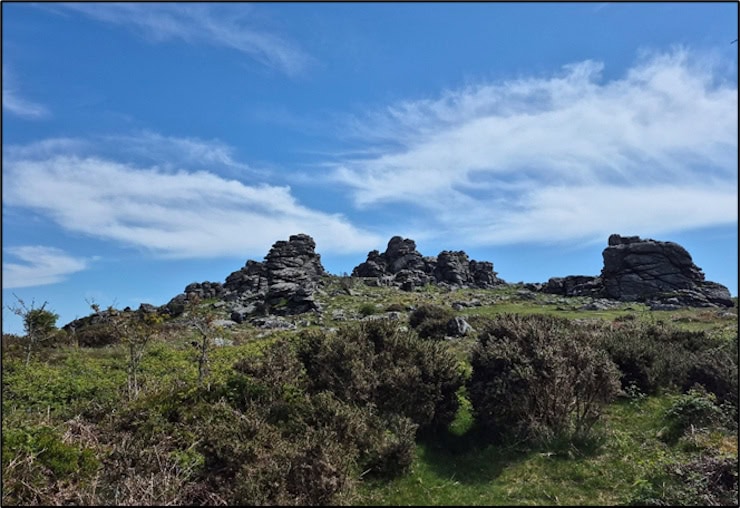 The rocky summit of Hound Tor, in the shadow of which lies the remains of a medieval village. Photo by Mike Edwardson.
The settlement is first mentioned in the Domesday Book of 1086 as belonging to Tavistock Abbey, and seems well established. It comprised land enough for four ploughs as well as pasture and woodland. A notable population lived here, and while there was no church, it was nonetheless a place occupied year-round, made to last. The village seems to have remained functional until 1350 – 1400, when it appears to have been abandoned. Its farms cease to operate around this time, and the buildings were left to nature. An abrupt end for a village that had existed for centuries.
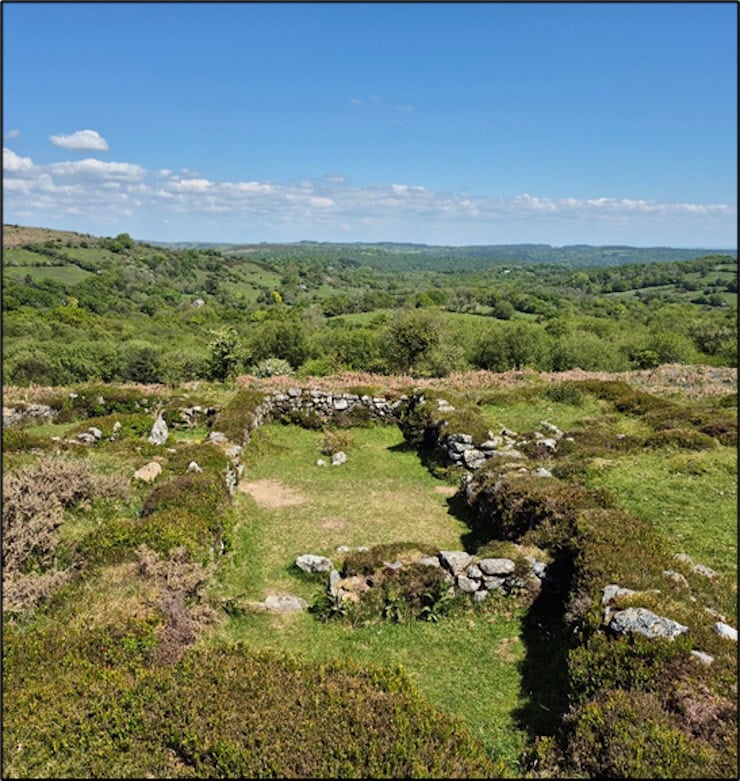 The remains of a longhouse at Hound Tor with its layout well preserved, looking out over the edge of Dartmoor and the valleys beyond. Photo by Mike Edwardson.
We must ask ourselves: why were all these Dartmoor sights abandoned, whether in the Bronze Age or medieval times? The answer is that they all seem to have been abandoned due to climate change. There was a natural, long-term climatic shift at the end of the Bronze Age, around 1200 – 800 BCE, causing the British climate to become cooler and wetter. Where the warm early Bronze Age had made the uplands of Dartmoor liveable for most of the year, the harsher climate likely made them inhospitable – a cold, wet and miserable existence. This likely forced a retreat from settlements like Merrivale and Grimspound to lowland sites more capable of sustaining the community.
More than 2,000 years later, the medieval warm period (c. 900 – 1250) had allowed a return to some of Dartmoor’s uplands, making the establishment of Hound Tor possible. But around 1300, another cooling period set in, bringing harsher winters and unsettled weather year-round. This almost certainly forced the abandonment of Hound Tor village by 1400, as the inhabitants sought the more sheltered and warmer lands of the South Hams.
It’s sometimes said that history doesn’t repeat itself, but it does rhyme. In the ruins of Dartmoor, the rhyme gets as close as possible to a repeat. Today, you can visit each of these well-preserved sites and let your imagination build them back to full grandeur. With luck, you’ll get a dry, bright day on which to enjoy the scenery – but be sure to take a jumper and raincoat all the same. They say the climate is very changeable.
Mike Edwardson is a professional analyst and writer with an MA in History from The University of Sheffield. Passionate about uncovering the lesser-known stories of British history, Mike combines his analytical skills with a love for storytelling to bring the past to life.
Published: 5th August 2025