

St Dwynwen’s Day is celebrated in Wales on 25 January. But who was St Dwynwen?
St Dwynwen is the Welsh patron saint of lovers, which makes her the Welsh equivalent of St Valentine.
Dwynwen lived during the 5th century and legend has it that she was one of the prettiest of Brychan Brycheiniog’s 24 daughters. Dwynwen fell in love with a prince called Maelon Dafodrill, but unfortunately her father had already arranged that she should marry someone else.
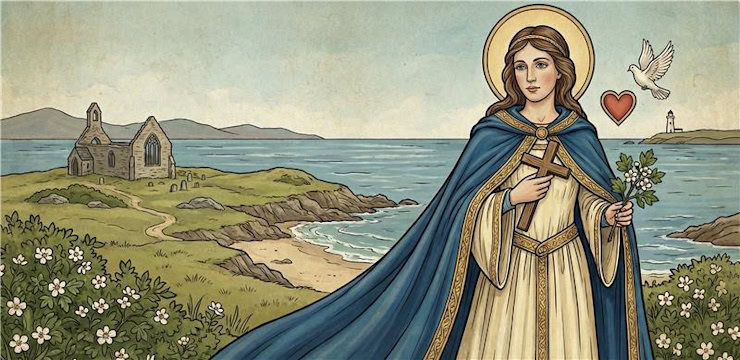
Dwynwen was so upset that she could not marry Maelon that she begged God to make her forget him. After falling asleep, Dwynwen was visited by an angel, who appeared carrying a sweet potion designed to erase all memory of Maelon and turn him into a block of ice.
God then gave three wishes to Dwynwen. Her first wish was that Maelon be thawed; her second that God meet the hopes and dreams of true lovers; and third, that she should never marry. All three were fulfilled, and as a mark of her thanks, Dwynwen devoted herself to God’s service for the rest of her life.
She founded a convent on Llanddwyn, off the west coast of Anglesey, where a well named after her became a place of pilgrimage after her death in AD 465. Visitors to the well believed that the sacred fish or eels that lived in the well could foretell whether or not their relationship would be happy and whether love and happiness would be theirs. Remains of Dwynwen’s church can still be seen today.

The popularity and celebration of St Dwynwen’s Day has increased considerably in recent years and many people now send St Dwynwen’s Day cards to each other. There are lots of outlets online from which these can be purchased.
So why wait until St Valentine’s Day to make your romantic feelings known, when you can wish your loved one ‘dwi’n dy garu di ‘ (I love you) three weeks earlier?