

‘Waltzing Matilda’ is Australia’s best known and much loved folk song, and the first verse is as follows:
Once a jolly swagman* camped by a billabong,
Under the shade of a coolibah tree,
And he sang as he watched and waited till his billy boiled,
“You’ll come a-waltzing Matilda** with me.”
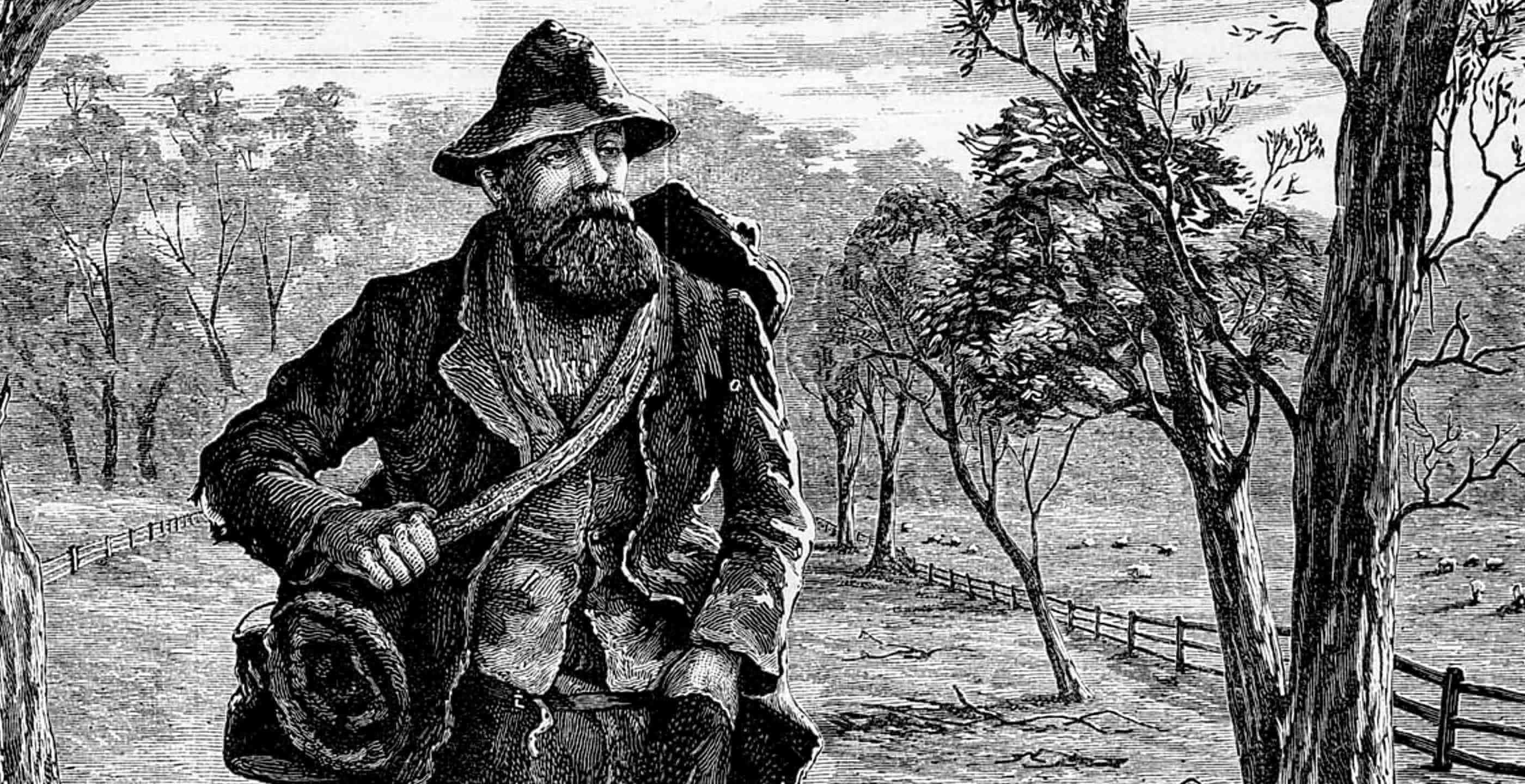
Yet possibly the most famous swagman of them all was a Welshman, Joseph Jenkins.
Joseph Jenkins (1818-98) was born at Blaenplwyf near Talsarn, Cardiganshire in 1818, one of twelve children. He lived on his parent’s farm until he married at the age of 28 when he began farming at Trecefel, Tregaron. Jenkins wrote poetry, specialising in the englynion, a Welsh verse form. He would walk to the Ballarat Eisteddfod each year to compete in the poetry competition which he won many times. He became a successful farmer (Tregaron was judged the best farm in Cardiganshire in 1857) and a leading figure in the community.
Then suddenly – at the age of 51 – he decided to leave his wife and family and emigrated to Australia, where he stayed for twenty-five years until he returned home again in 1894. While living and travelling throughout central Victoria in Australia and working as a “swagman” he kept a diary, which survives as an eye-witness account of life in the Bush in the 19th Century.
What could have made him decide to leave Wales and travel to the other side of the world to work as an itinerant worker, so late in life?
It is true that in the middle of the nineteenth century, the life of a farmer in Wales was a hard one but life as a swagman would certainly be no easier! One factor may have been an unhappy marriage but whatever it was, he left Wales in 1869 for a new life. Perhaps today we would call it a “middle age crisis” or a need to “find himself”.
Jenkins arrived in Port Melbourne on the 22 March 1869 and joined scores of swagmen* on the road looking for work.
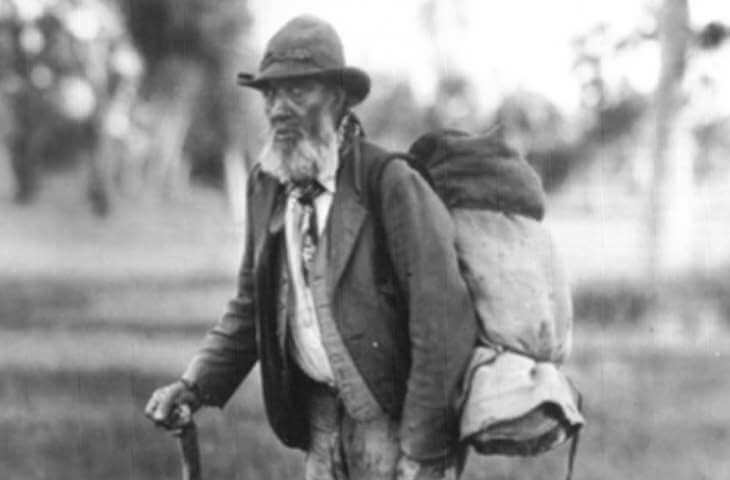
Between 1869 and 1894, Jenkins lived much of his life in central Victoria including Maldon, Ballarat and Castlemaine. His diaries record his experiences as an itinerant agricultural labourer and provide a unique account of life in colonial Australia.
The diaries are a reflective view of Jenkins’ life and detail the day-to-day tasks in a developing colony. He comments on such topics as farming practice, availability of work, costs of food, hut building, health and toothache and other everyday practicalities of life. His diaries also include poetry and comments on the social and political issues of that time.
Jenkins’ achievement – making daily entries in his diary for 25 years while working as a manual labourer for up to 16 hours a day – is nothing short of remarkable.
The diaries, consisting of 25 volumes, were discovered 70 years after Jenkins’ death in the attic of one of his descendants in Wales. Since being published in 1975 as Diary of a Welsh Swagman, Jenkins’ writings have become a popular Australian history text.
*SWAGMAN: An itinerant labourer, a tramp. So called because his most important possession is his bedroll (or “swag”), worn behind his head as he walks along.
**WALTZING MATILDA : the act of carrying the swag.
More information
‘Diary of a Welsh swagman’, 1869-1894 abridged and annotated by William Evans. — South Melbourne, Vic : Macmillan, 1975.