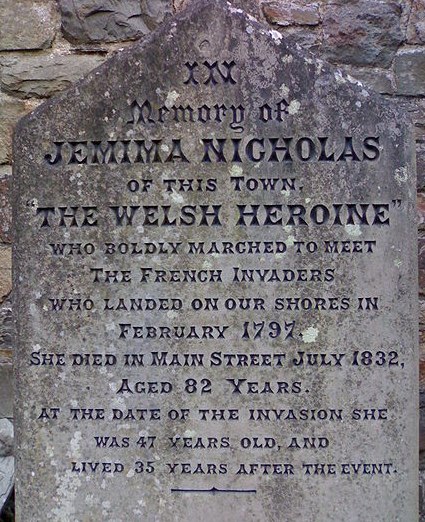


The annals of history record the name of Hastings as the site of the last invasion of mainland Britain by Norman forces in 1066. True, this was the last successful invasion. However, little is reported about the French invasion of Fishguard, which took place in southwest Wales in 1797, nor of the brave resistance offered by Jemima Nicholas, also known as “Jemima Fawr” (Jemima the Great), who single-handedly captured twelve of the invading soldiers.
In 1797, Napoleon Bonaparte was busy conquering in central Europe. In his absence the newly formed French revolutionary government, the Directory, appears to have devised a ‘cunning plan’ that involved the poor country folk of Britain rallying to the support of their French liberators. Obviously the Directory had recently taken delivery of some newly liberated Brandy!
The French invasion force comprising some 1400 troops set sail from Camaret on February 18th, 1797. The man entrusted by the Directory to implement their ‘cunning plan’ was an Irish-American septuagenarian, Colonel William Tate. As Napoleon had apparently reserved the cream of the Republican army for duties elsewhere in Europe, Colonel Tate’s force comprised a ragtag collection of soldiers including many newly released jailbirds. Tate’s orders were to land near Bristol, England’s second largest city and destroy it, then to cross over into Wales and march north onto Chester and Liverpool. From the outset however all did not proceed as detailed in the ‘cunning plan’. Wind conditions made it impossible for the four French warships to land anywhere near Bristol, so Tate moved to ‘cunning plan’ B, and set a course for Cardigan Bay in southwest Wales.
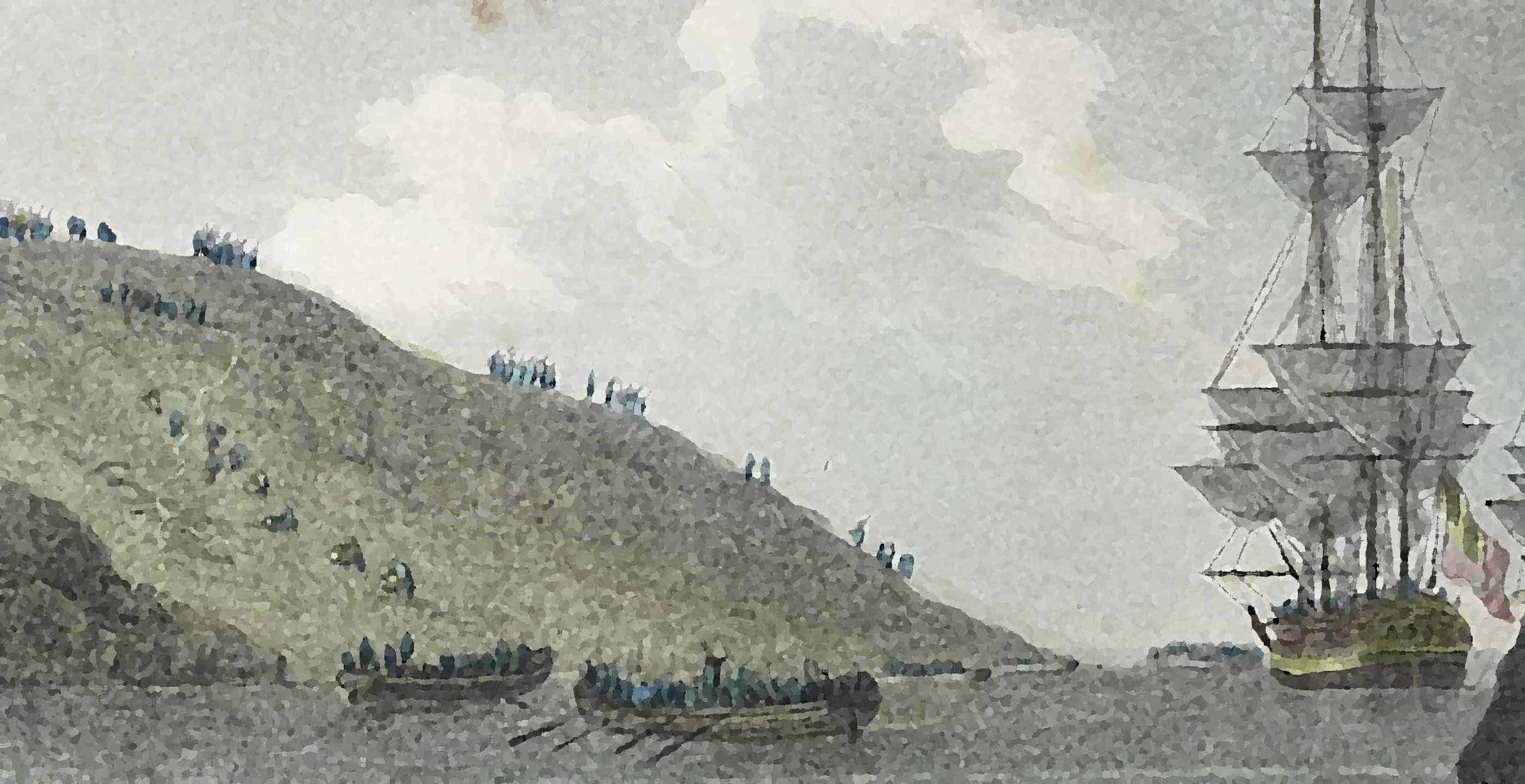
On Wednesday February 22nd, the French warships sailed into Fishguard Bay to be greeted by canon fire from the local fort. Unbeknown to the French, the cannon was being fired as an alarm to the local townsfolk. Nervously the ships withdrew and sailed on until they reached a small sandy beach near the village of Llanwnda. Men, arms and gunpowder were unloaded and by 2 am on the morning of Thursday February 23rd, the last invasion of Britain was completed. The ships returned to France with a special despatch being sent to the Directory in Paris informing them of the successful landing.
Upon landing, the French invasion force appear to have run out of enthusiasm for the ‘cunning plan’. Perhaps as a result of years of prison rations, they seem to have been more interested in the rich food and wine the locals had recently removed from a grounded Portuguese ship. After a looting spree, many of the invaders were too drunk to fight and within two days, the invasion had collapsed: Tate’s force surrendered to a local militia force led by Lord Cawdor on February 25th 1797.
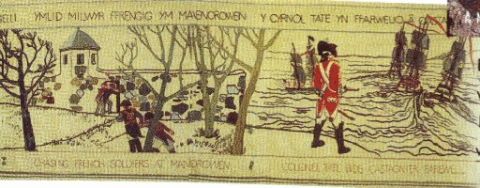
Strange that the surrender agreement drawn up by Tate’s officers referred to the British coming at them “with troops of the line to the number of several thousand.” No such troops were anywhere near Fishguard, however hundreds, perhaps thousands of local Welsh women dressed in their traditional scarlet tunics and tall black felt hats had come to witness any fighting between the French and the local men of the militia. Is it possible that at a distance, and after a glass or two, those women could have been mistaken for British army Redcoats?
 During their two days on British soil the French soldiers must have shaken in their boots at mention of name of “Jemima Fawr” (Jemima the Great). The 47-year-old Jemima Nicholas was the wife of a Fishguard cobbler. When she heard of the invasion, she marched out to Llanwnda, pitchfork in hand, and rounded up twelve Frenchmen. She ‘persuaded’ them to accompany her back into town, where she locked them inside St Mary’s Church and promptly left to look for some more! Men of Harlech meet your match!