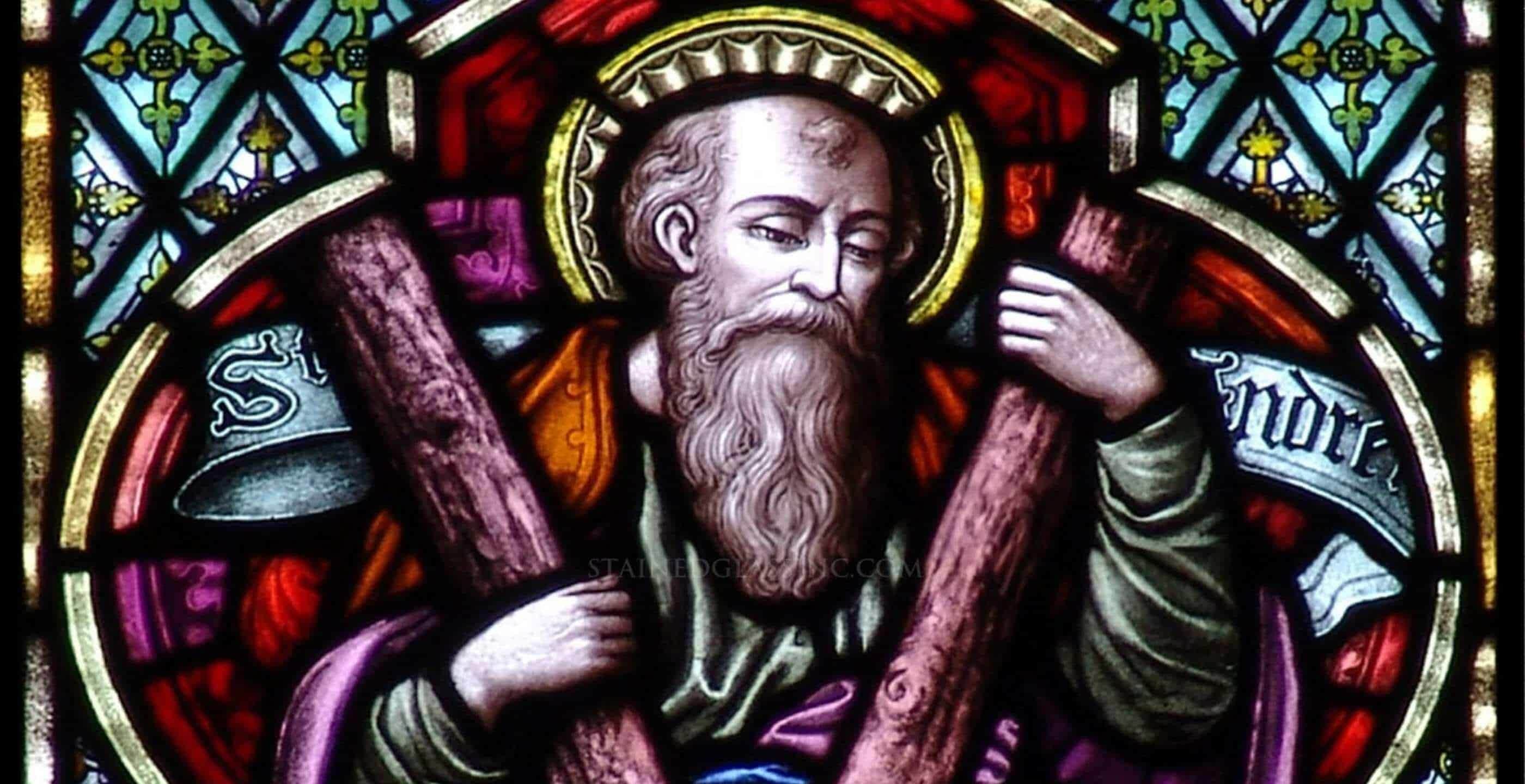


The union flag of the United Kingdom of Great Britain and Northern Ireland is sometimes referred to as the Union Jack and is made up of three overlaid crosses. One of these crosses is the flag of the Patron Saint of Scotland, Saint Andrew, although he was not actually born in Scotland.
Andrew’s home was the village of Bethsaida on the Sea of Galilee, and like his brother Simon Peter, he was a fisherman.
Andrew, along with Peter, James and John formed the inner circle of Jesus’ 12 apostles. Andrew was however a disciple of St. John the Baptist prior to becoming a follower of Christ.

Not a great deal is known about his early life other than he is mentioned in the Bible as taking part in the ‘Feeding of the Five Thousand’. It is not absolutely certain where he preached the Gospel, or where he is buried, but Patras in Achia claims to be the place where he was martyred and crucified on a cross.
Whilst it is not certain where Andrew actually preached – Scythia, Thrace and Asia Minor have all been mentioned – it appears he traveled great distances in order to spread the word, and it may be this which links him with Scotland.
Two versions of events claim this link.
One legend builds upon Andrew’s extensive travels, claiming that he actually came to Scotland and built a church in Fife. This town is now called St Andrews, and the church became a centre for evangelism, and pilgrims came from all over Britain to pray there.
Another ancient legend recalls how it was after the death of Andrew, sometime in the 4th century, that several of his relics where brought to Fife by Rule, a native of Patras.
Whichever legend is closer to the truth we are unlikely to ever unravel, however it is these links that explain why Andrew is now the Patron Saint of Scotland.
Churches were dedicated to him from early times throughout Italy and France as well as in Anglo Saxon England, where Hexham and Rochester were the earliest of 637 medieval dedications.
St. Andrew has also been remembered down through the ages for the way he met his terrible death in A.D. 60.
It is said that he believed himself unworthy to be crucified on a cross like that of Christ, and so he met his end on a ‘saltire’, or X-shaped cross (St Andrew’s cross) which became his symbol. His cross, in white on a blue background, remains the proud symbol of Scotland today and forms a central component of the flag of the United Kingdon of Great Britain and Northern Ireland.
The supposed anniversary of his martyrdom is 30 November, and it is this date that is honoured as his feast day each year.

Today, pilgrims of another sort make the journey from all over the world to the tiny city of St Andrews, internationally recognised as the traditional home of golf.