

Common throughout the highlands, islands and lowlands of Scotland, the prickly purple thistle has been Scotland’s national emblem for centuries. This proud and regal plant, which grows to a height of five feet, has no natural enemies because of the vicious spines that cover and protect it like a porcupine.
There are several different legends that tell how the thistle became Scotland’s symbol, but most date from the reign of Alexander III and in particular the events surrounding the Battle of Largs in 1263.
It is often forgotten, that for hundreds of years much of Scotland was part of the Kingdom of Norway. By 1263 however, Norway seems to have had little interest in their former territory. However, that was until King Alexander III proposed to buy back the Western Isles and Kintyre from the Norse King Haakon IV. The thought of relieving King Alexander of some of his riches and territories appears to have re-kindled Norse interest in Scotland.
Late in the summer of 1263 King Haakon of Norway, now intent on conquering the Scots, set off with a sizeable fleet of longships for the Scottish coast. Gales and fierce storms forced some of the ships onto the beach at Largs in Ayrshire, and a Norwegian force was landed.
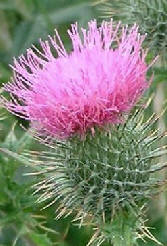 Legend has it that at some point during the invasion the Norsemen tried to surprise the sleeping Scottish Clansmen. In order to move more stealthily under the cover of darkness the Norsemen removed their footwear. But as they crept barefoot they came across an area of ground covered in thistles and one of Haakon’s men unfortunately stood on one and shrieked out in pain, thus alerting the Clansmen to the advancing Norsemen.
His shout warned the Scots who rose up and engaged the enemy, thus saving Scotland from invasion. The important role that the thistle had played in the Battle of Largs was recognised and so was chosen as Scotland’s national emblem.
The first use of the thistle as a royal symbol of Scotland was on silver coins issued by James III in 1470.
It is said that the Order of the Thistle, the highest honour in Scotland, was founded in 1540 by King James V who, after being honoured with the Order of the Garter from his uncle King Henry VIII of England and with the Golden Fleece from the Emperor of France, felt a little left out. He resolved the issue by creating the royal title of Order of the Thistle for himself and twelve of his knights, ‘…in allusion to the Blessed Saviour and his Twelve Apostles’. He set up the arms and badges of the order over the gate of his palace at Linlithgow.
The common badge worn over the left breast by the knights is a cross surmounted by a star of four silver points, and over this a green circle bordered and lettered with gold, containing the motto “Nemo me impune lacessit”, “No-one harms me without punishment” but more commonly translated in Scots as “Wha daurs meddle wi me”, in the centre is the thistle.