

The first roads in Britain were built by the Roman legions, which had their own surveyors, engineers and the equipment they needed for this type of construction work. The availability of local materials dictated the details of road construction, but the basic principles were always the same. The road took the form of an embankment, raised above the level of the surrounding land, with drainage ditches on either side. It would be built up in a series of layers, comprising a foundation of large rocks, followed by smaller stones, gravel and sand laid down in successive layers and rammed into place.
A cobbled surface was commonplace in towns or areas of heavy use, but usually it would be gravel. The embankment was cambered for drainage, often 10m (33ft) or more wide; it was rarely less than 3m (9ft) wide to allow room for two-wheeled vehicles to pass. As elsewhere, Roman roads in Britain were built as straight as possible. The Roman surveyors had no need to worry about who owned the land along the route-way because as conquerors they could choose the most direct route. Nevertheless, they by-passed mountains, marshes and forest, where they posed particular obstacles, and they would seek out suitable crossing points at rivers.
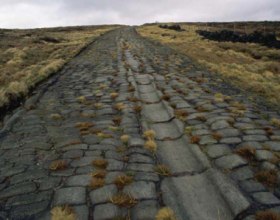
Above: Blackstone Edge, on Rishworth Moor near Manchester, is remarkably well preserved with rain gullies and close-fitting cobbles still intact. Some archaeologists believe it to be of Roman origin, whilst others are less convinced. Below: close-up detail

Although their primary purpose in the early days of the conquest was to speed the movement of troops, roads subsequently became even more important as communication routes between different parts of the empire. They enabled important information to be passed between Rome and the provincial governors of the areas under their control. In Britain, the Roman economy was agricultural, based around villa estates, which produced surplus food to provide supplies for the army and the urban populations. The roads also made possible the movement of pottery and other goods, whose production became commonplace in Britain in the third and fourth centuries AD.
Well-known Roman roads include Watling Street, which ran from London to Chester and the Fosse Way, which crossed England from Exeter in the south-west to Lincoln in the north-east. The latter followed a route in use since prehistoric times and around AD47 it marked the first boundary of the new Roman province. Roman roads later became a liability because invading barbarians could travel along them as quickly as the Roman armies. The Salisbury–Badbury road was deliberately blocked by the Bokerley Dyke during a crisis in the fourth century. The roads went into decline after the Roman departure and not until the advent of railways in the nineteenth century did Britain again enjoy such an efficient communications network.
This reconstruction (below) reveals the benefits of Roman civilisation. The central feature is the road which provides easy transport for troops and commerce. The legionary cavalry soldier, accompanied by a foot soldier, is of high status and would have a cohort of legionnaires not far behind him. In the distance you can see the classical design of a villa which represents the beginning of an architecture that was new to Iron Age Britain.
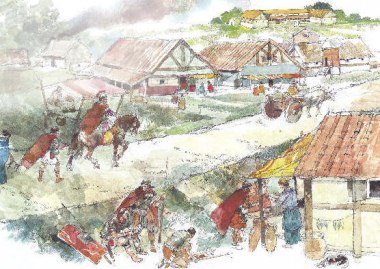
A small settlement takes advantage of the passing traffic. A woman is selling food and drink and you can see the amphora containing oil and wine – examples of imports introduced by Roman merchants. The buildings are roofed in tile and some have painted plaster. However, despite these innovations, you can also see Romano-British carrying on with their lives, emphasising that not every aspect of British life was romanised. The soldiers pay in coin – most likely small denomination bronze-copper alloy coins, received as change after paying taxes with silver or gold coins received as wages. The soldier on his knees in the foreground has lost the gold coin that represents a month’s wages – it will be this coin that will be found 1800 years later. The road is the Fosse Way – still a major route today. As in Roman times, it links up with a system with London as its hub.
Extract from “The Time Team – What Happened When”, Tim Taylor