

During World War II the daily newspapers were at their most popular …even though they consisted of only a few pages. People throughout Britain could find out what was happening in the parts of the world where our troops were engaged in the fight against Hitler and the Nazis
At the beginning of the war, the news was mainly bad with the German blitzkrieg advances throughout Europe but as the years rolled on, the news slowly became better …and in October 1942 British morale was greatly bolstered by General Montgomery’s famous success at El Alamein in North Africa.
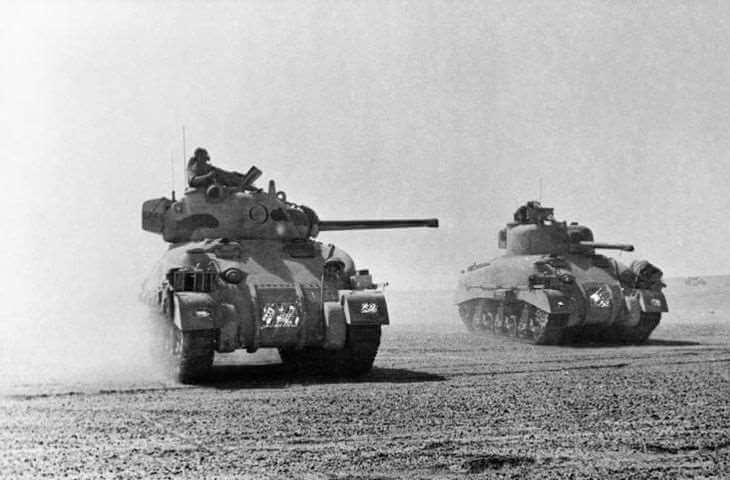
British Sherman tanks during the Battle of El Alamein, 1942
But it wasn’t just the news that was eagerly sought in the papers; there were other matters of interest. Nearly all newspapers had crossword puzzles in them and they were very popular as they helped fill in the hours spent in the air-raid Shelters, waiting for trains or just simply engaged in that great British tradition of queuing.
One of the popular ‘dailys’ of the time was the Daily Telegraph, and so too was its crossword puzzle.
It was in January 1943 that the British Prime Minister Winston Churchill and American President Franklin D Roosevelt met and agreed that the future of the war must include an invasion of northwest Europe or a ‘return to the Continent’.
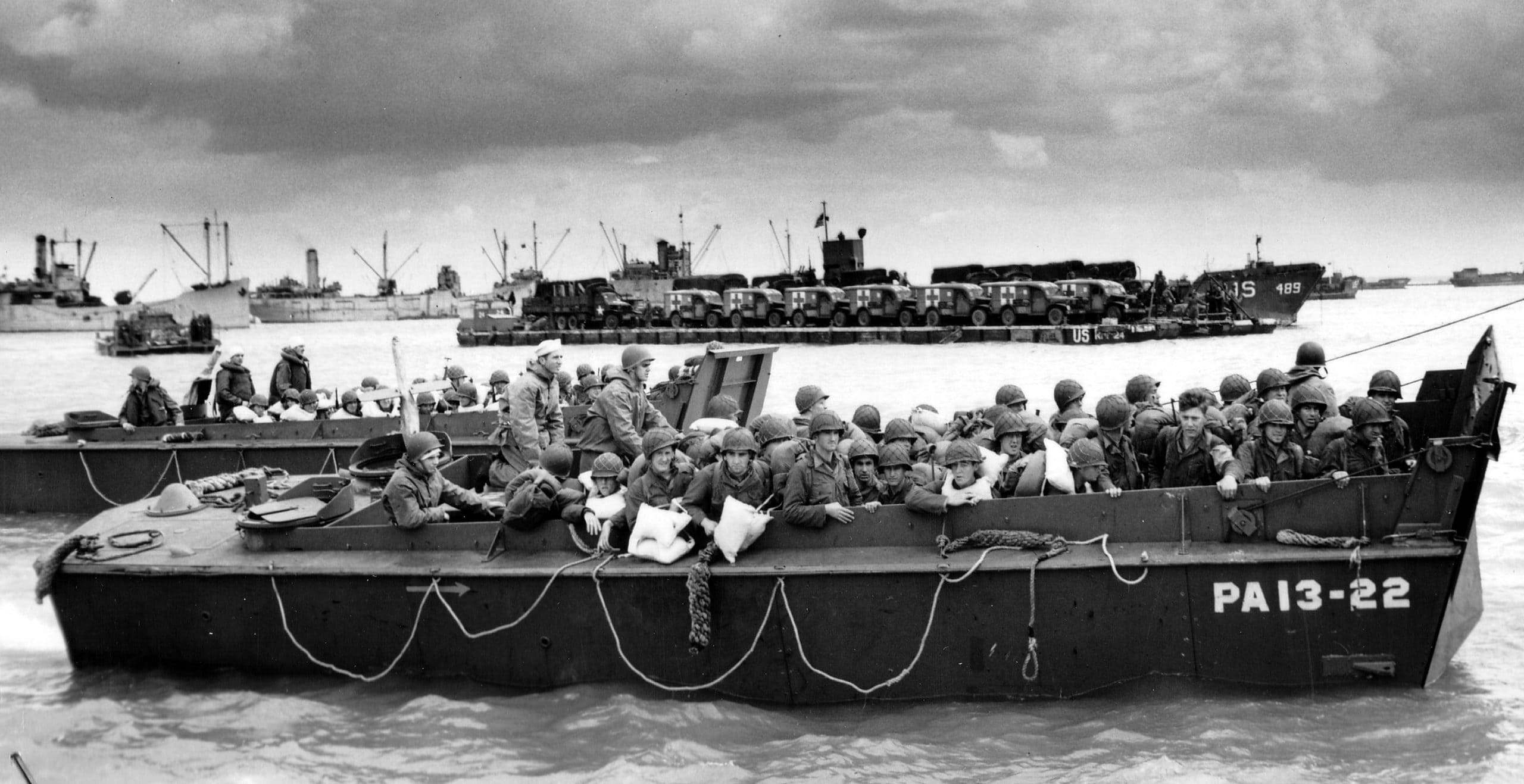
Planning for the invasion started almost immediately, and after extensive research it was decided that the sheltered Normandy coastline with its wide sandy beaches presented the best option for the surprise attack that was to be the D-Day landings. The assault was code-named Operation Overlord by Churchill himself.
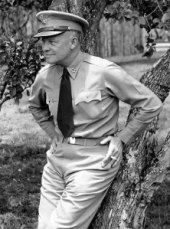 The US General Dwight D Eisenhower was made overall commander of Operation Overlord in December 1943, with the British hero General Bernard Law Montgomery assuming control of ground troops. It was in early May 1944 that Eisenhower decided that D-Day would fall on 5th June 1944.
A huge security blanket had been thrown over all aspects of the operation, including the place and exact date of the landings, in order to maximise the element of surprise and minimise casualties. One US major-general was even demoted and sent home for simply speculating at a cocktail party on the date of the invasion.
But while some members of MI5, Britain’s counter-espionage service, were whiling away their spare moments in May 1944 by doing the Telegraph Crossword, they noticed that vital code-names that had been adopted to hide the mightiest sea-borne assault of all time, appeared in the crossword.
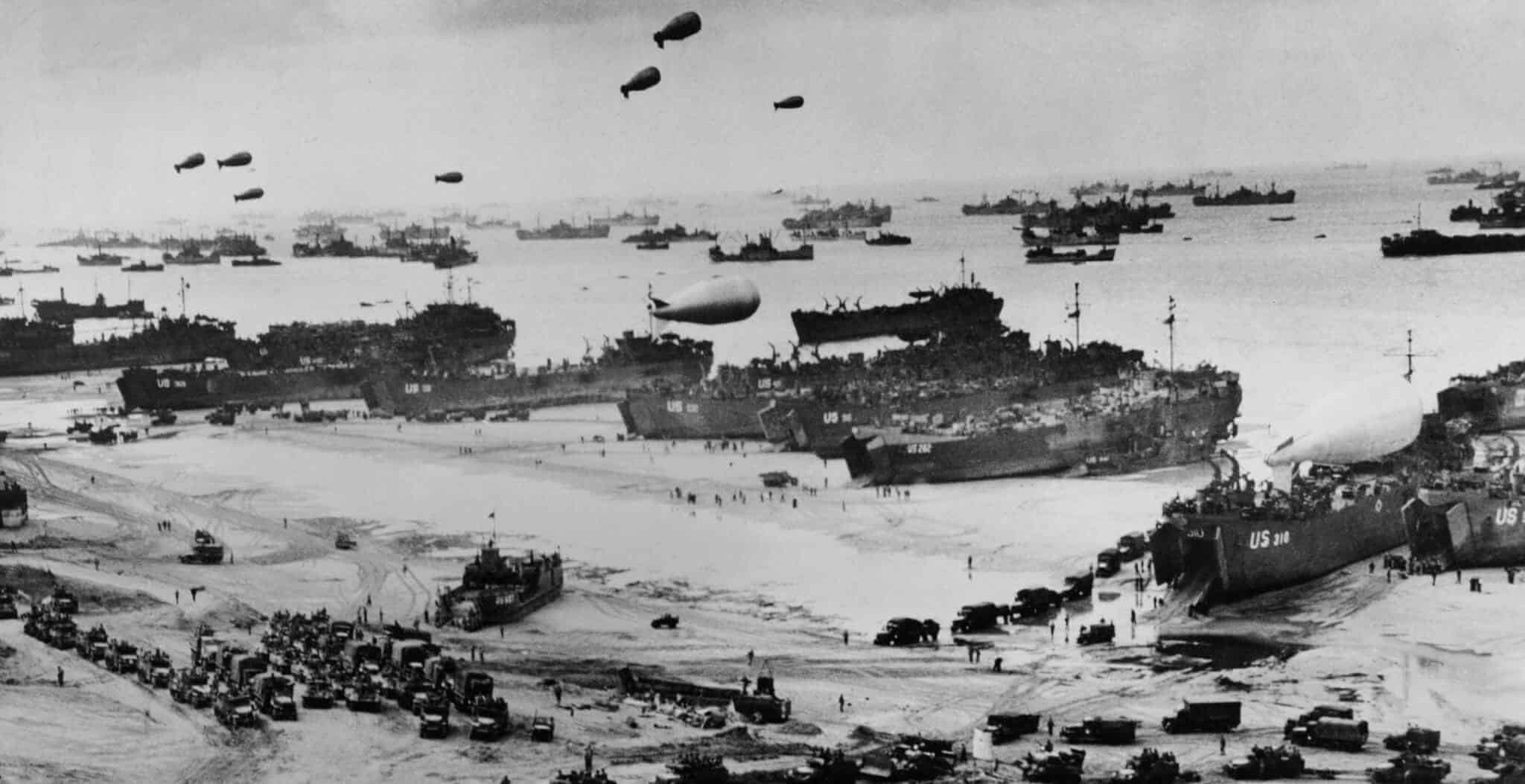
They noticed that the answer to one clue, ‘One of the USA’, turned out to be Utah, and another answer to a clue was Omaha. These were the names given by the Allies to the beaches in Normandy where the American Forces were to land on D-Day.
Another answer that appeared in that month’s crossword was Mulberry. This was the name of the floating harbour that was to be towed across the Channel to accommodate the supply ships of the invasion force. Neptune, another answer, referred to the code-name for the naval support for the operation.
Perhaps the most suspicious was a clue about a ‘Big-Wig’, to which the answer was Overlord. This was the code-name given for the entire operation!
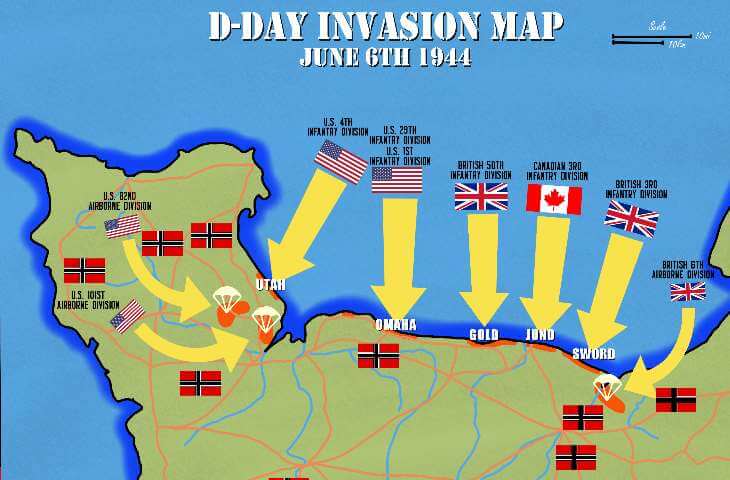
D-Day ‘Operation Overlord’ Invasion Map
Alarm bells rang throughout MI5 …was the crossword being used to tip-off the Germans?
Two officers were sent immediately to Leatherhead in Surrey, where a man called Leonard Dawe lived. He was the crossword compiler, a 54 year-old teacher.
Why, the officers demanded to know, had he chosen these five words within his crossword solutions?
“Why not?” was Dawe’s indignant reply. Was there a law against choosing whatever words he liked?
MI5 eventually became convinced of Dawe’s honesty and he managed to convince them that he had no knowledge of the coming D-Day invasion.
It appears his crossword solutions were perhaps just another of life’s astonishing coincidences!
Footnote
The above article was originally compiled by Historic UK researchers in 2004, based upon the best information available at that time. We have however, recently been contacted by Mr Richard S J Wallington, who updates the article with some fascinating facts that reveal that the solutions were perhaps not, after all, simply astonishing coincidences!
“Mr Dawe was and had for some time been the Headmaster of Strand School – originally a part of King’s College, London. In 1939 the school was evacuated from its home in South London to the area of Great and Little Bookham in Surrey. The school buildings it occupied were in Effingham. Both boys and masters were billeted in that general area.
Mr Dawe was a compiler of puzzles for the Daily Telegraph and it was often his practice to call in 6th formers and ask them for words for inclusion. At that time the US Forces were liberally strewn through Surrey, particularly in the Epsom area and there is no doubt that boys heard these code words being bandied about and innocently passed them on. I should know as I was then a 6th former there myself, although not involved with this particular matter.
Mr Dawe was a disciplinarian and a man of extremely high principle and one could not imagine anyone less likely to be involved in anything incorrect.”
Richard S J Wallington