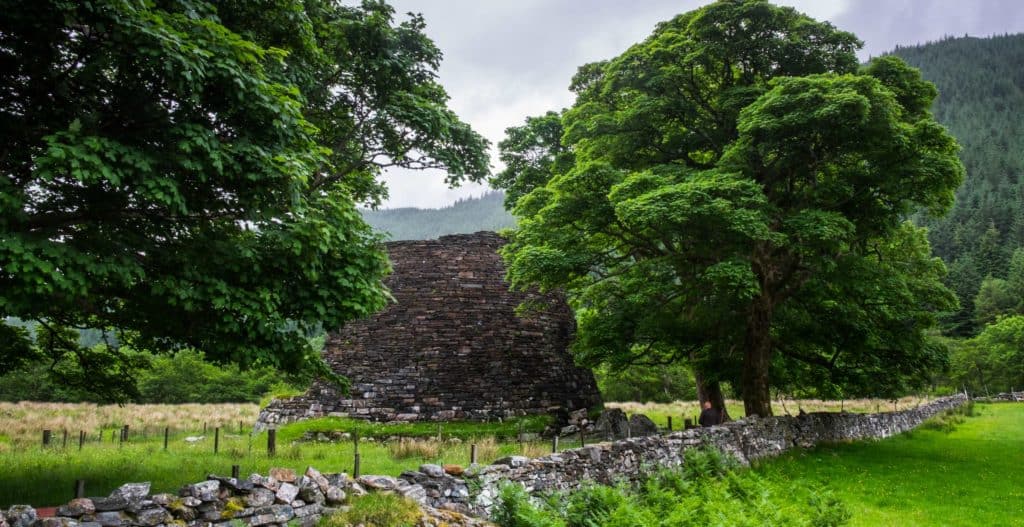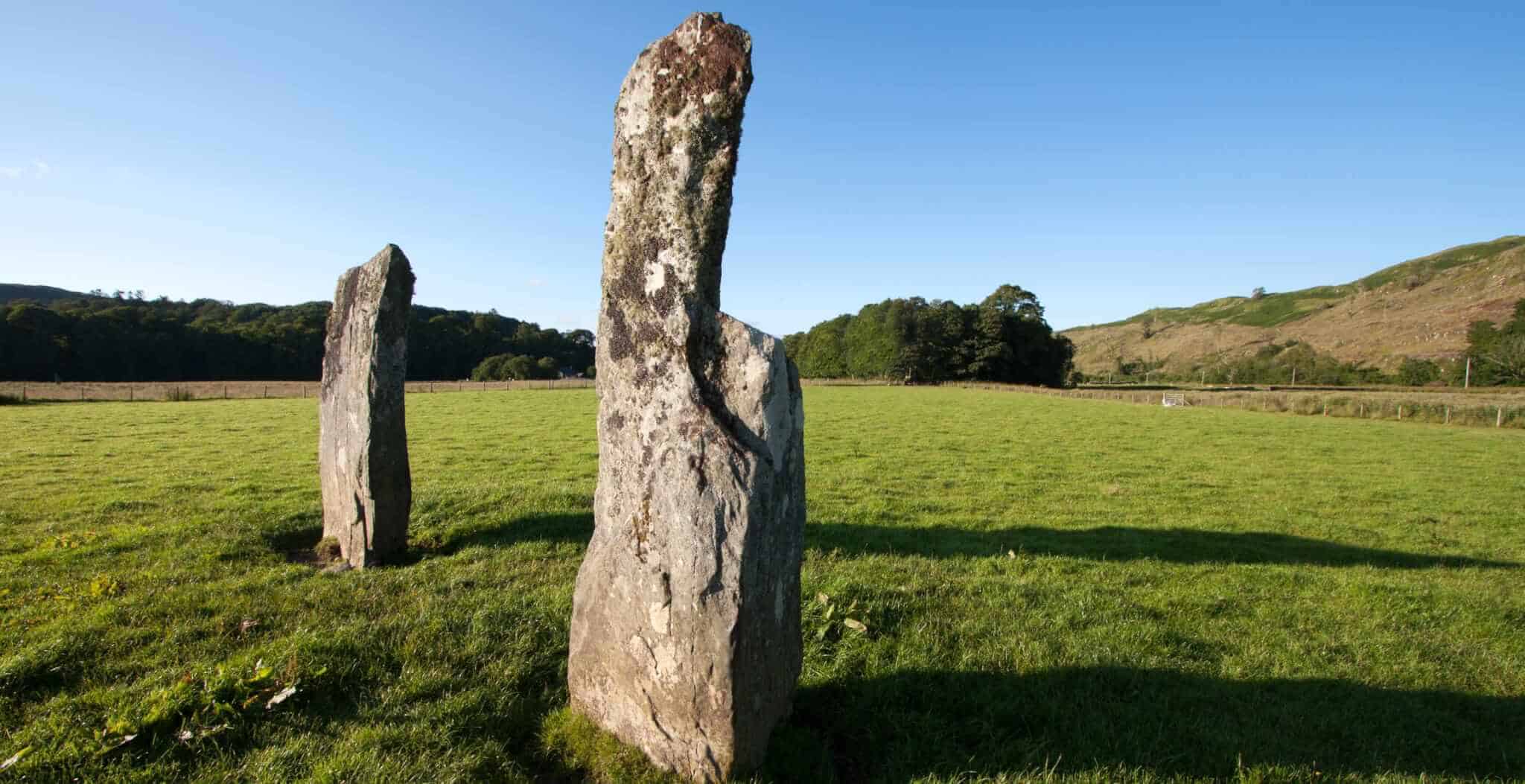


Drive south from Oban to Lochgilphead and the Crinan Canal on the Western Coast of Scotland, and as you enter Kilmartin Glen, you will realise that you have entered a very special place.
Over 5000 years of human history can be traced across the Kilmartin valley. At least 350 ancient monuments, of which 150 are prehistoric, lie within six miles of the quiet village of Kilmartin. Of particular interest are the earlier prehistoric monuments: chambered cairns, round cairns, cists, standing stones and rock carvings.
When visiting Kilmartin Glen, it is best to start at the Kilmartin House Museum of Ancient Culture. This is located in the old manse in Kilmartin village and admission includes an atmospheric audio visual presentation as well as entry to the museum itself which includes a model of the glen. There is also an excellent cafe here!
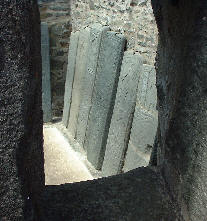 Almost next to the Museum is Kilmartin Parish Church with its remarkable collection of early grave slabs, some of which have been collected together in a small open enclosure for easier viewing. Some grave slabs are of early Christian design, some are medieval.
Before the pyramids were built, the inhabitants of this area of Scotland had built the first of the burial cairns that make up the Linear Cemetery at Nether Largie South. These Neolithic and Bronze Age monuments, together with the stone circle at Temple Wood and the standing stones at Ballymeanoch and other sites, are all part of the ritual landscape of Kilmartin Glen.
About a mile south of Kilmartin village along the A816, there is a car park from where you can visit the group of sites at Nether Largie South. The Nether Largie stones are to be found in the field across the road from the car park.
It is only a short walk from the Nether Largie stones to Temple Wood and its stone circle with a cairn at the centre. The trees were planted in Victorian times when the site was renamed Temple Wood. From here a short stroll along the lane takes you to Nether Largie South cairn, believed to have been built around 3000-2500BC. A well signed path takes you back to the standing stones and the car park.
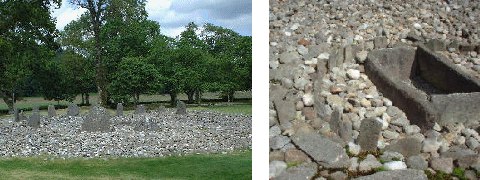
(Left) Temple Wood (Right) Detail from the centre of the stone circle at Temple Wood
Further down the A816 on the right hand side you will notice a rocky outcrop with whitewashed buildings at its foot. A trip up the track towards these buildings brings you to the car park at the base of Dunadd, an Iron Age fort which overlooks the Moine Mhor (Great Moss) which covers 1,200 acres and is one of very few estuarine raised bogs left in Europe.
Dunadd has a very special place in Scottish history as this was the capital of the Ancient Kingdom of Dalriada. Legend has it that the Stone of Destiny was used here in the crowning of the first Kings of Scotland. A climb up to the top not only gives the visitor a great view over to the sea and up the Glen, but also at the summit there is a carved flat stone slab with a cup indentation in it, the purpose of which is unknown. There is also a foot print, still very visible, carved into the stone. By Irish tradition, the King of Dalriada was crowned by placing his foot into this imprint.
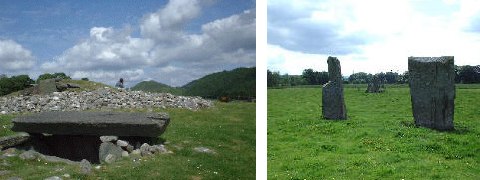
(Left) Nether Largie South Cairn (Right) Stones at Nether Largie.
Continuing down the A816 as it leaves the Glen, a right turn onto the B841 takes you along the Crinan Canal to the sea. The Crinan Canal was built by Thomas Telford in the late 18th century and is now used mainly by pleasure craft. A scenic drive alongside the canal takes to Crinan where the canal enters Loch Crinan and the Sound of Jura. The canal basin here is a delightful place to while away a couple of hours – watch the boats pass through, have a cup of tea or an ice cream at the little cafe or take a stroll along the shoreline.
Museums
View our interactive map of Museums in Britain for details of local galleries and museums.
Battlefield Sites
Browse our interactive map of the Battlefield Sites in Britain for details of nearby sites.