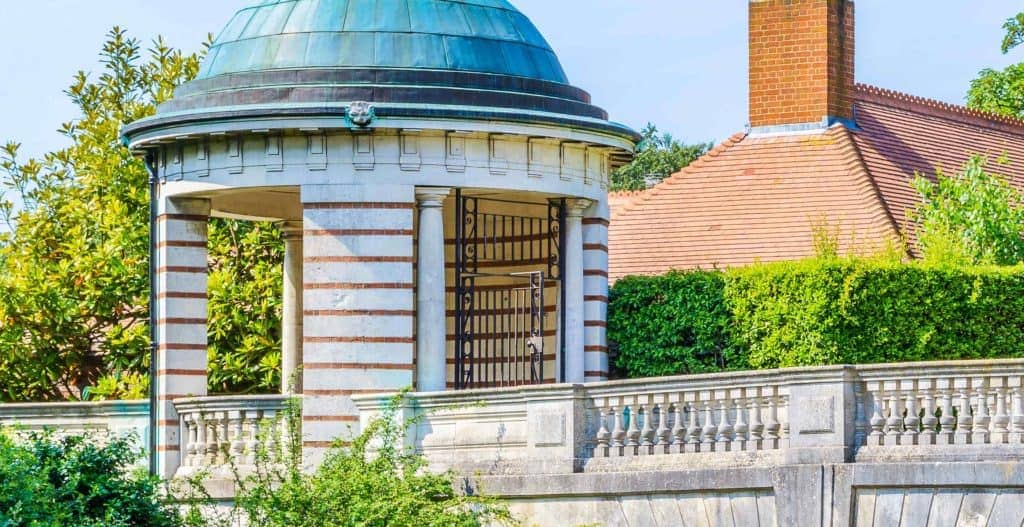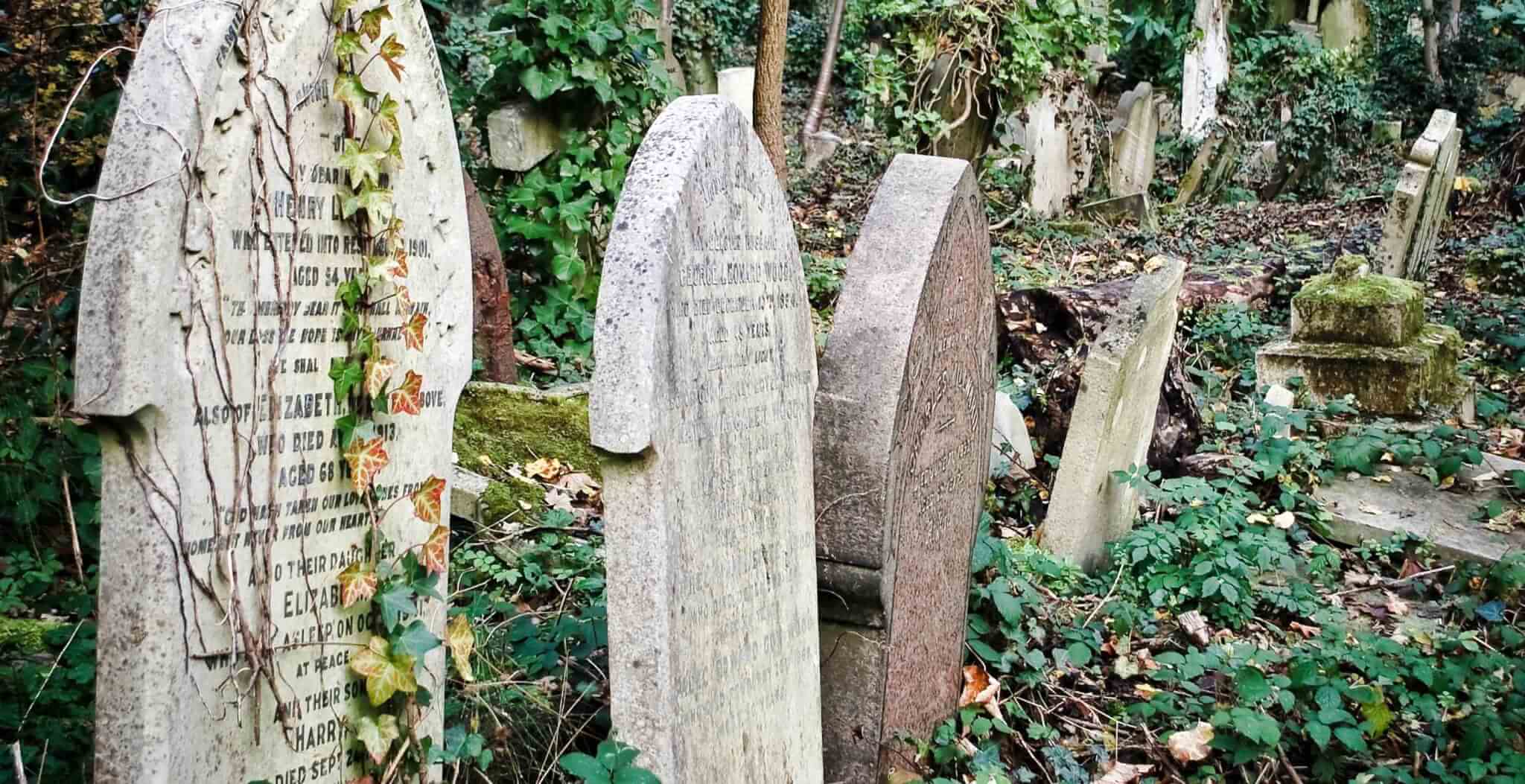


Perhaps one of our more unusual historical destinations, Highgate Cemetery is a famous cemetery located in Highgate, London.
The cemetery in its original form (the older, Western part) was consecrated by the Bishop of London on 20th May 1839. It was part of an initiative to provide seven large, modern cemeteries to ring the city of London. The inner-city cemeteries, mostly the graveyards of individual churches, had long been unable to cope with the number of burials and were seen as a health hazard and an undignified way to treat the dead.
The first inhumation at Highgate Cemetery took place on the 26th May, and was of Elizabeth Jackson, a 36 year old spinster of Golden Square in Soho.
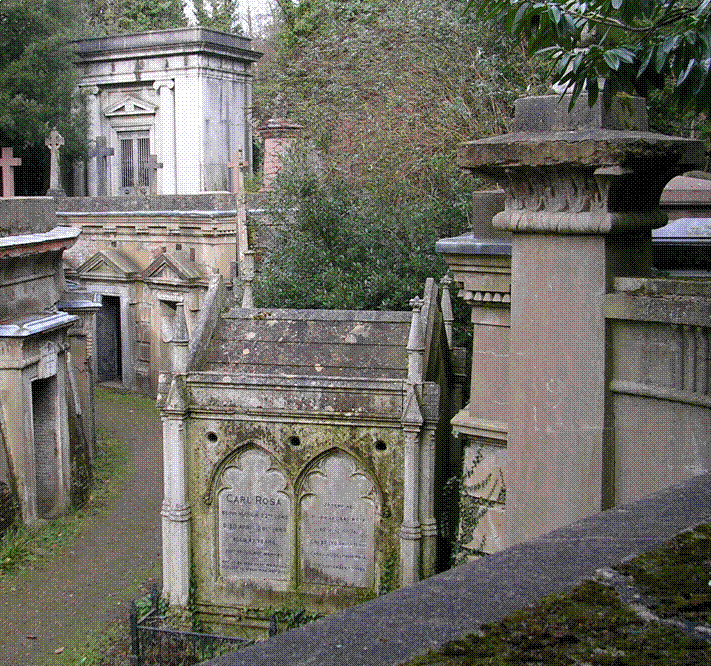
Perched on a hill above the smoke and filth of the city, Highgate Cemetery soon became a fashionable place for burials and was much admired and visited. The Victorian romantic attitude to death and its presentation led to the creation of a labyrinth of Egyptian sepulchres and a wealth of Gothic tombs and buildings. The rows of silent stone angels have born witness to pomp and ceremony as well as to some dreadful exhumations…read on!
In 1854 the eastern part of the cemetery was opened, across Swains Lane from the original.
These avenues of death entomb poets, painters, princes and paupers. There at least 850 notable people buried at Highgate including 18 Royal Academicians, 6 Lord Mayors of London and 48 Fellows of the Royal Society. Although perhaps its most famous occupant is Karl Marx, several other people worthy of mention are also buried here including:
- Edward Hodges Baily – sculptor
- Charles Cruft – founder of Crufts dog show
- Catherine Dickens – wife of Charles Dickens
- George Eliot, (Mary Ann Evans) – novelist
- Michael Faraday – electrical engineer
- William Friese-Greene – inventor of cinematography
- George Michael – singer and songwriter
- Karl Heinrich Marx – father of Communism
- Elizabeth Eleanor Siddal – model of the PreRaphaelite Brotherhood
Today the cemetery’s grounds are full of mature trees, shrubbery and wildflowers that provide a haven for birds and small animals. The Egyptian Avenue and the Circle of Lebanon (topped by a huge Cedar of Lebanon) feature tombs, vaults and winding paths through the hillside. For its protection, the oldest section, with its impressive collection of Victorian mausoleums and gravestones plus elaborately carved tombs, allows admission only in tour groups. The newer section, which contains most of the angel statuary, can be toured unescorted.
For further detailed information concerning opening times, dates, directions and details of the escorted tours visit the Friends of Highgate Cemetery web site.
And back to some of those people of note and their stories…
Edward Hodges Baily.
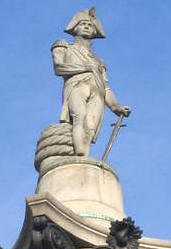 Edward Hodges Baily was a British sculptor who was born in Bristol on 10th March 1788. Edward’s father was a celebrated carver of figureheads for ships. Even at school the Edward demonstrated his natural talent producing numerous wax models and busts of his school friends. Two pieces of his early work were shown to the master sculptor J. Flaxman, who was so impressed with them that he brought Edward back to London as his pupil. In 1809 he entered the academy schools.
Edward was awarded the academy gold medal for a model of in 1811. In 1821 he exhibited one of his best works, Eve at the Fountain. He was responsible for the carvings on the south side of the Marble Arch in Hyde Park, and produced many busts and statues, with perhaps the most famous of all Nelson in Trafalgar Square.
Charles Alfred Cruft
Charles Cruft was a British showman who founded the world famous Crufts dog show. Born in 1852, one of four children, Charles started his working life as the office boy in the London shop of James Spratt, the manufacturer of Spratt’s dog biscuits. He rose to the position of general manager, and whilst working for Spratt’s in France he was invited to run his first dog show in 1878.
After running dog shows in London for four years, he ran his first Cruft’s dog show in 1891, and continued to run a further 45 shows until his death in 1938.
Catherine Dickens
Catherine Thomson “Kate” Dickens (née Hogarth) was born in Edinburgh in 1815, and moved to London with her family in 1824. Her father was writer and music critic for the Morning Chronicle, where Dickens was a young journalist.
Enchanted by the attractive 19-year-old Catherine, the couple were married on 2 April 1836. Setting up home in Bloomsbury, London, they went on to have 10 children together.
In June 1858, Charles and Catherine separated, amid rumours of an affair between Dickens and Ellen Ternan and / or Catherine’s sister Georgina Hogarth.
Highgate is also the resting place of John and Elizabeth Dickens, parents of Charles, as well as his elder sister Fanny and Alfred, his younger brother.
George Eliot
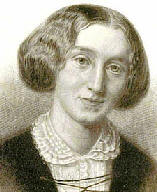 George Eliot was the pen name of English female novelist Mary Ann Evans. Mary was born on 22nd November 1819 on a farm near Nuneaton in Warwickshire, she used many of her real-life experiences in her books, which she wrote under a man’s name in order to improve her chances of publication.
She defied the convention of the day by living with George Henry Lewes, a fellow writer, who died in 1878. On 6th May 1880 she married her ‘toy-boy’ friend, John Cross, an American banker, who was 20 years her junior. They honeymooned in Venice and, it is reported, that Cross celebrated their wedding night by jumping from their hotel balcony into the Grand Canal. She died in London of a kidney ailment.
Her works include:The Mill on the Floss (1860), Silas Marner (1861), Middlemarch (1871), Daniel Deronda(1876). She also wrote a considerable amount of fine poetry.
Michael Faraday
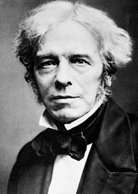 Michael Faraday was a British engineer who contributed to the modern understanding of electromagnetism and invented the Bunsen burner. Michael was born on 22nd September 1791, near the Elephant & Castle, London. At fourteen he was apprenticed as a book-binder and during his seven year apprenticeship developed an interest in science.
After he sent Humphrey Davy a sample of notes that he had made, Davy employed Faraday as his assistant. In a class-ridden society, Faraday was not considered to be a gentleman, and it is said that Davy’s wife refused to treat him as an equal and would not associate with him socially.
Faraday’s greatest work was with electricity. In 1821, he built two devices to produce what he called electromagnetic rotation. The resulting electric generator used magnets to generate electricity. These experiments and inventions form the foundation of modern electromagnetic technology. Ten years later, in 1831, he began his great series of experiments in which he discovered electromagnetic induction. His demonstrations proving the concept that electric current produced magnetism.
He gave a successful series of lectures at the Royal Institution, entitled `The Natural History of a candle‘; this was the origin of the Christmas lectures for young people that are still given there every year. Faraday died at his house at Hampton Court on August 25, 1867. The unit of capacitance, the farad is named after him.
William Friese-Greene
William Friese-Greene (born William Edward Green), was a photographer and prolific inventor. He is principally known as a pioneer in the field of motion pictures and is credited by some as the inventor of cinematography.
William Edward Green was born on 7th September 1855 in College Street, Bristol. He was educated at Queen Elizabeth’s Hospital. In 1869 he became an apprentice to a photographer named Maurice Guttenberg. William quickly took to the work and by 1875 he had set up his own studios in Bath and Bristol, and later expanded his business with two further studios in London and Brighton.
He married Helena Friese on 24th March 1874, and decided to add that artistic touch by modifying his name to include her maiden name. It was in Bath that William made the acquaintance of John Arthur Roebuck Rudge, an inventor of magic lanterns. Rudge had devised a lantern, the ‘Biophantoscope’, which could display seven slides in rapid succession, giving the illusion of movement.
William found the idea amazing and started work on his own camera – a camera to record real movement as it occurred. He realised that glass plates would never be a practical medium for true moving pictures and in 1885 he began to experiment with oiled paper and two years later was experimenting with celluloid as a medium for motion picture cameras.
Early one Sunday morning in January 1889, William took his new camera, a box about a foot square with a handle projecting at the side, to Hyde Park. He placed the camera on a tripod and exposed 20 feet of film – his subjects, “leisurely pedestrians, open-topped buses and hansom cabs with trotting horses”. He rushed to his studio near Piccadilly were he developed the celluloid film, becoming the first man ever to see moving pictures on a screen.
Patent No. 10,131, for a camera with a single lens to record movement was registered on 10th May 1890, but the making of the camera had bankrupt William. And so to cover his debts, he sold the rights to his patent for £500. The first renewal fee was never paid and the patent eventually lapsed in 1894. The Lumiere brothers patented Le Cin’matographe in March one year later in 1895!
In 1921 William was attending a film and cinema industry meeting in London to discuss the current poor state of the British film industry. Disturbed by the proceedings he got to his feet to speak but soon became incoherent. He was assisted to his seat, and shortly afterward slumped forward and died.
William Friese-Greene died a pauper, and on the hour of his funeral, all the cinemas in Britain halted their films and held a two-minute silence in belated respect to ‘The Father of the Motion Picture’.
George Michael (born Georgios Kyriacos Panayiotou)
The son of a Greek-Cypriot restaurateur who emigrated from Cyprus to England in the 1950s, George spent most of his childhood in Kingsbury, London, and rose to fame as a member of the music duo Wham!
Together with his fellow bandmate Andrew Ridgeley, the music duo established themselves as a global act touring China in 1985; the first Western pop group to do so.
One of the best-selling muscians of all time, Michael’s first solo single “Careless Whisper” reached number one in over 20 countries.
Michael died of heart disease on Christmas Day in 2016, at his home in Goring-on-Thames, Oxfordshire.
Karl Marx
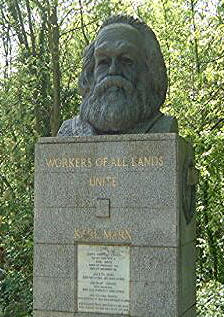 Marx was born into a progressive Jewish family in Trier, Prussia (now a part of Germany) on 5th May 1818. His father Herschel was a lawyer. The Marx family was very liberal and the Marx household hosted many visiting intellectuals and artists through Karl’s early life.
Marx first enrolled in the University of Bonn in 1833 to study law. Bonn was a notorious party school, and Marx did poorly as he spent most of his time singing songs in beer halls. The next year, his father made him transfer to the far more serious and academically oriented Friedrich-Wilhelms-Universität in Berlin. It was there, that his interests turned to philosophy.
Marx then moved to France and it was in Paris that he met and began working with his life-long collaborator Friedrich Engels. After he was forced to leave Paris for his writings, he and Engels moved to Brussels.
In Brussels they co-wrote several works which ultimately lay the foundation for Marx and Engels’ most famous work, The Communist Manifesto, first published on February 21, 1848. This work was commissioned by the Communist League (formerly, the League of the Just), an organization of German emigrés whom Marx had met in London.
That year Europe experienced revolutionary upheaval; a working-class movement seized power from king Louis Philippe in France and invited Marx to return to Paris. When this government collapsed in 1849, Marx moved to London.
In London Marx also dedicated himself to historical and theoretical works, the most famous of which is the multivolume Das Kapital (Capital: A Critique of Political Economy), first published in 1867.
Marx died in London on 14th March 1883, and is buried in Highgate Cemetery. And the rest is history …
…World War I led to the Russian Revolution and the ascendence of Vladimir Lenin’s leadership of the communist movement. Lenin claimed to be both the philosophical and political heir to Marx, and developed a political program, called Leninism, which called for revolution organised and led by the Communist Party.
After Lenin’s death, the Secretary-General of the Communist Party of the Soviet Union, Joseph Stalin, seized control of the Party and proceeded to murder millions of his own people.
And in China, Mao Zedong also claimed to be an heir to Marx, and led a communist revolution there.
Elizabeth Siddal
Elizabeth Eleanor Siddal was said to be the epitome of aesthetic womanhood. Her mournful beauty appears time and again in the portraits of the PreRaphaelite Brotherhood. In William Holman Hunt’s ‘Valentine Rescuing Sylvia from Proteus’, she appears as a Sylvia.
In John Everett Millais’s ‘Ophelia’ she lies amongst the grassy water plants.
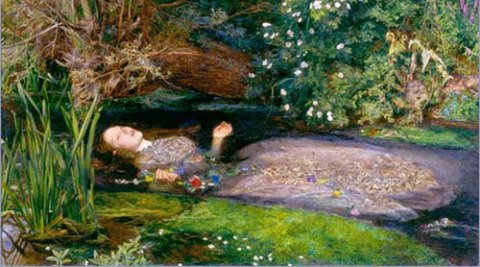
But it is with Gabriel Dante Rossetti that Siddal’s name will be best remembered.
It was Walter Deverall, honorary artist of the Pre-Raphaelite Brotherhood, who discovered Elisabeth Siddal. Looking through the window of a hat shop near Piccadilly whilst shopping with his mother, Deverall noticed the striking looks of the milliner’s assistant.
Introducing her to his fellow artists, Rossetti, Millais and Hunt, the three founders of the Pre-Raphaelite Brotherhood, Elizabeth’s full and sensual lips and waist length auburn hair, soon made her their favourite model. But the intense demands placed on her by the three artists nearly killed her. In 1852, Millais composed and painted the famed portrait of ‘Ophelia’ in his converted greenhouse studio. For this work Elizabeth was required to lie day after day in a bath of luke-warm water, from which she ultimately contracted pneumonia.
None of the three young men found her more attractive or alluring than the poet and painter, Dante Gabriel Rossetti. The attraction proved mutual, as first she became his lover, then subsequently his fiancée.
Having lived together for a number of years they eventually married in 1860. Their relationship however was not a happy one with Siddal’s continuing health problems, and Rossetti’s sexual philandering; their marriage had begun to flounder within a short time.
After two years of increasing marital stress, Rossetti arrived home one day to discover his Elizabeth dying. She had misjudged the strength of a draft of Laudanum, and had fatally poisoned herself.
As she lay peacefully in her open coffin in the sitting room of their house in Highgate village, Rossetti tenderly placed a collection of love poems against her cheek. Elizabeth took these words with her to the grave.
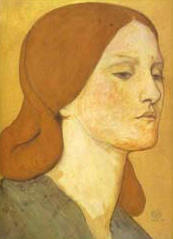 It was seven years later when Rossetti’s artistic and literary reputation had begun to wane, perhaps due to his increasing addiction to Whisky that this strange story took an even stranger twist.
In an attempt to bring his client back into the public eye, Rossetti’s literary agent suggested that the love poems should be retrieved from Elizabeth’s grave.
And so with an Exhumation Order signed, the Rossetti family tomb resounded to the sound of picks and shovels once more. To ensure that no member of the public witnessed the event the grave was opened after dark, a large bonfire lit the ghoulish scene.
Those who were present, and that did not include the brave Mr Rossetti, gasped as the last screw was removed and the casket opened. Elizabeth’s features were perfectly preserved; she seemed to have merely slept for the seven years since her burial. The manuscripts were carefully removed, after which the casket was re-buried.
After first being disinfected the manuscripts were returned to Rossetti. The love poems were published shortly after but they were not the literary success expected and the whole episode haunted Rossetti for the rest of his short life.
Tours of Historic London
Find out more about this great city by browsing our Selected Tours of London.
Museums
View our interactive map of Museums in Britain for details of local galleries and museums.
Getting here
Highgate is easily accessible by road or rail, please try our UK Travel Guide for further information.