

The Tichborne Dole is an ancient English tradition still very much alive today. It takes place in the village of Tichborne near Alresford in Hampshire every year on March 25th the Feast of the Annunciation (Lady’s Day) and dates back to the 13th century.
Suffering from a wasting disease which had left her crippled, on her deathbed Lady Mabella Tichborne asked her miserly husband, Sir Roger, to donate food to the needy regularly every year. Her husband was reluctant but made a bizarre agreement as to how much he would give.
Sir Roger agreed to give the corn from all the land which his dying wife could crawl around whilst holding a blazing torch in her hand, before the torch went out. Lady Mabella succeeded in crawling around a twenty-three acre field which is still called ‘The Crawls’ to this day and which is situated just north of Tichborne Park and beside the road to Alresford.
Lady Tichborne charged her husband and his heirs to give the produce value of that land to the poor in perpetuity. But aware of her husband’s miserly character, Mabella added a curse – that should the dole ever be stopped then seven sons would be born to the house, followed immediately by a generation of seven daughters, after which the Tichborne name would die out and the ancient house fall into ruin.
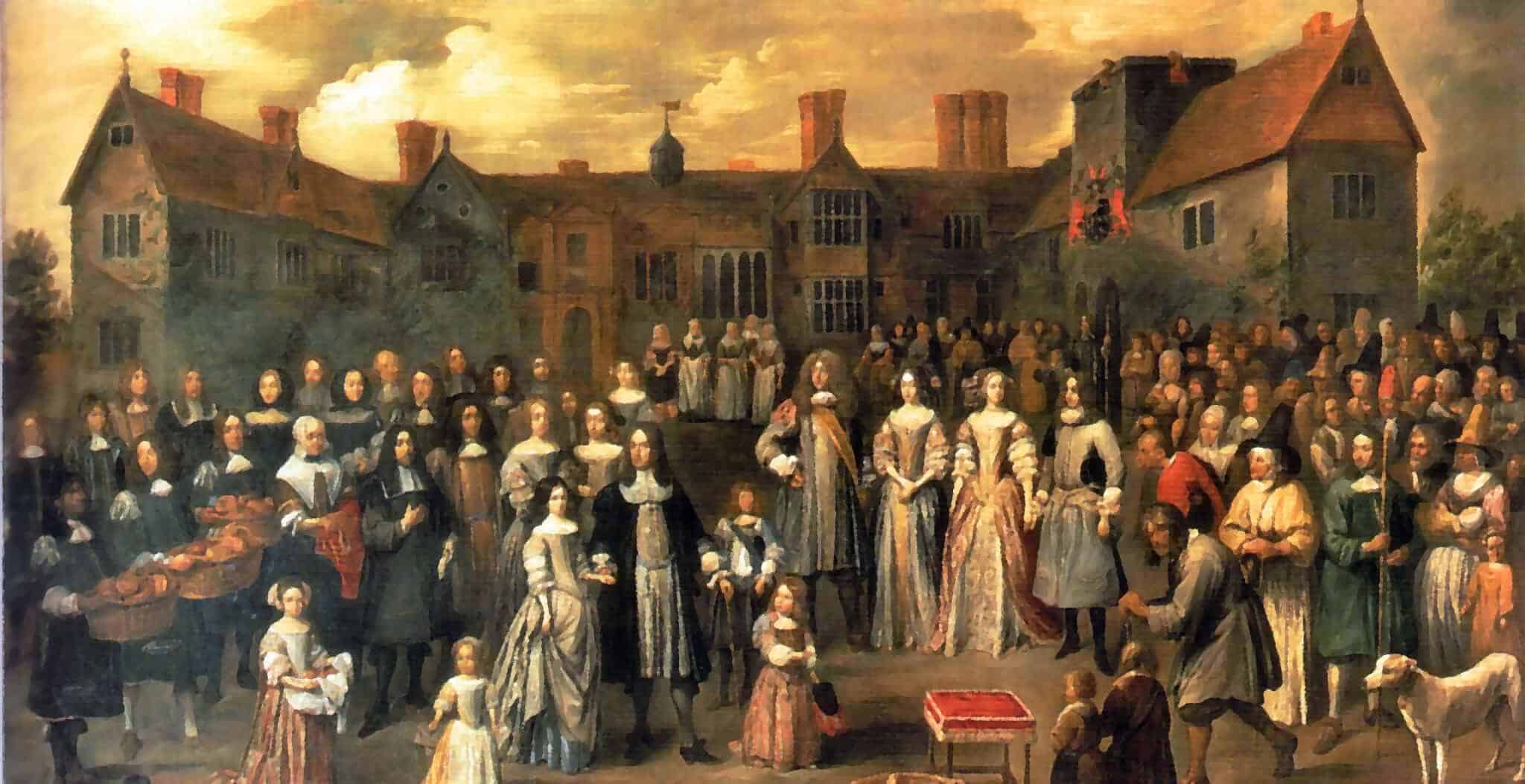
The Tichbourne Dole in 1671
The custom of giving the dole, in the form of bread, on 25th March, Lady Day continued for over 600 years, until 1796, when owing to abuse by vagabonds and vagrants, it was temporarily suspended by order of the Magistrates.
Local folk however, remembered the final part of the Tichborne legend and Lady Tachborne’s curse. The penalty for not giving the dole would be a generation of seven daughters, the family name would die out and the ancient house fall down. In 1803 part of the house did indeed subside and the curse seemed to have been fulfilled when Sir Henry Tichborne who succeeded to the baronetcy in 1821(one of seven brothers), produced seven daughters.
The tradition was hastily re-established and has continued to this day.
Roger, Henry’s nephew, was born before the restoration of the Dole and his younger brother Alfred afterwards. Roger was lost at sea in 1845 and was impersonated two decades later by the unsuccessful Tichborne claimant, Arthur Orton (pictured at the top of the article). Alfred was the only one to survive Lady Tichborne’s curse and thus the Tichborne name did not die out.
The Dole is held every Lady Day, March 25th. The parish priest carries out the traditional Blessing of the Tichborne Dole before the flour is distributed to the local people – only those families in Tichborne, Cheriton and Lane End are entitled to the dole. They receive one gallon of flour per adult and half a gallon per child.
Lady Day itself is celebrated in honour of the Virgin Mary as this day, nine months before Christmas, is the day of the Annunciation from the Archangel Gabriel that she would bear Christ. In the 12th century Lady Day was considered the first day of the year and persisted until the official calendar change of 1752.
Published: 23rd June 2015