

Traditional folklore events in December are often linked to the passing of the old year and the coming in of the New Year.
Readers should always check with local Tourist Information Centres (TIC’s) that events or festivals are actually taking place before setting out to attend.
Permanent dates in December
| 6thDecember | Enthroning of Boy Bishops | Berden, Hertfordshire; Boston, Lincolnshire; Bristol; Hereford Cathedral; Par, Cornwall; Edwinstowe, Nottinghamshire. | The custom of choosing a Boy Bishop from the members of a cathedral choir is thought to date from the 13th century. Following his election he is fitted out in full Bishop’s regalia including robes, mitre and crozier. During the ceremony the chosen chorister and his attendants enter the church, or cathedral, and the new Boy Bishop takes his place on the Bishop’s throne and receives a blessing. He then holds this post from the Feast of St Nicholas on 6th December until Holy Innocents Day on the 28th December. During this period he enjoys many of the powers and privileges of the real thing. The concept of grand people humbling themselves at least once a year is a well documented phenomenon within the Christian faith. The enthroning of the Boy Bishop was abolished by Elizabeth I and has only been revived in recent years. |
| 24thDecember | Tolling the Devil’s Knell | Dewsbury, Yorkshire | In the parish church, a team of bell ringers toll the tenor bell ‘Black Tom of Soothill’ – once for every year since Christ was born. The final stroke is timed for midnight. Legend has it the practice began in the 13th century when Thomas de Soothill, a local baron, killed a servant boy. As penance he gave a bell to All Saint’s Church and ordered it rung every Christmas to remind him of his crime. After midnight Black Tom is rung once more to remind the Devil of his defeat by the birth of Christ and to protect the town from evil for the coming year. |
| 26thDecember | Old Glory & the Cutty Wren | Middleton, Suffolk | This recently revived ancient tradition takes place in the village of Middleton each Boxing Day. Once darkness falls, the main street of the village begins to fill with folk; flaming torches approach to the sound of a slow drum beat as the East Anglian form of Morris is re-created by local Molly Dancers & Musicians. |
| 31stDecember | Allendale Fire Ceremony | Allendale, Northumberland | Celebrating the end of the old year and start of the new with fire festivals still continues in several places through Britain. Believed to have pagan origins, the Allendale Fire Ceremony is perhaps one of the most spectacular with a procession of ’guisers’ carrying tubs of flaming tar above their heads. The procession eventually arrives at the town square were the flaming tubs are thrown onto a bonfire. At the stroke of midnight the church bells ring out to symbolise the supplanting of paganism by Christianity. |
| 31stDecember | Burning the Old Year Out | Biggar, Strathclyde; Wick, Highland | A re-enactment of the ancient fire festival is continued with a torchlight procession through the town followed by a bonfire. The bonfire symbolizing the burning out of the old year. During World War II a candle was lit in a tin can to ensure the tradition survived. |
| 31stDecember | Flambeaux Procession | Comrie, Tayside | The Flambeaux is an ancient torchlight procession originally performed to drive out evil spirits. The villagers march round the village to the four points of the compass and then back into the main village square where the torches are thrown onto a bonfire. |
| 31stDecember | Swinging the Fireballs | Stonehaven, Grampian | The ceremony at this east coast fishing village is one of the most unique Hogmanay festivals in Scotland. At the strike of midnight the High Street is lit up as sixty local fireball-swingers make their way, swinging their fireballs above their heads; they proceed through the town down to the harbour where the balls are thrown into the sea. The modern ceremony dates from a fisherman’s festival in the 19th century, but its origins may stem from pagan times. There are other theories on the significance of the festival. One recalls that some time in the dark-ages a shooting star appeared above Stonehaven. In the year that followed the sighting, the local farmers recorded a bumper harvest. Attributing their prosperity to the shooting star, the villagers introduced the fireball ceremony to symbolise its coming as an omen of good fortune for the future. |
Flexible dates in December
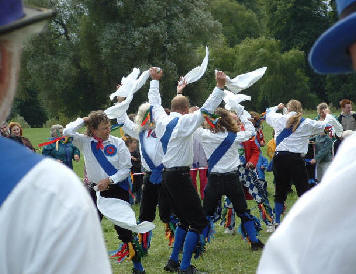
| Various dates in December, checkout the details of these events at the Morris Ring website | Morris Dancing | Birchington, Claygate, Esher, Flamborough, Handsworth, Horsham, Ipswich, Moulton, Ripley, Shipston-on-Stour, Wimbledon, etc. | Regarded as an ancient tradition even in the reign of Elizabeth I, these ‘madde men’ with their ‘Devils dance’ were banned by the Puritans following the Civil War. |
We have taken great care in recording and detailing the festivals, customs and celebrations presented in our Folklore Year calendar, if however you consider that we have omitted any significant local event, we would be delighted to hear from you.
Related Links:The Folklore Year – January |