

Welcome to the fourth and final part of our Fashion Through the Ages series. This section covers British fashion from the Victorians, Edwardians, Roaring Twenties, World War II, all the way up to the Swinging Sixties!
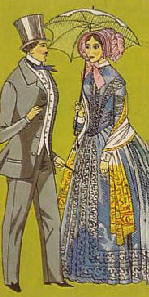 |
Day Clothes about 1848/9 (left)
This restrictive and demure line is typical of the early Victorian period 1837 – 50. The lady wears a dress with a long, tight, pointed bodice and full skirt supported on many petticoats. The sleeves are tight and she also wears a shawl. She carries a parasol. The gentleman wears the new-fashioned short lounge jacket with wide trousers, introduced for country wear around 1800. His collar is lower and a bow replaces the starched cravat. |
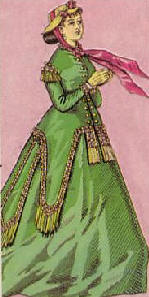 |
Lady’s Day Dress about 1867 (left)
Modern industrial inventions entered fashion in the 1850’s. This dress has its wide triangular skirt supported on a steel wire ‘artificial crinoline’, introduced around 1856 to replace the starched petticoats. The dress was probably stitched on the sewing machine which came into general use in the 1850’s. The bright green owes much to the aniline dyes introduced at this period. The dress is plain with a high neck and long sleeves. The hat had completely replaced the bonnet. |
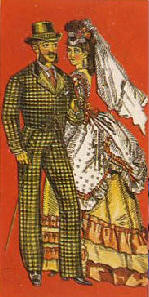 |
Day Clothes about 1872 (left)
This dress is described as a ‘seaside costume’. A gathered ‘overskirt’ supported on a ‘crinolette’ makes the back the most important feature. The materials are light and the sewing machine has made it possible to attach quantities of pleated trimming. The jaunty hat perches on a huge bun probably made in part from false hair. Evening dresses only differed in being low necked and almost sleeveless. The man wears an informal lounge suit, the shape based on a cut-away coat. He wears the more comfortable turn-down collar with knotted tie and low-crowned ‘bowler’-like hat. Pictured right – Lady around 1870. Please note the pleated bodice, tight high collar and tight sleeves with trimming. |
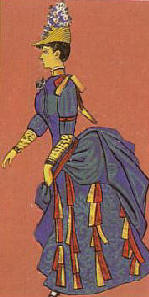 |
Lady’s Day Dress about 1885 (left)
This day dress has a bustle to support the weight of the heavily-trimmed overdress. The skirt, pleated and fairly wide, was thought to be an advance in comfort, although the corset was still very tight and the dress bulky. The high hat, tight collars and sleeves further restricted movement. Many women preferred the masculine-styled, plain ‘tailor-made’. Indeed the Rational Dress Society was founded in 1880 with the aim of making dress healthier and more comfortable. |
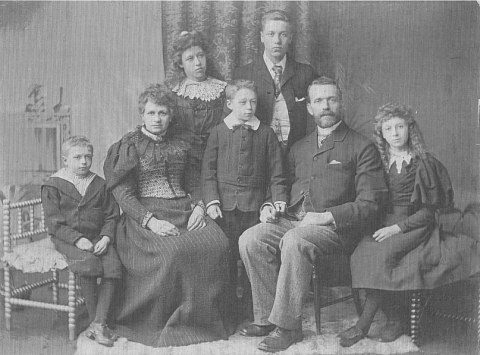
Pictured above – Family group photograph, mid 1890’s.
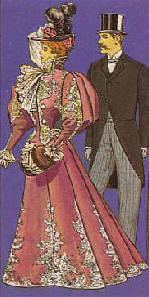 |
Day Clothes 1896
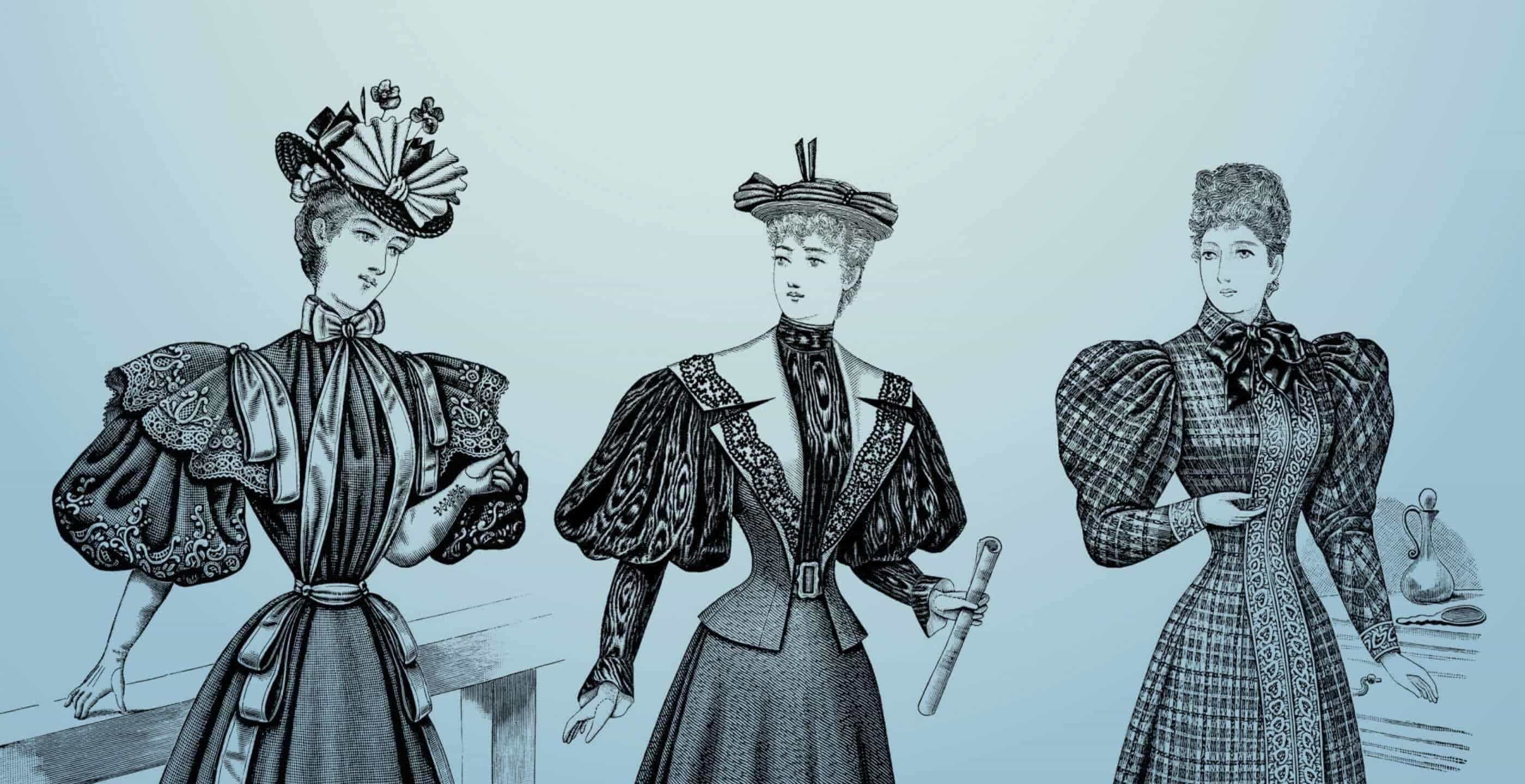
The lady wears tailored ‘walking dress’. Typical of the middle of the 1890’s is the great ‘leg-of-mutton’ sleeve, the tight bodice, the small back frill (all that remains of the bustle) and the smooth flared skirt. The gentleman wears the top hat and frock coat that have become established formal dress for over forty years. Black is established as the standard colour for formal dress, and little else has changed except details like the length of the lapel and the curve of the tails. He wears a high starched collar. |
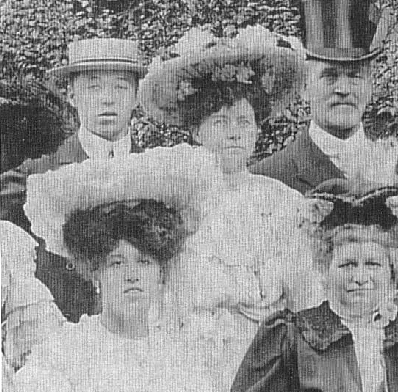
Above: Detail from a photograph taken around 1905. Please note the gentleman’s top hat (right) and the boater (gentleman, left). The ladies are wearing hats perched on top of the head, the hair worn very full.
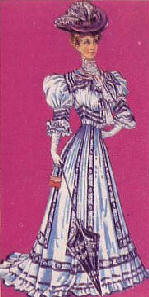 |
Lady’s Day Dress 1906
This summer dress, though worn over a ‘hygienic’ straight-fronted corset, is far from plain. It is made in soft pale material, trimmed with much embroidery, lace and ribbon. Since 1904 there had been new emphasis on the shoulders, and until 1908 sleeves were to be puffed out almost square. The smoothly flowing skirt is supported on petticoats almost as pretty as the dress itself. Hats were always worn, perched on the puffed-out coiffure. The parasol was a popular accessory. She carries a leather handbag, a fashion introduced at the beginning of the 19th century and revived at the end. |
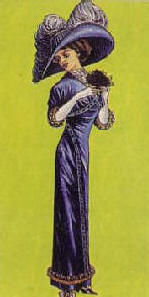 |
Lady’s Day Dress 1909
The line has changed in this summer dress. It is straighter and short-waisted with a new severity of outline. The most important accessory was the hat, very large and much trimmed. The band of trimming at the ankle of the narrow skirt suggests a ‘hobble’ and makes it look difficult to walk, which was rather an odd fashion for women who were fighting for freedom and equal rights. |
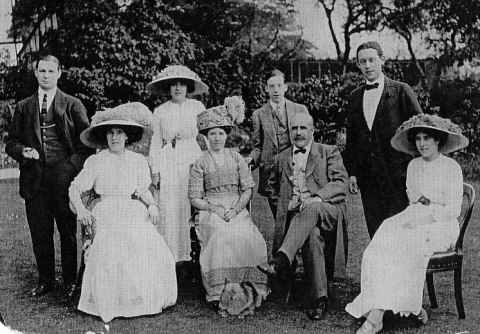
Photograph Above – Family group from around 1909. The gentleman (seated centre, below) wears a long frock coat, the other gentleman wear either formal dress or lounge suits. The ladies all sport the large trimmed hats of the period.
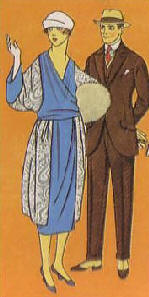 |
Day Clothes 1920
1920 saw the introduction of the shorter, low-waisted dress, loosely cut and concealing, not defining, the figure. Flat-chested women were about to become fashionable. Hats were small, worn over neatly coiled hair. Evening dresses were often low cut, supported only by shoulder straps and made in exotic materials and colours. The man’s lounge suit fits tightly and still retains its long jacket. The trousers are straight but shorter, generally with the turn-up, introduced about 1904. He wears the new, soft felt hat and spats protecting his shoes, introduced in the middle of the 19th century. |
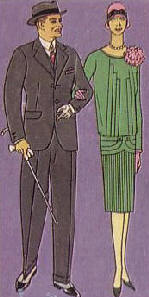 |
Day Clothes about 1927
This lady shows how plain the straight, loosely-fitting, low-waisted dresses had become. They became shorter from 1920, and by 1925 legs clad in beige flesh-coloured stockings were visible to the knee. Flat figures and short ‘bobbed’ hair-styles reflect the boyish styles of the time. The man’s suit is still high waisted with a rounded jacket. Men’s trousers were full, sometimes widening at the turn-up to form ‘Oxford bags’. Contrasting sports jackets were beginning to be worn at this time. |
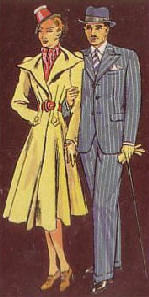 |
Day Clothes 1938
In 1938 outfits had become square at the shoulder, with a fairly tight, natural waist and full, flaring skirt. Styles were varied and inspired by French designers like Elisa Schiaparelli and Gabrielle ‘Coco’ Chanel, and by what the film stars wore. Evening dresses were ‘classical’ in satins and sequins or ‘romantic’ with full skirts. Hats were still small and worn tilted over the eye. Men’s suits had become much broader and more padded at the shoulder, with a long jacket and wide straight trousers. Narrow ‘pin’-striped materials were popular. The soft felt hat generally replaced the bowler. |
Clothes Rationing
 The Second World War made the importation of cloth for clothing virtually impossible and so clothes rationing was introduced on 1st June 1941. Rationing books were distributed to every man, woman and child in Britain.
Clothing was rationed on a points system. Initially the allowance was for approximately one new outfit per year; as the war progressed, the points were reduced to the point where the purchase of a coat constituted almost an entire year’s clothing allowance.
Inevitably styles and fashion were affected by the clothing shortages. Fewer colours were used by clothing companies, allowing chemicals usually used for dyeing to be used for explosives and other much needed resources for the war effort. Materials became scarce. Silk, nylon, elastic, and even metal used for buttons and clasps were difficult to find.
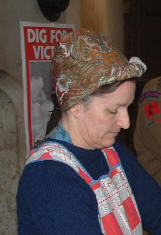
The turban and the siren suit became very popular during the war. The turban began life as a simple safety device to prevent the women who worked in factories from getting their hair caught in machinery. Siren suits, an all-enveloping boiler suit type garment, was the original jumpsuit. With a zip up the front, people could wear the suit over pyjamas making it ideal for a quick dash to the air raid shelter.
The end of clothes rationing finally came on 15th March 1949. Photograph Above: The turban
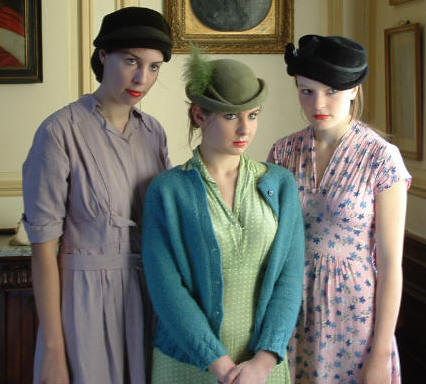
Photograph Above:
Kentwell Hall, WW2 Re-Creation.
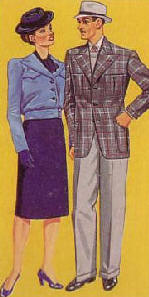 |
Day Clothes 1941 (left)
The lady’s suit was designed in 1941 when materials were restricted because of war. Modelled on the soldier’s battledress, the jacket is waist-length with flapped pockets. The line is still pre-war with its square shoulders, natural waist and flaring skirt. Hair was worn curled, sometimes in a long, eye-covering style. For comfort and warmth many wore ‘slacks’ and headscarves. The man’s suit has a new longer waist and fits more loosely. Sports jackets with contrasting trousers gave variety and economised on the ‘coupons’ that were issued to everybody when clothes were rationed.
|
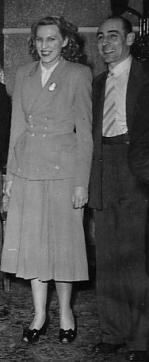 |
“The New Look” 1947
In 1947 Christian Dior presented a fashion look with a fitted jacket with a nipped-in waist and full calf length skirt. It was a dramatic change from the wartime austerity styles. After the rationing of fabric during the Second World War, Dior’s lavish use of material was a bold and shocking stroke. This style became known as the ‘New Look’. |
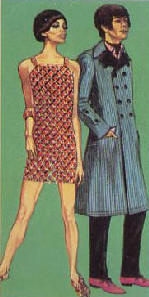 |
Day Clothes 1967 (left)
By 1966 Mary Quant was producing short mini dresses and skirts that were set 6 or 7 inches above the knee, making popular a style that had not taken off when it made its earlier debut in 1964. The Quant style became known as the Chelsea Look. The girl (left) has a simple natural hairdo with exotic makeup. She is very slim and wears a short, mini-skirted semi-fitted tunic made of linked colourful plastic disks, one of many new materials. The cut is simple and variety of texture, pattern and colour are all important. Short hair, dark coats and trousers and plain white shirts had been worn by men for a hundred and fifty years. Now however men’s hair is worn longer, and there is a return to flamboyant materials, bright stripes, velvet trimmings and flower patterns on shirts. He blends a Georgian style cravat, mid-Victorian tail coat and military trimmings. |
Related Links:Part 1 – Medieval Fashion |