

Located on the A49 Shrewsbury-Hereford road, Ludlow is the gastronomic capital of Shropshire. Ludlow has more Michellin Starred restaurants than any other town in the country.
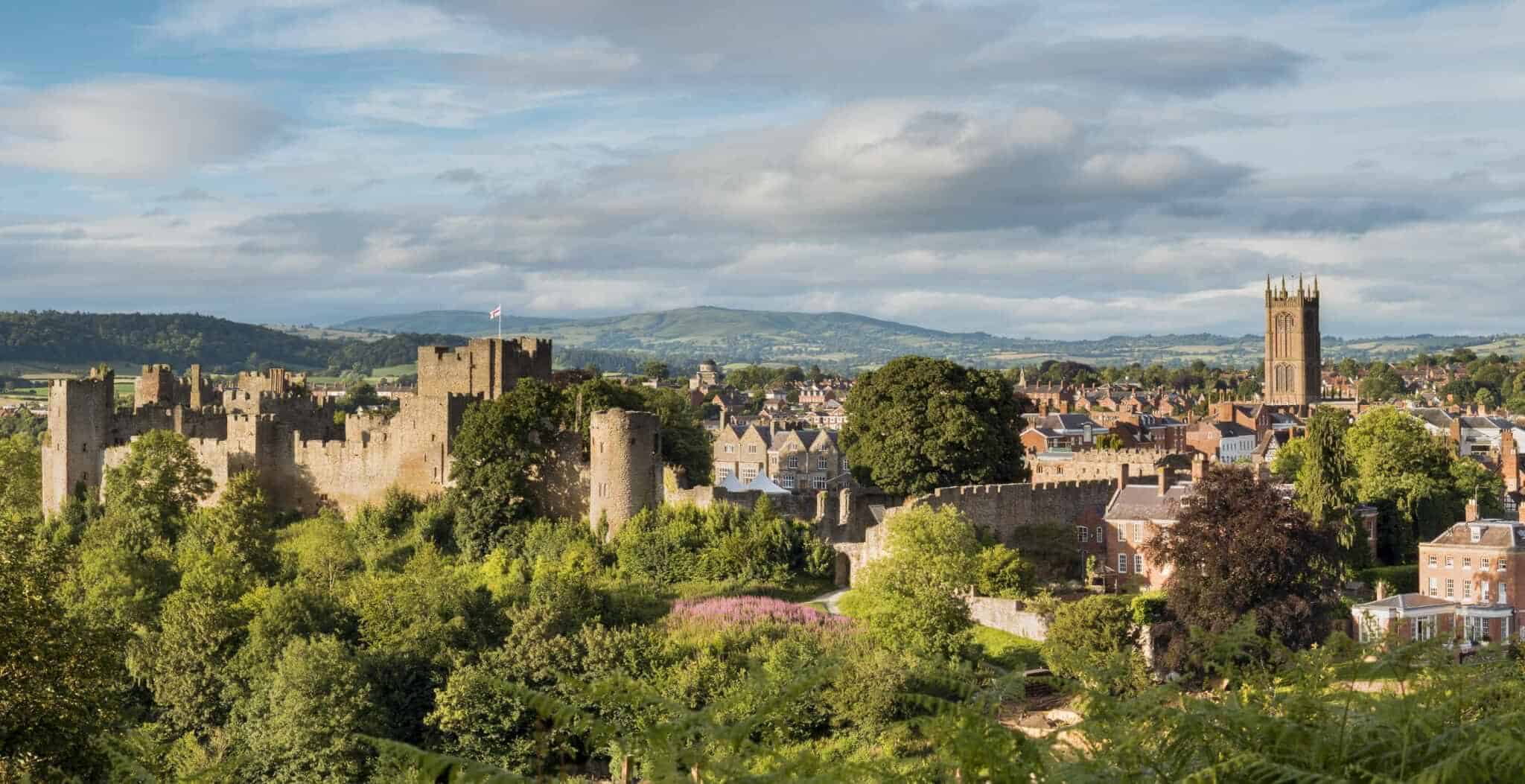
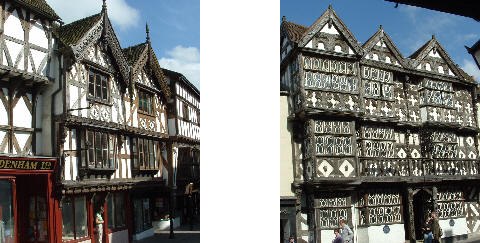
However good food isn’t the only reason to visit Ludlow. Famously described by John Betjeman as “the loveliest town in England“, and with over 500 listed buildings, mainly Georgian or half-timbered, Ludlow is a feast for the eyes.
The name of the town is believed to derive from two old English words hlud (meaning loud and describing the river) and hlaw (meaning hill), so a place ‘on a hill by the loud river’. Ludlow and its castle are perched on a cliff above the picturesque River Teme.
 Ludlow is one the jewels of the Welsh Marches. A “march” is the name the Normans used to describe a boundary or frontier area. After he invaded England in 1066, William the Conqueror created Marcher Lords to help him defend his border with Wales. In due course, a line of fortifications was established along the English/Welsh border, with work starting on Ludlow Castle in 1085, under the command of Roger de Lacy.
Ludlow Castle is situated on an excellent defensive site in a bend of the River Teme just south of where it is joined by the River Corve. A settlement soon grew up around the castle. Ludlow’s town was carefully planned by the Normans and the rectangular street plan can still be seen in the medieval heart of the town.
Town walls were built between 1233 and 1304, with seven gates, one of which, Broadgate at the bottom of Broad Street, still survives.
By the 16th century the town had become the administrative headquarters of the Council of the Marches of Wales. This was founded by Edward IV and administered the whole of Wales and five adjacent English Counties.
When the Council of the Marches was dissolved in 1689 the castle became derelict but the town continued to prosper and many of Ludlow’s finest buildings date from this period between 1700 and 1740. In Victorian times the town was less prosperous and fewer new buildings were built; this has meant that its character has been largely preserved.
 Ludlow is best explored on foot. It’s compact centre is easy to stroll around and for those who enjoy a walk, the following circular route is a lovely way to see the town: from the castle, walk down the hill to the river below at Dinham Bridge (there is a nice cafe here), cross the bridge then along the river bank to Ludford Bridge and return up Broad Street (through Broadgate) to the Buttercross.
Shopping is a delight in Ludlow. There is a wide and varied range of individual shops: bakeries, delicatessens, clothes shops, ironmongers, gift shops, book shops, antique shops and craft shops, to name but a few.
Ludlow’s fortunes have always been linked with the countryside around it. In the past, sheep’s wool from miles around was processed here and turned into cloth. Nowadays local producers and growers from Shropshire, Powys and Herefordshire converge on the town to sell their wares.
There has been a market in Ludlow for over 700 years, and a regular market thrives today, with a monthly farmers’ market and a series of special markets that includes a fleamarket every other Sunday in Spring, Summer and Autumn.
View our interactive map of Museums in Britain for details of local galleries and museums.
Getting here
Ludlow is easily accessible by both road and rail, please try our UK Travel Guide for further information.