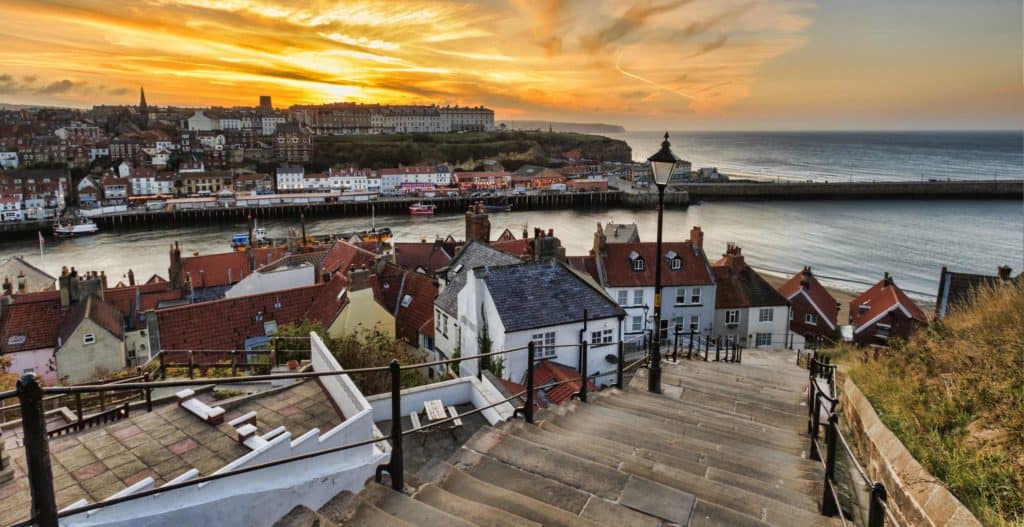


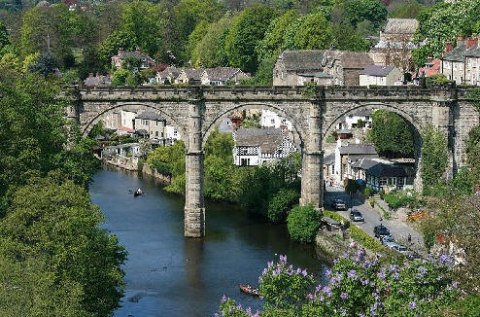
This picturesque Yorkshire spa town lies beside an enchanting gorge of the River Nidd, built up around the original defensive site on the top of the craggy cliffs. The location is described in the origins of the name Knaresborough; “knarre” meaning rocky outcrop in Anglo-Saxon, and “burgh” meaning fortress. Originally, Knaresborough was simply the “fortress on the rock”, and the settlement developed around the castle. It wasn’t actually until the Normans conquered the Angles and Saxons, however, that the castle really began to take shape.
Perhaps the most notorious of occupants of Knaresborough Castle were Hugh de Moreville and his three fellow assassins, Reginald Fitzurse, William de Tracy and Richard le Bret. The murder of Thomas Becket by these four knights, a famous event in English history in 1170, was a gruesome act. Becket was Archbishop of Canterbury at the time and was in a period of conflict with the King, Henry II, after the King’s coronation was held in York rather than Canterbury. The four murderers were followers of Henry II, and apparently thought that they were acting under the King’s orders.
After they had committed this terrible crime, they fled north and barricaded themselves into Knaresborough Castle, where they lived for a year. The reasons for Knaresborough as their place for self-imposed imprisonment seem to be built on the fact that there was a strong anti-Becket feeling in the north and it was the Archbishop of York who was Becket’s enemy. Their time and experiences there are woven into Knaresborough traditions. Legend has it that over the course of that year, they were subject to overwhelming guilt and remorse and also to demonstrations of Divine justice. It was told that animals shrank away from the knights; dogs even refused the crumbs that fell from their table.
The murder of Daniel Clark
And speaking of murder, one of the most talked about murders in more recent history is that of Daniel Clark. Daniel Clark was one member of a trio of thieves operating in Knaresborough in the mid 18th Century. He was murdered by his fellow crooks, Richard Houseman and Eugene Aram, whilst they all divided up their loot. Subsequently, Aram fled the town and made a new, but tormented, life in Norfolk as a school usher. However, Houseman remained in Knaresborough, denying all knowledge of Clark and Aram.
But the story does not end there; they had hidden his body in St Robert’s Cave but it was a skeleton, found 14 years later in 1758 by a labourer working in a local quarry, that sparked a renewed enquiry into Clark’s disappearance. An interview with Aram’s wife left the finger pointing towards Houseman, who, under Police interrogation, made comments that actually left Aram in the frame for it.
The body of Daniel Clark was unearthed in St Robert’s Cave and so police travelled all the way to Norfolk to arrest Aram under suspicion of murder. He was taken to York Castle where he was tried and found guilty on evidence primarily from Houseman, despite his attempts to convince the jury of his innocence. He wrote his own defence, which was “so admirable for its ingenuity” that the whole court were “astonished”. It didn’t work though and he was finally executed on August 16th 1759, “almost in a state of insensibility” after a failed suicide attempt. He did, however, eventually confess to the murder just before his execution.
It seems that Aram was involved in the death of Clark but that he was alone in it seems unlikely. When Houseman died he was found to have a secret stash of Daniel Clark’s possessions. It was probably unfair, therefore, for only one man to have been executed for murder.
There are many legends and superstitions surrounding prominent figures in Knaresborough’s history, an introduction to a choice few are given here. At around the same time that Thomas Becket was becoming widely known as the martyred St Thomas of Canterbury, Robert Flower, later St Robert, had become a hermit living in a cave beside the River Nidd.
St Robert’s Cave
Born Robert Flower in York in around 1160, St Robert became a hermit in a riverside cave near Knaresborough. He was said to have had healing powers and influence over wild animals. After his death in 1218 a following came together spreading the word of the healing powers of the waters at St Robert’s Well.
Mineral waters with powers seem to have dominance in the heritage of Knaresborough, and it was, after all, a spa town and the source of water for some of the Harrogate spas. The mystery of the Knaresborough springs is woven into the famous local tale of the prophetess Old Mother Shipton as her cave is positioned right next to the Petrifying Well.
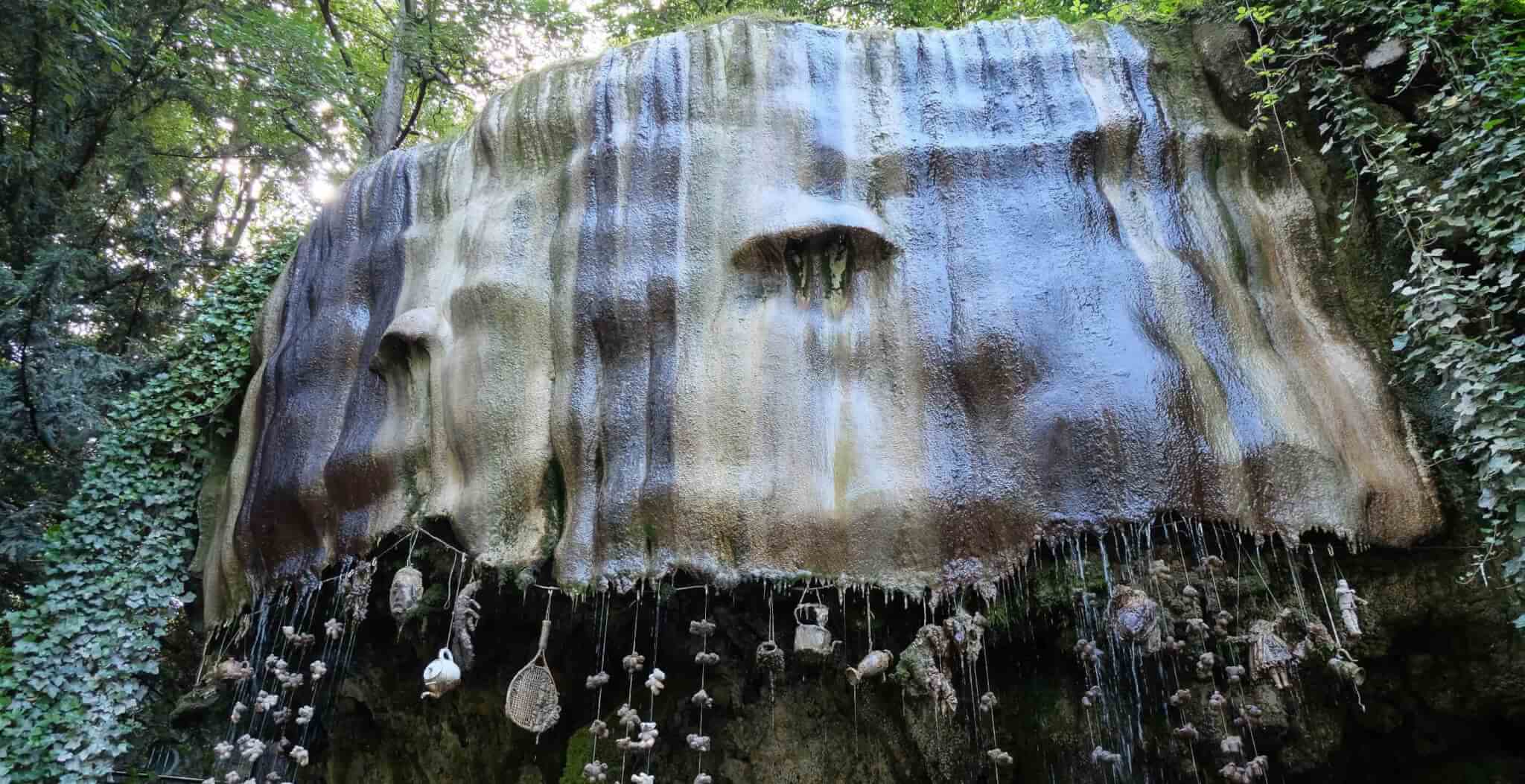
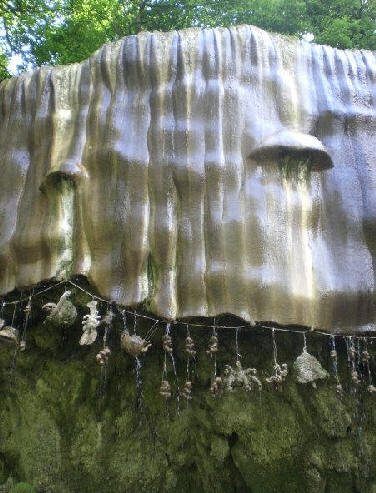
The Petrifying Well
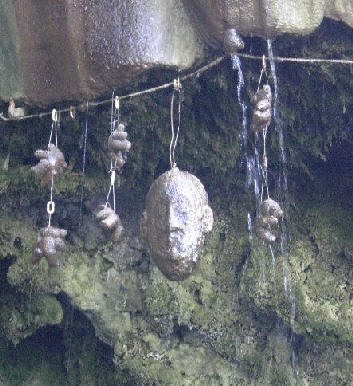
The Petrifying Well, hidden beside the River, does exactly what its name describes! Watch the water from the spring trickle over the rocky face of rock that juts out of the hillside, and then drip from the stone teddy-bears, hats, lobsters and even a pair of knickers! The high mineral content of the water means that anything the water runs over is left with a thin mineral deposit on its surface. This builds up over time and turns objects left in the stream’s way to stone. And surprisingly quickly too; porous objects like soft toys can be turned to stone within only 3 to 5 months. Over the years many celebrities have donated objects to be petrified; even John Wayne’s hat was hung there and preserved.
Old Mother Shipton
At the time of Old Mother Shipton, people feared the Petrifying Well and believed it to be magic. This was probably because they had seen leaves, twigs, perhaps even dead animals turned gradually to stone. Old Mother Shipton was born in the cave beside the Well, perhaps adding to the aura of mystery and magic around her life…
In 1488, in the Knaresborough cave that is now named Old Mother Shipton’s Cave, a young girl gave birth to an illegitimate child, Ursula Sontheil. The young girl, Agatha, an orphan, had been described as “slothful” or “idle”, meaning that she preferred casual prostitution to hard, manual labour to earn her money. It is said she was seduced by a handsome, charming man when she was only fifteen, and he kept her comfortably whilst he visited her. When she became pregnant, her neighbours were furious and ordered that she be prosecuted for prostitution. However, she managed to escape without charge when she announced in court that the judge himself had two young servants pregnant by him at that same time.
Agatha went into labour on a summer evening, the air thick with thunder, split by lightening. Apparently from an account by the woman present at the birth, a smell of sulphur and a giant crack of thunder rolled just as the baby came into the world. Huge and misshapen, the baby allegedly “jeered and laughed”, silencing the storm. However, these circumstances are only accounted in written documents about 150 years after the events; before this the stories would only have been spread by word of mouth, and we all know how tales can be exaggerated with a bit of poetic license.
Old Mother Shipton’s appearance added to the awe, and sometimes fear, about her that local people had. She allegedly had a misshapen appearance, perhaps a hunch back or crooked spine and because of this it was surprising when she married Toby Shipton, a respected local carpenter. There were tales of love powders and potions and spells. And after her marriage she began to make frighteningly accurate predictions about the future, including the provision of water to York over the Ouse Bridge, the Dissolution of the Monasteries, the Great Plague and the Great Fire of London. Her predictions are intricately detailed and have been passed down, her words still awe inspiring, especially now when we know these events to have happened.
Museums
View our interactive map of Museums in Britain for details of local galleries and museums.
Anglo-Saxon Remains
Try our interactive map of Anglo-Saxon Sites in Britain for details of nearby sites.
Battlefield Sites
Browse our interactive map of the Battlefield Sites in Britain for details of nearby sites.
Getting here
Knaresborough is easily accessible by both road and rail, please try our UK Travel Guide for further information.