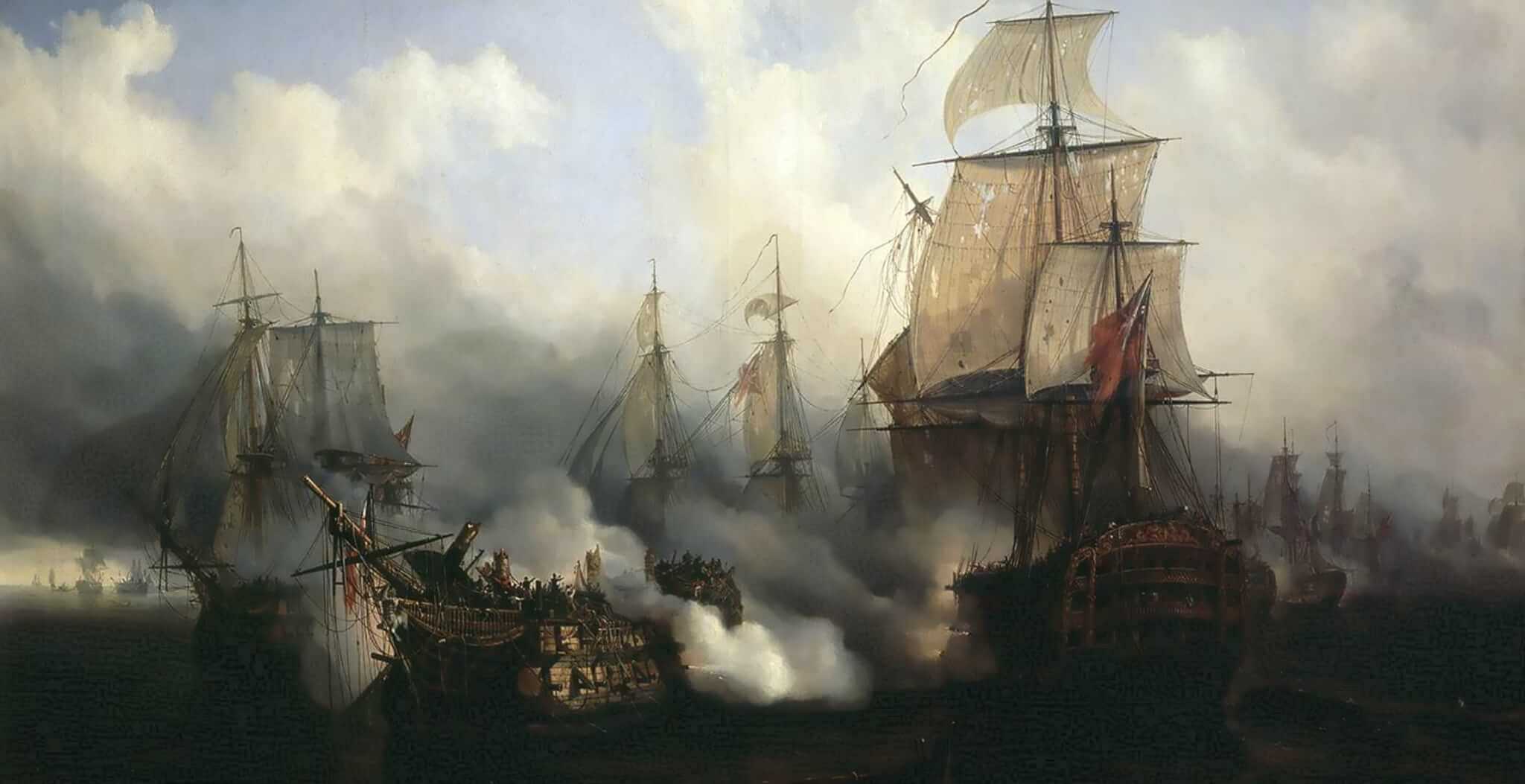


One of the most famous battles in British history, the Battle of Trafalgar is commemorated every Trafalgar Day with a Victory Service held in Portsmouth on the 21st October.
Readers should always check with local Tourist Information Centres (TIC’s) that events or festivals are actually taking place before setting out to attend
Permanent dates in October
| 7th October | Lost in the Dark Peal | Twyford Church, Hampshire | On a dark October night in 1754 William Davis became lost in the Hampshire countryside. He was just about to ride his horse over a cliff when the sound of Twyford’s church bells rang out. As they did so William realised he was heading in the wrong direction and pulled up to take stock. It was then he noted he was on the edge of a deep quarry and had he not stopped would have plunged to certain death. In gratitude he left a pound for a peal of bells to be rung annually with a feast provided for the bell ringers. The funds ran out long ago but the tradition remains. |
| 8th October | Feast day of St Keyne | St Keyne’s Well, near Liskeard, Cornwall | The most famous holy well in Cornwall is named after Keyne (Cain Wyry – Cain the virgin) (461-505), a Celtic saint who lived in the 5th century. She was the daughter of Brychan, the English King of Brecknock. Keyne dedicated her life to bringing Christianity to the West Country. Legend recalls that she planted four trees around this well – an oak, an elm, a willow and an ash – and as she was dying, she imparted to its waters a strange power.
It is believed that after a wedding the first of the bridal pair to drink from the well would be the dominant partner. ‘A well there is in the west country, – Robert Southey (1774 – 1843), English poet. |
| 13th October | St. Edward’s (The Confessor) Day | Westminster Abbey, London | A special service commemorates the last Anglo-Saxon King and the Abbey founder. He earned the pious nickname ‘The Confessor’ partly for his monk-like qualities of generosity to the poor and partly due to his unconsummated marriage to Queen Edith.
One of the more famous legends associated with the king recalls when he was riding by a church in Essex and an old man asked for alms. As Edward had no money to give he removed a large ring from his finger and gave this to the beggar. A few years’ later, two pilgrims were travelling in the Holy Land and became stranded. They were helped by an old man and when he knew they came from England he told them that he was St John the Evangelist and asked them to return the ring to Edward telling him that in six months he would join him in heaven. Edward died shortly afterwards, in 1066, to be followed by the ill-fated Harold. |
| 21st October | Trafalgar Day and Victory Service | HMS Victory, Portsmouth, Hampshire | In 1805, a fleet of 27 British ships, under the command of Vice Admiral Lord Horatio Nelson, engaged and fought a combined French and Spanish force of 33 ships off the coast of South-West Spain, at Trafalgar near the port of Cadiz.
The result was an overwhelming British victory with 19 enemy ships either captured or sunk. More than 7,000 French and Spanish sailors were killed or wounded. Losses on the British side numbered a mere 700; but amongst them was Nelson himself. The Royal Navy’s greatest hero, whose tactics and leadership had brought about the victory that would establish British domination of the seas for the next 100 years; Nelson had been shot as he paced the quarterdeck of his flagship, HMS Victory, by a sniper from the rigging of the French ship, Redoubtable. |

A Pearly King with his Pearly Taxi!
Flexible dates in October
| Early in the month | Fall Opening of the Law Courts | St Peter’s Cathedral, London. | The legal and political communities of London mark the Fall Opening of the Courts with a prayer service. At the service, divine guidance is sought on behalf of those involved with the administration of justice and the making and enforcement of English law. Oaths of office are also renewed. |
| Last Thursday of the month | Punky Night | Hinton St George, Somerset. | This tradition goes back over 100 years, when it is said that the men from Hinton travelled to the fair at the nearby village of Chiselborough. When they didn’t return as promised, the women of the village went looking for their husbands with mangold lanterns. A mangold is a crop grown by farmers for cattle feed – a cross between a turnip and a pumpkin. The women pulled these up from the fields, carved them out and put candles in them to shed light, and then walked the four miles to Chiselborough, in search of their drunken husbands.
To commemorate the event local children still hollow out their mangolds, carving designs or faces onto the outside. In the evening candles are lit and the punky’s are paraded through the village. |
We have taken great care in recording and detailing the festivals, customs and celebrations presented in our Folklore Year calendar, if however you consider that we have omitted any significant local event, we would be delighted to hear from you.
Related Links:The Folklore Year – January |